What should I test my well water for?
Not sure where to start? Find the row that matches your situation — a symptom you have noticed, a life event, or the routine annual check — and order the test panel it points to from a state-certified lab. Each row links to a deeper guide and to the testing labs near you.
The baseline: test every private well once a year
At a minimum, test annually for coliform bacteria and nitrate, and re-test after flooding, well work, or any change in taste, smell, or color. Private wells are not regulated under the Safe Drinking Water Act, so testing is up to you.
What to test for, by situation
| Your situation | What to test for | Learn more |
|---|---|---|
| Why does my well water smell like rotten eggs?A rotten-egg or sulfur smell coming from your well water, at one or more taps. | hydrogen sulfidesulfatecoliform bacteria | |
| Why does my well water leave orange or red stains?Orange, red, brown, or black stains on fixtures, sinks, tubs, toilets, or laundry. | ironmanganesepH | |
| Why does my well water taste metallic?A metallic, tinny, or coppery taste in your well water. | pHleadcopperiron | |
| Why is my well water cloudy or milky?Cloudy, milky, or murky-looking water from your well. | turbiditycoliform bacteria | — |
| Could my well water be making my family sick?Recurring stomach upset, diarrhea, or nausea in your household that may track with your well water. | total coliformE. colinitrate | |
| Is my well water safe to drink after a flood?Floodwater has reached or covered your wellhead, or your area has recently flooded. | coliform bacteriaE. coli | |
| Is my well water safe for making baby formula?You are mixing infant formula with private well water, or have a baby under six months in a home on a well. | nitratenitritecoliform bacteria | |
| My neighbor's well is contaminated — should I test mine?A nearby or neighboring private well has tested positive for a contaminant. | the contaminant your neighbor foundcoliform bacterianitrate | |
| Why does my well water leave blue-green stains?Blue or blue-green stains on sinks, tubs, faucets, or anywhere water drips. | pHcopperlead | |
| Why does my well water taste salty?A salty or brackish taste in your well water. | chloridesodiumtotal dissolved solids | — |
| You have never tested this well (or just bought the home)Start with the universal baseline panel for a new or never-tested private well. | coliform bacterianitratearsenicpHlead | |
| You live near farmland, feedlots, or heavy fertilizer useAgricultural land use is the leading driver of nitrate (and sometimes bacteria) in private wells. | nitratecoliform bacteria | |
| You are pregnant or have an infant under 6 monthsNitrate and bacteria are acute risks for infants; lead and arsenic matter for development too. | nitratecoliform bacterialeadarsenic | |
| Your area has uranium- or radon-rich bedrock (e.g. granite)Radioactive contaminants from granite bedrock give no taste or smell — a lab test is the only way to know. | uraniumradongross alphaarsenic | |
| Routine annual check (recommended baseline)Test every private well at least once a year for coliform bacteria and nitrate, plus anything of local concern. | coliform bacterianitrate |
Prefer a Simpler Option?
Can't find a convenient local lab? Mail-in testing offers EPA-certified analysis without appointments or travel.
SimpleLab
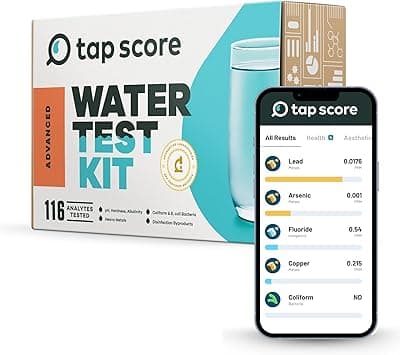
Advanced Home Water Test
$269
Comprehensive water analysis testing over 200 contaminants including bacteria, heavy metals, and chemical compounds.
Tap Score
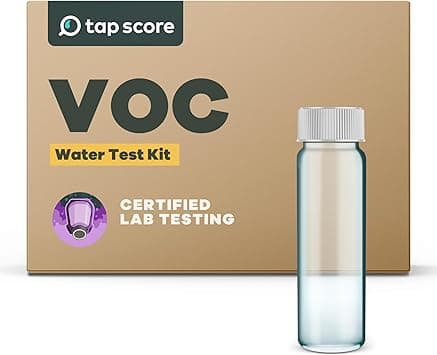
Volatile Organic Compounds (VOC) Test
$139
Detects volatile organic compounds including industrial solvents, fuels, and chemical contaminants.
SimpleLab
Coliform and E. coli Water Test
$99
The bacteria test a private well needs before closing and once a year after.
Need whole-house or professional water treatment?
For the problems a pitcher or under-sink filter cannot fix — scale, rust and black staining, sulfur smell, well contamination, or test results you cannot explain. Tell us what is happening and we will connect you with a local water-treatment professional.
By TapWaterData Editorial.
Well water testing FAQ
What should I test my well water for at least once a year?
Test every private well at least once a year for coliform bacteria and nitrate, plus anything of local concern — for example arsenic, uranium, or radon where the local bedrock warrants it. Private wells are not covered by the Safe Drinking Water Act, so this routine testing is the owner's responsibility.
How do I know which contaminants are a risk in my area?
Start with your county page, which shows USGS-modeled area risk for arsenic, nitrate, and (in New Hampshire) uranium and radon, plus local land-use and observed-sample context. Those are area estimates — use them to decide what to prioritize, then confirm with a lab test of your own well.
Can I tell what is in my well from how the water looks, tastes, or smells?
Sometimes. A rotten-egg smell points to hydrogen sulfide, orange stains to iron or manganese, a salty taste to chloride. But the most serious contaminants — arsenic, nitrate, lead, uranium, radon, and bacteria — are invisible, tasteless, and odorless. A clean-looking, good-tasting well can still be unsafe, which is why testing is the only way to be sure.
Stay Informed About Your Water Quality
Get EPA reports, filter recommendations, and safety alerts for your area.
Weekly water-quality guidance for your area. Unsubscribe anytime.