Why does my well water leave orange or red stains?
What causes this
Iron (orange and red stains)
Orange and reddish-brown staining on fixtures and laundry is the signature of dissolved iron in well water. When the water hits air, the iron oxidizes (rusts) and deposits the familiar rust-colored stain.
Manganese (black and brown stains)
Black or dark-brown staining and grit usually points to manganese, which often occurs alongside iron in groundwater and stains at even lower concentrations.
Is it dangerous?
Iron at staining levels is an aesthetic problem — the water is generally considered safe to drink but it stains fixtures and laundry and can taste metallic. Manganese is different: it has a health guideline, and elevated manganese is a particular concern for infants. So orange iron stains are mostly cosmetic, while black manganese stains are worth testing against the health guideline.
The test that tells you
A symptom only narrows it down. To know for sure, have a state-certified lab test for:
- iron
- manganese
- pH
Already have a well water test? Upload my well test
Prefer a Simpler Option?
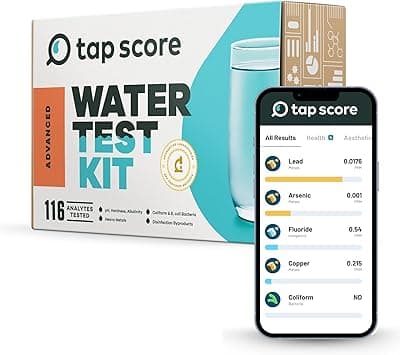
Can't find a convenient local lab? Mail-in testing offers EPA-certified analysis without appointments or travel.
SimpleLab
Advanced Home Water Test
$269
Comprehensive water analysis testing over 200 contaminants including bacteria, heavy metals, and chemical compounds.

Tap Score
Volatile Organic Compounds (VOC) Test
$139
Detects volatile organic compounds including industrial solvents, fuels, and chemical contaminants.
SimpleLab
Coliform and E. coli Water Test
$99
The bacteria test a private well needs before closing and once a year after.
How to fix it
For low levels of iron and manganese, a water softener can remove them along with hardness. For higher levels, an oxidizing or iron filter (often using manganese greensand) oxidizes the metals and filters them out. Testing the pH first matters, because treatment performance depends on it.
- 1
Identify the stain color
Note whether the stains are orange/red (iron) or black/brown (manganese). The color tells you which metal is likely the culprit and which health framing applies.
- 2
Test for iron, manganese, and pH
Have a certified lab measure iron, manganese, and pH. Manganese in particular should be compared to its health guideline, especially if there is an infant in the home.
- 3
Match the treatment to the levels
Choose a water softener for low levels, or an oxidizing/iron filter (such as manganese greensand) for higher levels of iron and manganese.
- 4
Re-test to confirm removal
After installing treatment, re-test the water to confirm iron and manganese are below the levels that stain and, for manganese, below the health guideline.
A symptom is a clue, not a diagnosis. Only a lab test of your individual well confirms what is in your water — do not assume a symptom is definitely harmless or definitely dangerous until you have tested. The county-level USGS area estimates elsewhere on this site describe a region as a whole and cannot stand in for testing your own well.
By TapWaterData Editorial
Frequently asked questions
Is orange-staining well water safe to drink?
Iron at the levels that cause orange stains is generally considered safe to drink — it is an aesthetic problem that stains fixtures and laundry and can taste metallic. Black or brown stains, however, suggest manganese, which has a health guideline and is a particular concern for infants, so it is worth testing rather than assuming it is harmless.
What is the difference between iron and manganese stains?
Iron leaves orange and reddish-brown rust-colored stains, while manganese leaves black or dark-brown stains and grit. The two often occur together in well water, so a test for both — plus pH — tells you what you are dealing with.
How do I remove iron and manganese from well water?
A water softener can handle low levels of iron and manganese; higher levels usually need an oxidizing or iron filter, often using manganese greensand. Test pH first, because treatment performance depends on it, and re-test after installation to confirm removal.
Need whole-house or professional water treatment?
For the problems a pitcher or under-sink filter cannot fix — scale, rust and black staining, sulfur smell, well contamination, or test results you cannot explain. Tell us what is happening and we will connect you with a local water-treatment professional.
Worried about your well water?
Get our plain-English guide to testing private-well water and reading the results.
Free forever. Unsubscribe anytime. We never share your email.
Stay Informed About Your Water Quality
Get EPA reports, filter recommendations, and safety alerts for your area.
Weekly water-quality guidance for your area. Unsubscribe anytime.