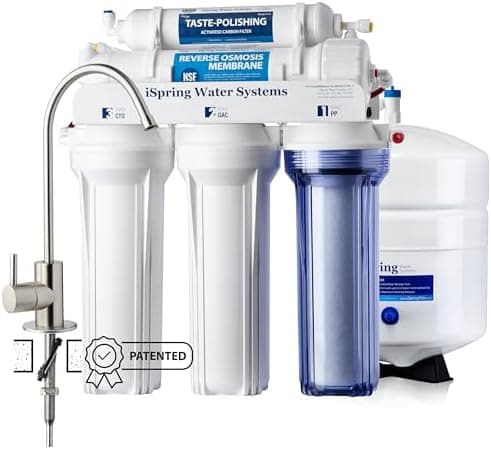
iSpring RCC7AK-BN 6-Stage Reverse Osmosis System
iSpring
Not certified for hexavalent chromium — the NSF/ANSI 58 listing names nine other contaminants
The iSpring RCC7AK-BN is a 6-stage under-sink reverse osmosis system and the most-reviewed pick on this page (21,508 ratings at 4.6 stars). Read its listing before its marketing: NSF/ANSI 58, active, covers asbestos, barium, cadmium, trivalent chromium, copper, fluoride, lead, selenium and total dissolved solids — nine claims, and hexavalent chromium is not among them. the listing names Chromium (Trivalent) — a different species from the Chromium (Hexavalent) this page is about, and the one RO handles differently. NSF/ANSI 58 is the standard under which Cr-VI reduction CAN be certified, and this record does carry the trivalent species, but nobody has tested and listed it, so we do not print it as verified. What this unit is genuinely good for is the rest of that list — lead and fluoride certified on the same record — plus an alkaline stage that fixes the flat taste of plain RO water. If hexavalent chromium is your actual concern, buy the APEC RO-90 or Brondell RC100, whose NSF/ANSI 58 listings name hexavalent chromium by that name.
Key Features
- NSF/ANSI 58 listing carries nine claims — lead and fluoride included, but not the contaminant this page is about
- 6 stages including carbon adsorption and a post-RO alkaline remineralizer
- 75 GPD membrane — enough output for a family kitchen
- Largest review base on this page (21,508 ratings at 4.6 stars)
Our Review
This is the most-reviewed system on the page and the cheapest to run, and neither of those is a hexavalent chromium certification. Its NSF/ANSI 58 record lists asbestos, barium, cadmium, trivalent chromium, copper, fluoride, lead, selenium and total dissolved solids. the listing names Chromium (Trivalent) — a different species from the Chromium (Hexavalent) this page is about, and the one RO handles differently. Holding a standard is not the same as carrying a claim, and this page exists to make exactly that distinction. NSF/ANSI 58 is the standard under which Cr-VI reduction CAN be certified, and this record does carry the trivalent species — but likely is not listed, and we do not print a mechanism as a certificate. What you can rely on is the nine claims above, an alkaline post-filter that fixes RO's bland mouthfeel, and the lowest running cost here. The trade-off is the install: a storage tank takes cabinet space and refills slowly after a big draw. For a listed hexavalent chromium claim, buy the APEC RO-90 or Brondell RC100, whose NSF/ANSI 58 listings name hexavalent chromium by that name.
Pros
- +Nine certified claims on one NSF/ANSI 58 record, lead and fluoride among them
- +Broad dissolved-solids reduction from a 6-stage membrane system
- +Remineralization stage puts calcium and magnesium back after the membrane
- +Low annual filter cost keeps long-run ownership cheap
Cons
- -No listed hexavalent chromium claim — reduction here is by mechanism, not by certificate
- -Self-install with a storage tank — needs under-sink cabinet space and ~1 hour of plumbing
- -Tank-based RO is slower to refill than a tankless system after heavy draws
- -Sediment/carbon pre-filters need replacing every 6–12 months to hold certified performance
Specifications
Stages
6-stage
Filter Life
12 months
Annual Filter Cost
$60/year
Warranty
1 year