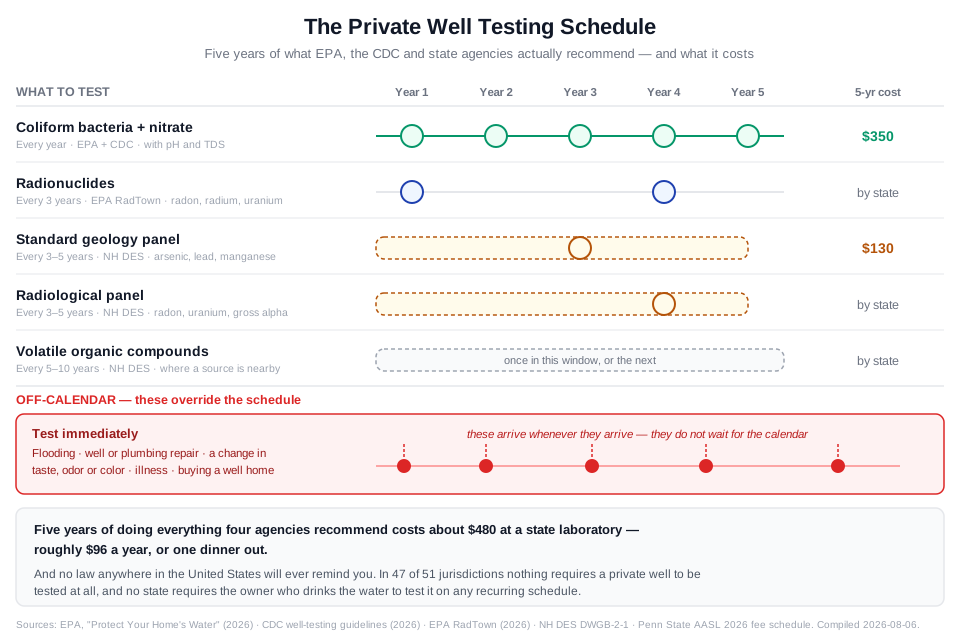
Test a private well every year for total coliform bacteria and nitrate, every three to five years for the contaminants your local geology puts in the groundwater, and immediately after flooding, well repairs, or any change in taste, smell, or color. That is the schedule EPA, the CDC, and state agencies converge on (EPA, 2026; CDC, 2026). What none of them advertise is the part that explains why almost nobody follows it: in 47 of 51 US jurisdictions there is no law that ever requires a private well to be tested at all (TapWaterData statute audit, 2026).
Public water is different. A utility samples on a federal schedule, reports to the state, and mails you a Consumer Confidence Report whether you asked for one or not. A private well sits outside the Safe Drinking Water Act entirely, so the owner is the utility, the lab client, and the regulator at once. More than 43 million people — about 15% of the US population — drink from one (USGS, 2019). Not one of them carries a recurring legal duty to test the water coming out of their own tap.
This guide gives you the assembled schedule, priced from two public lab fee schedules, plus a map of where a law does fire and what it actually covers. If you already know you need a test and just want a certified lab, skip ahead to our state-by-state directory of certified testing labs.
Key Takeaways
- No law will ever prompt you. Only 4 of 51 US jurisdictions require a private-well test, and all four fire on a property sale or lease — zero impose a recurring duty on the owner who drinks the water (TapWaterData statute audit, 2026).
- Yearly: bacteria and nitrate. EPA and the CDC both put total coliform bacteria, nitrate, total dissolved solids, and pH on an annual cycle (EPA, 2026; CDC, 2026).
- Every 3 to 5 years: your geology. New Hampshire's environmental agency runs arsenic, uranium, radon, lead, and manganese on a three-to-five-year cycle, "except for bacteria and nitrate which are yearly" (NHDES, 2026).
- About $70 a year, $480 over five. Penn State's public laboratory charges $70 for a package covering the entire annual list, and $130 for the trace-metals panel that adds arsenic and lead (Penn State, 2026; five-year total is our calculation from that schedule).
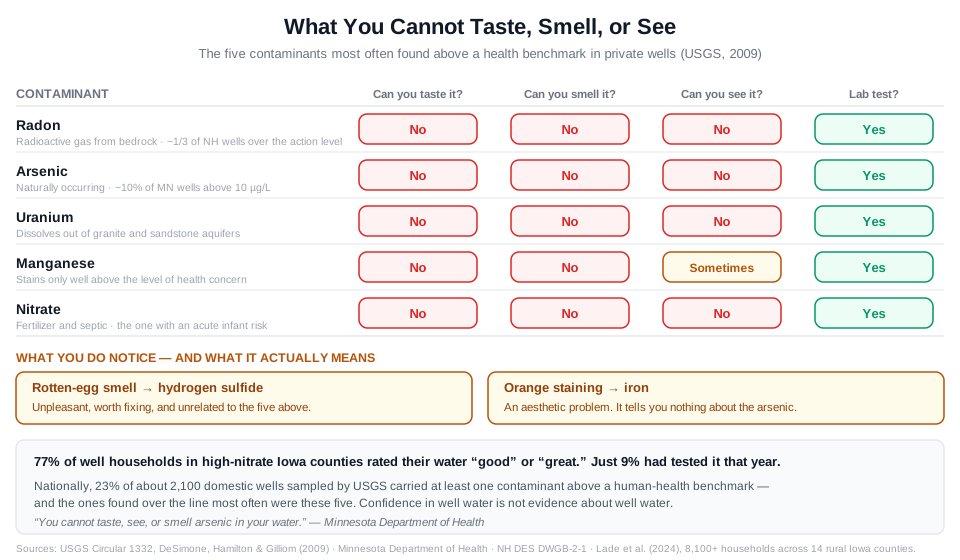
- The ones that matter cannot be tasted. Radon, arsenic, uranium, manganese, and nitrate are the contaminants most often found above a health benchmark in private wells, and none can be seen, smelled, or tasted (USGS, 2009; MN DOH, 2026).
Look up your county's groundwater risk → See the modeled well-water risk where you live before choosing a panel — local geology decides which test to add to the annual two.
You might reasonably wonder whether a site that runs filter guides is going to end up telling you to buy a filter. This one tells you to buy a $70 lab test and nothing else. No product is recommended anywhere on this page, because until you have results there is no honest way to recommend one — arsenic, nitrate, and uranium each need different treatment media, and the carbon filter most people reach for removes none of the three.
How often does each agency actually say to test?
There is no single federal testing schedule for private wells. That sounds like a technicality and it is in fact the answer to "why did nobody tell me" — the schedule is real, but it is published in pieces by four different agencies, each covering its own remit, and no one is responsible for handing a well owner the assembled version.
EPA and the CDC agree on the annual baseline. EPA's guidance is direct: "Test your private well annually for total coliform bacteria, nitrates, total dissolved solids, and pH levels" (EPA, 2026). The CDC names the same four, and adds that testing should be more frequent if there are small children or elderly adults in the house, or if someone is pregnant or nursing (CDC, 2026).
EPA's radiation program runs a separate clock. "Every three years, well owners should test for radionuclides" — which in a well means uranium, radium, and radon (EPA RadTown, 2026). This is the interval most well owners have never encountered, and it exists because radionuclides come from the rock the well was drilled into rather than from anything happening at the surface.
A state agency publishes the most complete version. New Hampshire's Department of Environmental Services puts out one table covering everything, and it is worth reading even if you live nowhere near New Hampshire, because it is the only place a well owner can see the whole cadence at once (NHDES, 2026).
| How often | What to test for | Why this interval | Who says so |
|---|---|---|---|
| Every year | Total coliform bacteria, E. coli | Bacteria arrive through surface pathways and change fast — a well can go from clean to contaminated in one season | EPA, CDC |
| Every year | Nitrate and nitrite | Responds to fertilizer, septic, and rainfall on a seasonal cycle; the one contaminant with an acute infant risk | EPA, CDC, NHDES |
| Every year | Total dissolved solids, pH | Inexpensive early indicators of corrosion and of change in the aquifer | EPA, CDC |
| Every 3 years | Radionuclides — radon, radium, uranium | Geologic in origin, so they move slowly, but they are invisible and unregulated in private wells | EPA RadTown |
| Every 3–5 years | Standard panel — arsenic, chloride, copper, fluoride, hardness, iron, lead, manganese, sodium | Rock-derived and stable: "water quality in wells is generally stable, and if a change is going to occur, it occurs slowly" | NHDES |
| Every 3–5 years | Radiological panel — radon, uranium, gross alpha | Same reasoning, run as its own analysis because the laboratory methods differ | NHDES |
| Every 5–10 years | Volatile organic compounds | Only enter groundwater from a specific source — fuel, solvents — so a long interval is defensible absent one nearby | NHDES |
| Immediately | Total coliform, plus anything local | After flooding, land disturbance, new construction, or new industrial activity near the well | EPA |
| Immediately | Total coliform | After replacing or repairing any part of the well system — and only after flushing the system thoroughly | EPA, NHDES |
| Immediately | Full panel | After any change in taste, odor, or color, or illness in the household | EPA, CDC |
| For comparison: a public water system | Total coliform on a routine federal schedule, plus the full regulated contaminant list | Community systems "collect routine water samples on a regular basis (monthly, quarterly, annually)" under the Revised Total Coliform Rule and report results annually in a Consumer Confidence Report | EPA |
Sources: EPA, "Protect Your Home's Water" (2026); CDC, "Guidelines for Testing Well Water" (2026); EPA RadTown, "Natural Radionuclides in Private Wells" (2026); EPA, Revised Total Coliform Rule (2026); New Hampshire Department of Environmental Services, "Water Quality Testing for Private Wells," DWGB-2-1. Compiled as of August 6, 2026.
Read the table as two halves. The top half is a calendar you can set once and leave alone. The bottom half is a trigger list, and it overrides the calendar — a test run in March says nothing about the water after a flood in June.
The last row is the comparison that makes the rest of the page make sense. A public water system is sampled on a federally set routine, and the results reach the customer in an annual report they never had to request (EPA, 2026). A private well gets none of that unless the owner buys it.
One thing NHDES gets right that federal pages leave out is why these intervals are measured in years rather than months: "water quality in wells is generally stable, and if a change is going to occur, it occurs slowly" (NHDES, 2026). A properly constructed well in a stable setting is not a fast-moving system. That is the honest reason a three-to-five-year interval is enough for arsenic — and also why bacteria are the exception, since they arrive through surface pathways that can open in a single storm.
Who is legally required to test a private well?
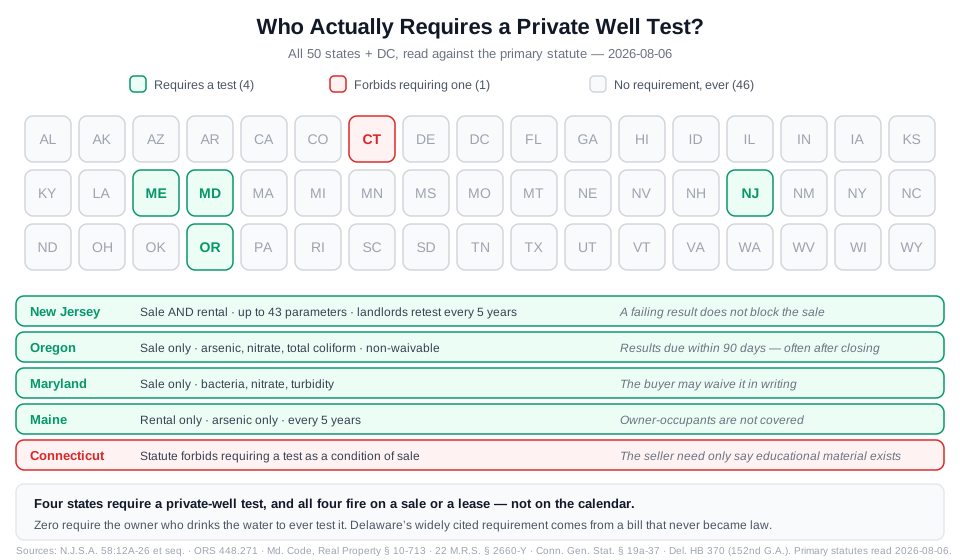
Almost no one. We read the statutes for all 50 states and the District of Columbia, and the result is smaller than most well owners expect: four jurisdictions have a state-level private-well testing mandate, and every one fires on a real-estate transaction rather than on a calendar (TapWaterData statute audit, 2026).
| Jurisdiction | When it fires | What gets tested | The catch |
|---|---|---|---|
| New Jersey | Sale and rental | Up to 43 parameters; landlords retest every 5 years | A failing result does not block the sale — it only has to be disclosed. Coliform results expire after 6 months |
| Oregon | Sale only | Arsenic, nitrate, total coliform bacteria | The seller tests on accepting the offer, then has 90 days to report results to the state and buyer — which can land after closing |
| Maryland | Sale only | Set by state agency — bacteria, nitrate, turbidity | The buyer may waive it in writing, and many do |
| Maine | Rental only | Arsenic only — nothing else | Every 5 years, results to tenants within 10 days. Owner-occupants are not covered |
| Connecticut | Never | — | State law prohibits regulators from requiring a test "as a consequence or a condition of the sale, exchange, transfer, purchase or rental." The seller need only give notice that educational material exists |
| The other 46 jurisdictions | Never, at state level | — | Some counties and towns require transfer testing; whether one applies depends on your township line |
Sources: N.J.S.A. 58:12A-26 et seq.; ORS 448.271; Md. Code, Real Property § 10-713; 22 M.R.S. § 2660-Y; Conn. Gen. Stat. § 19a-37. Primary statutes read August 6, 2026.
Two of these carry a recurring duty — New Jersey and Maine both require landlords to retest every five years. But that is a duty owed to a tenant. If you own the well and drink from it yourself, there is no jurisdiction in the United States where a law will ever tell you it is time.
Connecticut is worth sitting with. It is not that the state neglected to require a test; the legislature affirmatively removed the option, so that no regulator may make one a condition of sale (Conn. Gen. Stat. § 19a-37). A Connecticut buyer who wants a well tested has exactly one lever, and it is their own purchase agreement.
Two widely repeated "requirements" turned out not to exist once we read the primary sources. Delaware's pre-closing well test traces to House Bill 370 of the 152nd General Assembly, which did not become law; no such section exists in the Delaware Code. Iowa's well-known time-of-transfer inspection mandate covers septic systems, not wells — state law asks a seller only to disclose that a well exists and where it is. Rhode Island is a near-miss in the same direction: its statute gives the buyer a ten-day window to test at the buyer's own expense, which is a contingency rather than a seller obligation.
Buying a home with a well? → Check what your county's groundwater actually carries before the inspection window closes — outside four states, nobody will order the test for you.
If you are buying outside those four states, the test is yours to ask for. Mortgage programs sometimes fill the gap, since FHA, VA, and USDA loans impose their own well-test conditions, but a conventional loan often carries none. The fix is to write the test into the purchase agreement as a contingency and give yourself the results before the inspection period ends.
Why don't well owners test, if it is this inexpensive?
Because nothing prompts them, and because the water looks fine.
The largest field study of the question surveyed more than 8,100 private-well households across 14 rural Iowa counties, an area with well-documented nitrate risk. Just 9% had tested their water in the past year. Meanwhile 77% rated their well water "good" or "great," and 40% of that confident group drank from the well having neither tested it that year nor filtered it (Lade et al., 2024). Those are Iowa figures, not national ones, and they should be read as such — though reviewing the wider literature, the same researchers concluded that "at best, half of private well owners are testing with any frequency."
The 77% is the number worth pausing on, because confidence in well water bears little relationship to its quality. In the USGS's national survey of about 2,100 domestic wells, more than one in five — 23% — contained at least one contaminant above a human-health benchmark (USGS, 2009). The contaminants found over the line most often were not industrial spills. They were radon, arsenic, uranium, manganese, and nitrate — the aquifer's own chemistry, leaching out of the rock the well was drilled into.
Every one of those is undetectable without a laboratory. Minnesota's health department puts it plainly: "You cannot taste, see, or smell arsenic in your water" (MN DOH, 2026). New Hampshire's agency generalizes it: "Many contaminants often have no taste, odor or color. Their presence can only be determined by laboratory testing" (NHDES, 2026).
So the sensory signals well owners rely on are answering a different question than the one they think they are answering. Orange staining tells you about iron. A rotten-egg smell tells you about hydrogen sulfide. Both are real and both are worth fixing, and neither tells you anything about the arsenic. Water can look and taste perfect while carrying arsenic well above the limit EPA sets for public systems, and it can taste metallic while being chemically fine.
There is one encouraging finding buried in the Iowa work. When researchers mailed households free test strips, self-reported testing rose to over 40%, against 24% among households that received no mailer (Lade et al., 2024). The barrier was never belief. It was that nothing had ever arrived to start the process.
What does the yearly schedule actually cost?
Less than most people assume, provided you use a state-certified public laboratory rather than a commercial one. Two land-grant programs publish their fee schedules openly, which makes them the honest place to price this.
Penn State's Agricultural Analytical Services Laboratory charges (Penn State, 2026):
- $60 for the standard drinking-water package — total coliform bacteria, E. coli, pH, and total dissolved solids
- $70 for the agriculture/septic package, which is the standard package plus nitrate-nitrogen; this single package covers the entire EPA and CDC annual list
- $130 for the trace-metals package, adding arsenic, barium, cadmium, chromium, copper, lead, nickel, and zinc
- $220 for the extensive 16-parameter panel
- À la carte: bacteria $40, nitrate-nitrogen $15, arsenic $30, lead $25
Virginia's Household Water Quality Program, run through Virginia Tech's extension service, charges $70 per kit for 28 chemical and bacteriological constituents — bacteria, nitrate, lead, copper, arsenic, uranium, fluoride, sodium and twenty more — and notes that "comparable analysis at a private commercial lab would cost more than $300" (Virginia Tech, 2026).
Put the schedule and the price list together and the five-year bill is straightforward. Five annual packages at $70, plus one trace-metals panel at $130 somewhere inside the window, comes to $480 over five years — about $96 a year (TapWaterData calculation from the 2026 Penn State fee schedule). Through the Virginia clinic, five annual 28-constituent kits total $350 (TapWaterData calculation from the 2026 Virginia Household Water Quality Program fee).
These are what two named public laboratories actually charge, not a national average. Your own state's certified labs will differ, and many county health departments run subsidized bacteria and nitrate tests for less. But the order of magnitude holds, and it is worth stating plainly: the entire recommended monitoring program for the water a household drinks every day costs roughly what one dinner out costs, once a year.
Radon and uranium are the exception to that arithmetic. Neither appears in the Penn State packages above, and both are priced separately state by state — which matters most in exactly the regions where they are common. NHDES estimates that about one-third of New Hampshire's private wells exceed the radon action level (NHDES, 2026), and roughly 10% of Minnesota's private wells carry arsenic above 10 micrograms per liter (MN DOH, 2026).
When should you test outside the schedule?
Whenever something happens. The calendar is a floor, not a ceiling, and the off-schedule tests are the ones that catch events rather than slow drift.
EPA names four conditions that warrant a test regardless of when the last one was run (EPA, 2026):
- There are known problems with groundwater or drinking water in your area. A neighbor's failed test, a state advisory, or a documented plume nearby all count — groundwater does not respect property lines.
- Conditions near the well have changed significantly — flooding, land disturbance, new construction, or new industrial activity. Flooding is the significant one: floodwater over a wellhead is best treated as contamination until a laboratory says otherwise.
- You replaced or repaired any part of the well system. Pump work, casing work, or plumbing changes can introduce bacteria directly. NHDES adds the practical detail — run the bacteria test after substantial flushing, not immediately (NHDES, 2026).
- You notice a change in water quality — odor, color, or taste. A change is meaningful even though the absence of one is not.
The CDC adds a fifth that is easy to overlook: illness in the household. If more than one person is unwell without explanation, a bacteria test is fast and inexpensive enough to run before looking further (CDC, 2026).
And one more, which is the single most valuable off-schedule test anyone runs: before closing on a home with a private well. Outside New Jersey, Oregon, and Maryland nobody will do it for you, and in Maryland it can be waived in writing without you noticing.
One correction worth making before it costs someone. Boiling kills bacteria, so it is the right emergency response to a coliform hit. But boiling concentrates nitrate and arsenic — Minnesota's health department is explicit that "boiling the water will only concentrate the arsenic, due to evaporation of some of the water" (MN DOH, 2026). It is right for one hazard and backwards for the two most common chemical ones. Our guide to whether boiling makes water safe has the full breakdown.
How do you set up your own testing schedule?
Six steps, and the first is mostly to stop you waiting for a prompt that is not coming.
- Assume no law will ever tell you. Check the ledger above for your state. Unless you are in New Jersey, Oregon, Maryland, or Maine — and even then only at a sale or a lease — nothing fires. Your calendar is the mechanism.
- Book the annual baseline at a state-certified laboratory. Total coliform bacteria and nitrate at minimum; the package that bundles them with pH and total dissolved solids usually costs only a few dollars more. Find one in our state-by-state directory of certified labs.
- Add your geology panel once, then put it on a three-to-five-year cycle. Which contaminants belong in it depends on local groundwater — start from the modeled risk for your county and what to test for by situation, then confirm with the laboratory which panel covers those analytes.
- Write the trigger list somewhere you will see it. Flooding, well or plumbing work, any change in taste, smell, or color, illness in the house, and a nearby contamination report. These override the calendar.
- Read the results against the standards rather than filing them. A number on a laboratory report means nothing until it sits next to a limit. Our guide to reading water test results covers what "non-detect" does and does not mean.
- Let the results choose the treatment, not the other way round. Arsenic, nitrate, and uranium each need different media, and standard carbon removes none of them. Testing is what turns filtering from a guess into a decision.
Already have results in hand? → Interpret your well water numbers against the standards — or start from your county's modeled groundwater risk if you are still deciding what to order.
Reading this from a different angle?
- What to test your well water for, by situation — the panel-selection matrix that pairs with this schedule.
- Find certified well water testing labs near you — the 50-state directory, with each state's certification program.
- Who regulates your drinking water — the EPA/FDA/state/utility split that leaves private wells outside it.
- MCL vs. MCLG — why a legal limit and a health goal are different numbers, which matters when reading your own results.
- Strip tests vs. lab tests — what a home kit can and cannot detect, and why the annual well test has to be a laboratory one.
Methodology and disclosure
This guide draws on EPA's private-well guidance, its RadTown radionuclide program, and the Revised Total Coliform Rule; the CDC's well-testing guidelines; New Hampshire Department of Environmental Services fact sheet DWGB-2-1 for the complete interval table; the Minnesota Department of Health's arsenic guidance; USGS Circular 1332 (DeSimone, Hamilton and Gilliom, 2009) for the national survey of about 2,100 domestic wells; the USGS domestic-supply-well program for population figures; published 2026 fee schedules from Penn State's Agricultural Analytical Services Laboratory and the Virginia Household Water Quality Program; the survey of more than 8,100 Iowa well households by Lade and colleagues; and TapWaterData's own reading of the private-well testing statutes of all 50 states and the District of Columbia, completed June 25, 2026 and re-verified against primary sources on August 6, 2026.
Where a figure could be traced to more than one rounding we used the source's own wording and named the sample it came from. Where a widely repeated requirement could not be found in the primary statute — Delaware's pre-closing test, Iowa's well transfer rule — we report that it does not exist rather than repeating it.
Disclosure. TapWaterData earns affiliate commission on filters recommended in our Filter Buyer guides. This guide contains no affiliate links and recommends no products — its only recommendation is a laboratory test from a state-certified lab, which we do not sell and earn nothing from. Our filter scoring methodology — 50% contaminant coverage, 30% Amazon rating, 20% affordability, independent of commission rate — is published at our data page.