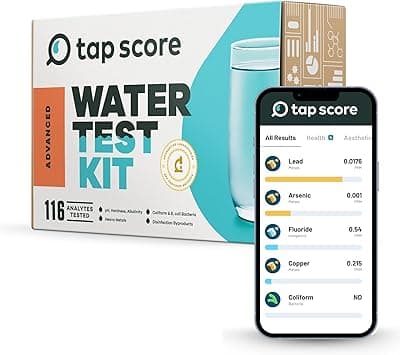
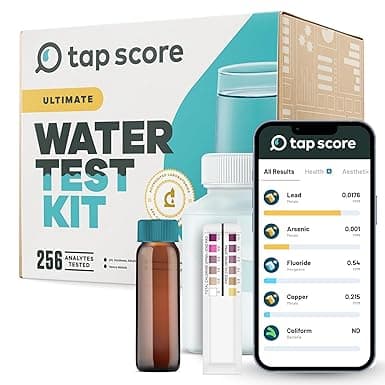
A home test strip and a certified lab test answer two different questions. A $25–$30 box of strips tells you, in about 60 seconds, whether something is obviously off — whether the water is hard, whether there's chlorine in it, whether the pH is roughly normal. A certified laboratory tells you exactly which contaminants are present and at what concentration, measured against the EPA's legal limits. For the parameters that actually drive health decisions — lead, PFAS, arsenic, nitrate for an infant, or bacteria — a strip cannot give you a usable answer, and a certified lab is the only real option (Kriss et al., 2021; CDC, 2024).
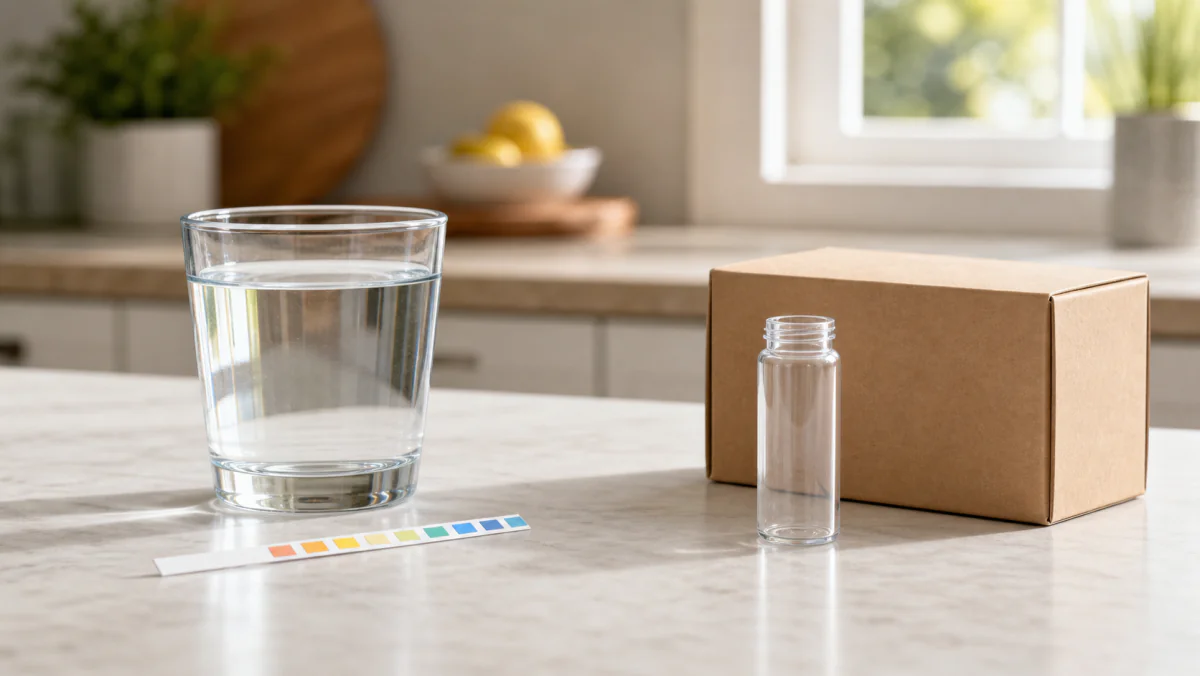
That distinction matters because the wrong tool produces false confidence. In one peer-reviewed evaluation, 12 of 16 at-home lead test kits were unsuitable for drinking water — their detection limits sat between 5 and 20 mg/L, hundreds of times higher than the EPA's 15-ppb (0.015 mg/L) lead action level (Kriss et al., 2021). A strip that reads "fine" while your tap sits at 12 ppb isn't really testing your water; it's reassuring you. Knowing which question you're actually asking — "is anything off?" versus "is it safe, and by how much?" — is the whole decision.
This guide covers what strips can and can't measure, when each method is genuinely enough, what a certified lab does differently, and what both cost. If you already know you need a lab, you can find a state-certified testing lab near you right now; if you'd rather start from your utility's own numbers, look up your city.
Key takeaways
- Strips are a screen, not an answer. Consumer test strips are semi-quantitative color-match chemistry; across analytes, visual strip readings correlated with lab results at only r = 0.37–0.80 (McCarty et al., 2025).
- They handle the easy, high-level stuff. Chlorine, hardness, and pH are the parameters strips read most reliably — chlorine correlated with the lab at r ≈ 0.89–0.91 — and none of the three is a health-based limit (McCarty et al., 2025; EPA, 2026).
- The health-critical contaminants are lab-only. Lead, PFAS (a 4.0-ppt limit), arsenic (10 ppb), VOCs, and bacteria require certified-lab instruments; no strip resolves them at the levels that matter (EPA, 2024; Kriss et al., 2021).
- "Certified" is the word doing the work. Compliance samples must be analyzed by an EPA- or state-certified lab; that accreditation — not the brand on the box — is what makes a result defensible (EPA, 40 CFR 141.28).
- Cost tracks the stakes. Strip kits run about $25–$30 and read in a minute; mail-in certified-lab panels run roughly $140 to $600+ and take one to two weeks (Amazon, 2026; mytapscore.com, 2026).
See what's already reported for your water → Look up your city's latest results before you spend a dime on a test kit.
You might be wondering whether an article that keeps pointing toward lab tests is just a setup to sell you one. Here's the honest version: TapWaterData earns affiliate commission only on mail-in lab kits — our catalog contains no test strips at all. So the recommendation you'll read below — that most people should start with a cheap strip and escalate to a lab only for specific contaminants — actively steers many readers away from the products we get paid on. We think it's the correct answer anyway.
What's the actual difference between a strip test and a lab test?
A test strip is a small paper or plastic stick with one or more reagent pads. You dip it, wait 15–60 seconds, and match the color the pad turns against a printed chart. That is the entire method: a chemical reaction whose result you read with your eyes. It's fast and cheap, and for a few parameters it's genuinely useful — but it's semi-quantitative. The color scale is banded into a handful of steps ("0, 25, 50, 100…"), so it can tell you roughly where you land, not precisely.
The precision problem is measurable. When researchers compared visual strip readings against certified-lab reference values across common analytes, the correlations ranged from weak to moderate — r = 0.37 to 0.80 depending on the parameter — driven by lighting, timing, reagent age, sample interference, and plain differences in how people perceive color (McCarty et al., 2025). Those banded scales also blur exactly where it counts: right around a regulatory threshold, a strip often can't distinguish "under the limit" from "over it."
A certified laboratory works the other way around. It runs EPA-approved instrument methods — inductively coupled plasma mass spectrometry (ICP-MS) for metals, liquid chromatography–tandem mass spectrometry (LC-MS/MS) for PFAS, gas chromatography–mass spectrometry (GC-MS) for volatile organics, and cultured incubation for bacteria — and returns a specific number measured down to a defined detection limit. That number is quantified, reproducible, and comparable to the EPA's maximum contaminant levels. The short version: a strip gives you a color; a lab gives you a concentration.
What can water test strips reliably measure?
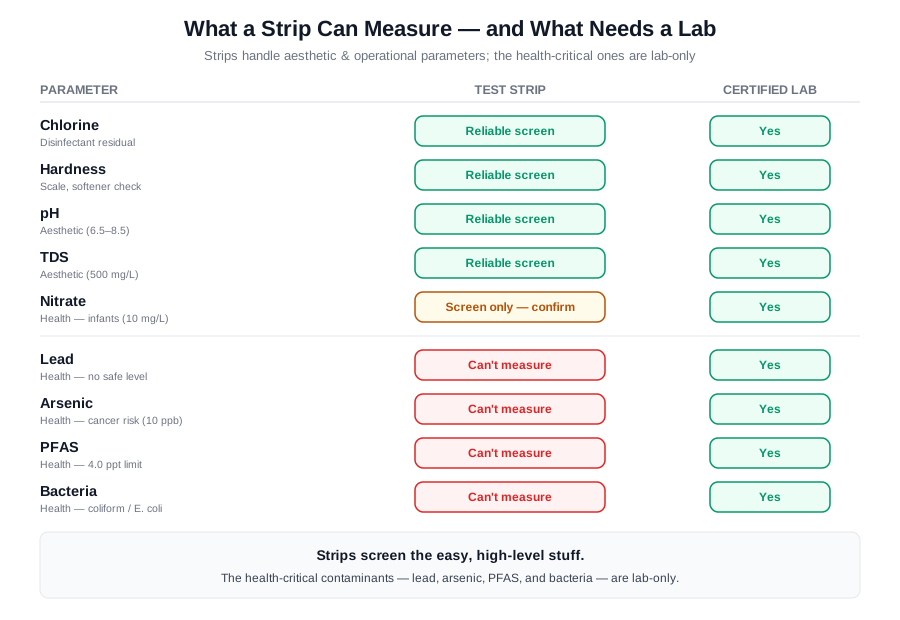
Strips do a real job for a specific set of parameters: the ones that occur at relatively high concentrations and behave predictably. Free and total chlorine are the standouts — chlorine had the strongest strip-to-lab agreement in the peer-reviewed testing (total r ≈ 0.91, free r ≈ 0.89), which makes strips a reasonable way to check disinfectant residual against the EPA's 4.0 mg/L maximum (McCarty et al., 2025; EPA, 2026). Total hardness is the other strong use: strips will tell you roughly where you fall on the USGS scale — soft (0–60), moderately hard (61–120), hard (121–180), or very hard (above 180 mg/L as calcium carbonate) — which is all you need to know whether a softener is working (USGS).
pH and total dissolved solids (TDS) round out the "good enough" list. Both are aesthetic parameters, not health limits: the EPA's secondary standard for pH is 6.5–8.5 and for TDS is 500 mg/L, and neither is federally enforceable (EPA, 2026). That's precisely why a strip is fine for them — you're looking for a ballpark, not a legal determination.
Nitrate sits on the boundary. Strips can screen for it, but anything near the limit is worth confirming with a lab. In a field study, home nitrate strips correlated with the lab at a Spearman r of 0.72 in groundwater but only 0.34 in surface water, the lab read higher than the strip in 81% of positive samples, and nitrite strips returned false positives about 5% of the time (Searles Nielsen et al., 2008); a separate 2025 evaluation put nitrate agreement at r ≈ 0.70 (McCarty et al., 2025). Since the nitrate limit — 10 mg/L as nitrogen — exists specifically to protect infants from methemoglobinemia ("blue-baby syndrome"), a screening-grade result isn't good enough when there's a baby in the house.
What can't a strip test tell you — and why does that matter?
Lead is the clearest failure, and it's the one people most want a strip to solve. The EPA's health goal for lead is zero — there is no known safe level — and the action level that triggers utility response is 15 ppb today, dropping to 10 ppb on November 1, 2027 under the Lead and Copper Rule Improvements (EPA, 2026). Those are parts-per-billion thresholds, and consumer strips can't get close: the 12-of-16 kits found unsuitable had detection limits of 5–20 mg/L — roughly 300 to 1,300 times above the action level (Kriss et al., 2021). Worse, binary lead strips detect only dissolved lead and miss the particulate lead that flakes off pipe scale and solder, so they can return a "safe" reading on genuinely unsafe water (Kriss et al., 2021). The EPA's own guidance is blunt: a lab test is the only sure way to know your lead.
PFAS is even further out of reach. The EPA set enforceable limits of 4.0 parts per trillion each for PFOA and PFOS, and those are measured with LC-MS/MS under EPA Methods 537.1 and 533 — detection at a scale no color-change chemistry can approach (EPA, 2024). (The EPA has said it will keep the 4.0-ppt PFOA and PFOS limits; the 2024 limits for four other PFAS and a proposed shift of the compliance deadline from 2029 to 2031 were still proposals as of mid-2026, not settled rules.) Arsenic (a 10-ppb limit, measured by ICP-MS) and volatile organic compounds like benzene and trichloroethylene (measured by purge-and-trap GC-MS) are likewise lab instruments' work, not strips'.
Bacteria are a different kind of impossible for a strip. Confirming total coliform or E. coli requires culturing a sample and incubating it, typically 24–48 hours, using an approved method such as EPA Method 1604; the health goal for both is zero, and testing is reported as presence/absence rather than a strip color (EPA, 2016). Disinfection byproducts — total trihalomethanes (80 ppb) and haloacetic acids (60 ppb) — are lab-only as well. The table below lays out the split.
| Contaminant | Why it matters | Test strip | Certified lab | EPA limit (2026) |
|---|---|---|---|---|
| Free/total chlorine | Disinfectant residual, taste | ✓ Good screen (r ≈ 0.90) | ✓ | MRDL 4.0 mg/L |
| Hardness | Scale, soap, softener check | ✓ Good screen | ✓ | No health limit (USGS: >180 = very hard) |
| pH | Corrosivity, taste | ✓ Reasonable screen | ✓ | Secondary 6.5–8.5 |
| TDS | General mineral load | ✓ Reasonable screen | ✓ | Secondary 500 mg/L |
| Nitrate | Blue-baby risk for infants | ⚠ Screen only; confirm near limit | ✓ | 10 mg/L (as N) |
| Lead | No known safe level; neurotoxin | ✗ Misses particulate; can't resolve ppb | ✓ (first-draw) | AL 15 ppb → 10 ppb Nov 2027; MCLG 0 |
| Arsenic | Long-term cancer risk | ✗ | ✓ (ICP-MS) | 10 ppb; MCLG 0 |
| PFAS ("forever chemicals") | Immune, developmental, cancer signals | ✗ No consumer strip | ✓ (LC-MS/MS) | PFOA/PFOS 4.0 ppt |
| VOCs (benzene, TCE) | Industrial/fuel chemicals | ✗ | ✓ (GC-MS) | Varies by compound |
| Bacteria (coliform/E. coli) | Fecal contamination | ✗ Can't quantify or confirm | ✓ (culture) | MCLG 0 (presence/absence) |
| TTHM / HAA5 | Disinfection byproducts | ✗ | ✓ | 80 / 60 ppb |
| Bottom line | Match the tool to the stakes | Aesthetic/operational screening | Health-critical, defensible numbers | — |
Sources: EPA National Primary & Secondary Drinking Water Regulations (2026) and 40 CFR 141; USGS hardness classes; Kriss et al. (2021) and McCarty et al. (2025) for strip performance. The lead action level is 15 ppb today, dropping to 10 ppb on Nov 1, 2027 under the LCRI. How we compiled this: our data and methodology.
Not sure what your water needs testing for? → Find a certified lab near you, or check what a filter is certified to remove before you buy one.
When is a strip test genuinely enough?
A strip is the right tool when the stakes are operational rather than medical, and when the thing you're checking sits well above trace levels. If you just want a quick pulse on your water — is anything obviously off before I dig deeper? — a multi-parameter strip for a few dollars is a sensible first move.
- You want to know if your softener is working. Hardness is a strong strip parameter; dip before and after the softener and compare.
- You're checking chlorine. Whether you're confirming a disinfectant residual or dechlorinating for an aquarium or garden, chlorine is the single most reliable thing a strip measures (McCarty et al., 2025).
- You want a rough pH or TDS reading. These are aesthetic, not health, questions — ballpark is all you need (EPA, 2026).
- You're doing a first-pass screen and will confirm any flagged result. A strip that flags high nitrate is a reason to send a sample to a lab, not a diagnosis on its own.
The through-line: if a "roughly right" answer is genuinely good enough, and the parameter isn't one that harms people at trace concentrations, a strip earns its place.
When do you need a certified or mail-in lab test?
Escalate to a certified lab whenever the answer needs to be defensible or the contaminant is dangerous at levels a strip can't see. The decision map below covers the common triggers.
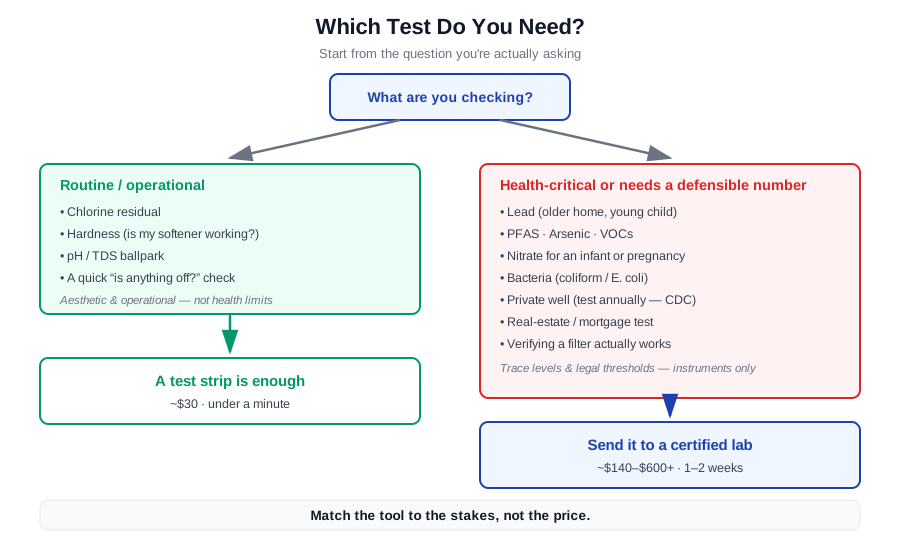
- Lead — especially in an older home or with a young child. First-draw sampling (water that's sat in the pipes at least six hours) to a certified lab is the only reliable read (EPA, 2024; Kriss et al., 2021).
- PFAS, if you're near a known source (military base, airport, certain industry) or your utility has reported detections — lab-only at 4.0 ppt (EPA, 2024).
- Arsenic, common in some groundwater and well geology, measured at the 10-ppb limit by ICP-MS (EPA, 2026).
- Nitrate when there's an infant or pregnancy in the household — the blue-baby risk makes a confirmed number worth the cost (EPA, 2026).
- Bacteria, which need a cultured lab method, not a field read (EPA, 2016).
- Private wells. The CDC recommends testing at least once a year for total coliform bacteria, nitrate, TDS, and pH — and to "use a state-certified laboratory" (CDC, 2024).
- Real-estate and mortgage tests. FHA and VA loans typically require a water test from a disinterested, certified party, with thresholds that mirror the EPA limits (total coliform absent, nitrate ≤ 10 mg/L); this is lender guidance rather than a single federal rule, so confirm your lender's specifics.
- Verifying a filter or treatment system actually works. A quantified before-and-after from a lab is the only way to prove a system is doing what it claims.
Are the free strips from filter companies worth anything?
The strip a water-softener salesperson hands you, or the freebie in a filter starter kit, is not a neutral instrument — it's usually a screening tool chosen to make a sale. Most of those free strips read hardness and chlorine, and on typical municipal water both will register, which lets the pitch become "see, your water needs treatment." That's not dishonest so much as incomplete: hardness and chlorine are real, but they're aesthetic and operational issues, not the health-critical contaminants a strip can't measure at all.
So treat a filter company's free strip as what it is: a fine way to confirm you have hard or chlorinated water, and no evidence whatsoever about lead, PFAS, arsenic, nitrate, or bacteria. If a company's marketing implies its strip "tests your water for safety," that claim outruns what any strip can do. The credible alternatives are a state-certified lab or a reputable mail-in kit that routes your sample to one — Tap Score, for instance, is "Powered by SimpleLab," which sends samples to a network of certified independent laboratories rather than testing them itself (mytapscore.com, 2024). The rule of thumb: trust the strip for what it measures, and trust the lab for what matters.
How do you get your water tested by a real lab?
Getting a defensible result is more straightforward than most people expect — a mail-in kit turns a certified lab into a shipping label. The process is five steps.
- Decide what to test for. Start from your concern: an older home points to lead; a nearby industrial site points to VOCs or PFAS; a private well points to bacteria and nitrate. If you don't know, a broad panel covers the common ones at once.
- Pick a state-certified lab — or a mail-in kit that uses one. The label to look for is "state-certified" or "EPA-certified"; the accreditation standard beneath it (NELAP, modeled on ISO/IEC 17025) is what makes the number hold up (EPA, 40 CFR 141.28).
- Collect the sample exactly as instructed. This step is where DIY tests go wrong. For lead, that means a first-draw sample after the water has been still for at least six hours; for bacteria, a sterile technique. Follow the kit's directions to the letter.
- Ship it back. Mail-in kits include prepaid packaging; you drop the vials in the mail.
- Read your results. Reports typically arrive about a week after the lab receives your sample — 10–12 business days for PFAS or microplastics panels (mytapscore.com, 2026). When yours comes back, our guide to reading a water test report walks through what each number means.
On cost: consumer strip kits run about $25–$30 and read in under a minute; mail-in certified-lab panels run roughly $140 for a targeted test to $600 or more for a comprehensive one, with results in one to two weeks (Amazon, 2026; mytapscore.com, 2026). You're paying for accredited methods, a quantified number, and a result you can act on — the difference between a color and a concentration.
Ready to test for real? → Find a state-certified lab near you, then learn how to read the results when they come back.
Reading this from a different angle?
- Got your results back? Read how to read your water test report and how to read your Consumer Confidence Report for what each line means.
- On a private well? See what to test your well water for and find a certified well-water lab near you; our well test interpreter reads the results back in plain language.
- Confused by legal vs. safe? Read MCL vs. MCLG — why "below the limit" and "at the health goal" are different things.
- Testing before you buy a filter? Read NSF water-filter certifications so a lab result actually tells you which filter to get.
Methodology and disclosure
This guide draws on EPA primary sources — the National Primary and Secondary Drinking Water Regulations, the Lead and Copper Rule Improvements, the PFAS drinking-water rule and lab methods (537.1, 533), the Revised Total Coliform Rule, and 40 CFR 141 — plus USGS hardness classifications, CDC well-testing guidance, and two peer-reviewed evaluations of consumer test-strip accuracy (Kriss et al., Environmental Science & Technology, 2021; McCarty et al., Environmental Monitoring and Assessment, 2025; nitrate-strip data from Searles Nielsen et al., 2008). Regulatory figures were verified against EPA and eCFR sources on July 1, 2026. TapWaterData earns affiliate commission on the mail-in lab kits recommended in our testing guides; it sells no test strips, and this guide's advice to screen with strips first steers many readers away from the products we earn on. Our methodology — including how we score filters (50% contaminant coverage + 30% Amazon rating + 20% affordability) — is published on our data page.