An MCL — a Maximum Contaminant Level — is the legally enforceable limit your utility must keep your water at or below. An MCLG — a Maximum Contaminant Level Goal — is the health-based level at which the EPA expects no known or anticipated harm, with an added margin of safety (EPA, 2024; 42 U.S.C. 300g-1). The two are frequently different numbers. For a likely carcinogen such as arsenic, the legal MCL is 10 parts per billion while the health-goal MCLG is zero (EPA, NPDWR, 2024). That single gap is the reason "meets EPA standards" and "sits at the health goal" are not the same statement.
The distinction decides how you read your own water report. When your Consumer Confidence Report says a contaminant is "below the limit," it is telling you the water is in compliance with the enforceable MCL — that it is legal. It is not telling you the water sits at the health goal, because for many contaminants the law cannot, by design, require that. The EPA must set each MCL "as close to the MCLG as is feasible," a word the statute defines around the best available treatment technology and its cost (EPA, 2024; 42 U.S.C. 300g-1). The gap is not a loophole; it is the visible seam between what is health-ideal and what is currently treatable at scale.
This guide explains what each number means, why the gap exists, which contaminants have the widest gap and which have none, and how to read your report against both. The fastest place to start is your own water — look up your city to see your utility's most recent report and the contaminants it measures.
✅ The key difference between MCL and MCLG:
- MCL is the legal limit; MCLG is the health goal. The MCL is enforceable and the MCLG is not — the MCLG is "the level at which no known or anticipated adverse effects on the health of persons occur," with an adequate margin of safety (EPA, 2024; 42 U.S.C. 300g-1).
- The gap exists because the law weighs feasibility. The EPA must set each MCL "as close to the MCLG as is feasible," considering the best available treatment and its cost (EPA, 2024) — so a health goal of zero can still carry a non-zero legal limit.
- The gap is widest for carcinogens. Where a chemical may cause cancer and has no dose considered safe, the EPA sets the MCLG to zero; arsenic is 0 against a 10-ppb MCL, and PFOA and PFOS are 0 against 4-ppt MCLs (EPA, 2024).
- For some contaminants the gap is zero. Nitrate and fluoride have MCL = MCLG — 10 mg/L and 4.0 mg/L — because their health threshold is well-characterized and non-zero (EPA, 2024).
- Lead has no MCL at all. It is a treatment-technique rule with an action level (15 ppb, dropping to 10 ppb under the 2024 LCRI) and an MCLG of zero — the action level is a system-wide trigger, not a safe level for your glass (EPA, 2024).
See your utility's most recent report and the contaminants it measures — then read each number against both the legal limit and the health goal.
You might be wondering whether this is EWG-style "everything is unsafe" content. It is not — most U.S. tap water is genuinely in compliance with EPA limits, and those limits are not arbitrary. The harder and more useful question, the one this guide answers, is when the gap between the legal MCL and the health-goal MCLG actually matters for a decision, and when it doesn't.
What is an MCL, and who decides the number?
An MCL is the enforceable ceiling. The EPA's National Primary Drinking Water Regulations (NPDWRs) are "legally enforceable primary standards and treatment techniques that apply to public water systems," and the MCL is the maximum concentration of a contaminant that is allowed in water delivered to any user of such a system (EPA, NPDWR, 2024). When a utility's water is at or below the MCL, it is in compliance — the precise meaning of "meets EPA standards."
The number is not set at the health-ideal level, and the statute is explicit about why. Under the Safe Drinking Water Act, each MCL must be set "as close to the maximum contaminant level goal as is feasible" (42 U.S.C. 300g-1). "Feasible" is itself a defined term: feasible with the use of the best technology, treatment techniques, and other means that the EPA finds are available, taking cost into consideration (42 U.S.C. 300g-1). So an MCL is a negotiated number — the health goal, pulled toward what large utilities can actually achieve and afford with current treatment.
That design has two consequences worth holding onto. First, the MCL is a floor of protection, not a definition of "safe": it is the lowest concentration the EPA judged feasible to enforce nationwide, which can sit above the level where risk truly disappears. Second, the MCL is a federal minimum — states with primacy may set stricter limits but never weaker ones (EPA, 2024). Your local legal limit is therefore whichever is stricter, the federal MCL or your state's, and your CCR reports your water against that enforceable number.
When monitoring at a true MCL isn't economically or technically feasible, the EPA writes an enforceable treatment technique instead of a concentration limit — a required process rather than a number. Lead and copper are regulated this way, which is why neither has an MCL at all (EPA, 2024). That exception matters enough to get its own section below.
What is an MCLG, and why is it sometimes zero?
An MCLG is the health target with the cost knob removed. The Safe Drinking Water Act defines it as the level "at which no known or anticipated adverse effects on the health of persons occur and which allows an adequate margin of safety," and it is explicitly non-enforceable — a goal, not a rule (42 U.S.C. 300g-1; EPA, 2024). Because feasibility and cost play no part in it, the MCLG is a purer statement of health than the MCL.
How the EPA lands on the number depends on what kind of harm the contaminant causes. For a non-carcinogen, the agency works from a Reference Dose — an estimate of the daily exposure a person can experience without appreciable risk — and builds in a margin of safety, producing a non-zero MCLG (EPA, 2024). For a contaminant where a safe threshold genuinely exists and is well-studied, that non-zero goal can be set with confidence.
For likely or known carcinogens, the logic changes, and this is where zeros come from. The EPA's stated policy: "EPA sets the MCLG at zero if both of these are the case: there is evidence that a chemical may cause cancer [and] there is no dose below which the chemical is considered safe" (EPA, 2024). If no exposure can be called risk-free, the only health-honest goal is none at all. The same zero applies to disease-causing microbial contaminants, where a single organism can in principle cause illness (EPA, 2024).
So a zero MCLG is not a claim that a contaminant is uniquely dangerous at any trace — it is a statement that science cannot identify a safe threshold for it, so the health goal defaults to the absence of it. Arsenic, benzene, vinyl chloride, uranium, PFOA, and PFOS all carry an MCLG of zero for exactly this reason (EPA, 2024). Their enforceable MCLs are non-zero because the law requires only what is feasible — not because zero is unimportant.
Why is there a gap between the legal limit and the health goal?
The gap is the distance between "no known risk" and "what we can currently treat for and enforce." Picture two marks on a number line: the MCLG sits at the health-ideal level (often zero), and the MCL sits higher, at the lowest concentration the EPA judged feasible to require of every public system in the country. Everything between those marks is water that is fully legal and still above the health goal.
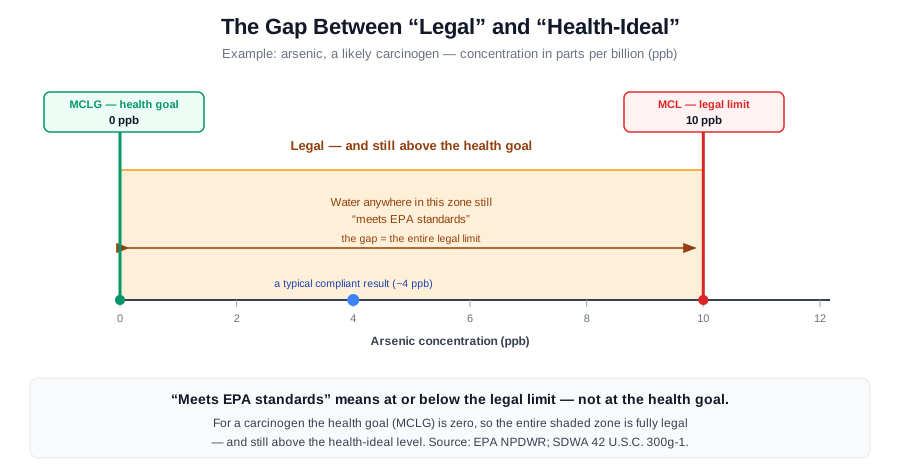
This is the single most useful idea for reading any water report, and it explains a confusion that traps a lot of households: the CCR that says "0.004 mg/L, below the 0.010 limit" is reporting compliance, not health-ideal water. The result is genuinely good news — the utility is doing its job and the water is legal. It also sits above a health goal of zero. Both things are true at once, and neither is a scandal.
The width of the gap is information, not alarm. A wide gap (a carcinogen with an MCLG of zero) tells you the contaminant is one where any reduction is a health improvement and where a certified filter can meaningfully lower your exposure if a result concerns you. A zero gap (nitrate, fluoride) tells you the legal limit already equals the health goal, so a result safely under the limit means the water is at the health target for that contaminant. Reading the gap is how you tell which of your CCR's "passing" numbers are worth a second thought and which are settled.
The gap also moves over time. As treatment gets cheaper and detection gets sharper, the EPA can lower an MCL closer to the goal — which is exactly what the 2024 PFAS rule did, setting enforceable 4-ppt limits for PFOA and PFOS against their zero goals where, a decade earlier, no enforceable limit existed at all (EPA, 2024). The goal didn't change; feasibility did.
Which contaminants have the biggest gap — and which have none?
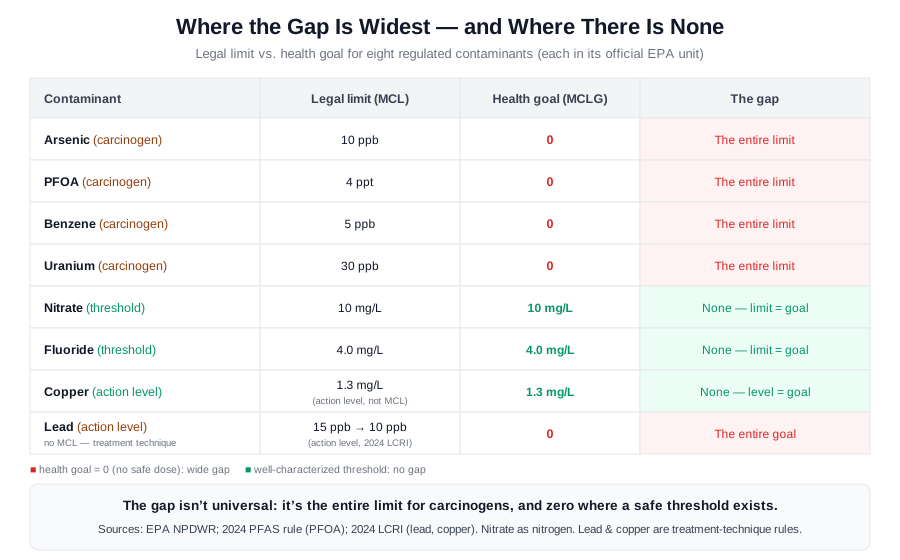
The pattern is consistent once you sort by how the health threshold behaves. Carcinogens with no safe dose carry the widest gap — the entire legal limit — because their goal is zero. Contaminants with a well-characterized, non-zero threshold often have no gap at all, because the EPA could set the legal limit right at the health goal. The table below shows both ends, using each contaminant's official EPA unit.
| Contaminant | Legal limit (MCL) | Health goal (MCLG) | The gap | Why the gap is this size |
|---|---|---|---|---|
| Arsenic | 10 ppb (0.010 mg/L) | 0 | The entire limit | Likely carcinogen; no dose considered safe |
| PFOA | 4 ppt (0.004 µg/L) | 0 | The entire limit | Carcinogen; MCL set at the feasible level (2024) |
| PFOS | 4 ppt (0.004 µg/L) | 0 | The entire limit | Carcinogen; MCL set at the feasible level (2024) |
| Benzene | 5 ppb (0.005 mg/L) | 0 | The entire limit | Known human carcinogen |
| Trichloroethylene (TCE) | 5 ppb (0.005 mg/L) | 0 | The entire limit | Carcinogen; no safe threshold |
| Uranium | 30 ppb (0.030 mg/L) | 0 | The entire limit | Carcinogen; also harms the kidneys |
| Nitrate (as N) | 10 mg/L | 10 mg/L | None | Threshold well-characterized (infant risk) |
| Fluoride | 4.0 mg/L | 4.0 mg/L | None | Threshold well-characterized (skeletal effects) |
| Copper | 1.3 mg/L (action level) | 1.3 mg/L | None | Threshold contaminant; regulated as a treatment technique, not an MCL |
| Lead | No MCL — action level 15 ppb (→10 under the 2024 LCRI) | 0 | The entire goal | No safe level; treatment-technique rule, not an MCL |
| National pattern | Set "as close to the MCLG as is feasible" | 0 for carcinogens; non-zero where a safe threshold exists | Widest for carcinogens, none for well-characterized thresholds | Feasibility and cost, not health alone, fix the legal number |
Sources: EPA National Primary Drinking Water Regulations table (all values except PFAS and lead); EPA 2024 PFAS rule (PFOA, PFOS — 4.0 ppt MCL, 0 MCLG); EPA 2024 Lead and Copper Rule Improvements (lead action level 15→10 ppb, MCLG 0; copper action level 1.3 mg/L = MCLG). Nitrate is measured as nitrogen. Copper and lead are treatment-technique rules with action levels, not MCLs. How this table was assembled: our data and methodology.
Two cases in that table are worth pausing on. Nitrate and fluoride have no gap because the science behind their thresholds is settled and non-zero — the EPA could set the legal limit at the health goal, so a nitrate result well under 10 mg/L means the water is at the health target for nitrate, not merely legal (EPA, 2024). Copper also shows no gap, but for a subtler reason: copper has no MCL, only an action level of 1.3 mg/L that happens to equal its MCLG of 1.3 mg/L (EPA, 2024). The action level reaching the health goal is the exception, not the rule — and lead, the other treatment-technique contaminant, is the opposite case entirely.
Where does lead fit if it has no MCL at all?
Lead is the contaminant the MCL/MCLG framework most often gets misquoted on, because lead has no MCL. It is regulated by a treatment technique under the Lead and Copper Rule, with an action level of 0.015 mg/L (15 ppb) that triggers system-wide corrective action — not a maximum a utility is permitted to deliver (EPA, 2024). Lead's MCLG is zero, because there is no known safe blood lead level in children (EPA, 2024; CDC, 2024).
The action level is widely misread as a safe line, and it is not. It is a statistical trigger: if more than 10 percent of sampled high-risk taps exceed it, the system must act — optimize corrosion control, expand monitoring, and replace lead service lines (EPA, 2024). A single home can sit below the action level and still have lead at the tap, because the rule is built around system-wide patterns, not your specific faucet. So "below the lead action level" is a statement about the utility's program, not a clean bill of health for your glass.
The 2024 Lead and Copper Rule Improvements (LCRI), finalized October 8, 2024 and effective December 30, 2024, tightened this further. The rule lowers the lead action level from 15 ppb to 10 ppb, requires most systems to replace their lead service lines within 10 years, and sets November 1, 2027 as the start of the mandatory requirements (EPA, 2024). The action level dropped; the health goal of zero did not move, because the science behind zero — no safe level — has not changed.
For your decision, the practical translation is simple. Because lead's goal is zero and lead largely comes from your home's own plumbing rather than the source, a utility "passing" the action level tells you little about your tap. If you have an older home or a lead or unknown service line, the only way to know your level is an independent certified-lab test, and the only filters worth considering for lead are those certified to reduce it — covered in the filter-buyer guide linked below.
So does "meets EPA standards" mean my water is safe?
"Meets EPA standards" means one specific, verifiable thing: every regulated contaminant in the water is at or below its enforceable MCL or satisfies its treatment-technique rule (EPA, 2024). That is a real and meaningful achievement — it is what the entire public-water-system apparatus exists to deliver, and most U.S. systems deliver it most of the time. It is a compliance statement.
What it does not mean is that every contaminant sits at its health goal, because for carcinogens the law cannot require that — the goal is zero and the feasible legal limit is not. So "safe" is the wrong word to chase; "in compliance, with these specific contaminants still above their health goals" is the accurate one. The gap tells you which contaminants those are.
This is also why the EPA and EWG can publish different numbers for the same chemical without either lying. EPA limits are the enforceable MCLs — health goals pulled toward feasibility and cost. Health-only benchmarks, like California's Public Health Goals or EWG's guidelines, are set closer to the MCLG, with no feasibility adjustment (California OEHHA, 2024). California's Public Health Goal for arsenic is 0.004 ppb against the federal 10-ppb MCL — a health-only number sitting near the MCLG of zero, not a competing legal limit (California OEHHA, 2024). Both numbers are honest; they answer different questions.
The useful posture is neither "it's legal, so it's perfect" nor "there's a gap, so it's unsafe." It is: the water is compliant, here are the contaminants where the legal limit still sits above the health goal, and here is whether any of them show up at a level worth acting on in your specific report.
What should you actually do about the gap?
Start by reading your own report against both numbers, not one. Pull your CCR — look up your city to find it — and for each detected contaminant, note the legal limit it's compared against and whether that contaminant has a gap. A result under the limit on a zero-gap contaminant (nitrate, fluoride) is settled. A result under the limit on a wide-gap contaminant (arsenic, PFAS) is legal and still above the health goal, which is where a closer look can pay off.
From there, the action depends on your situation rather than a universal rule. If your CCR shows a wide-gap contaminant detected at a level that concerns you, the response is a filter certified to reduce that specific contaminant — not a generic "purifier." If you have an older home or a lead or unknown service line, the gap that matters is lead's, and the answer is a certified-lab test at your own tap plus a lead-certified filter, because the utility's action-level result can't speak for your faucet (EPA, 2024). If your detected contaminants are all on zero-gap thresholds and safely under their limits, the honest answer may be that no filter is needed.
The one move that never makes sense is buying a filter against a number you haven't read. The gap is a tool for spending attention — and money — only where the data says it belongs.
💡 Start with your own water. Look up your city to pull your most recent report, then read each detected contaminant against both its legal limit and its health goal — no fear, no sales pitch, just what the data says. :::
Reading this from a different angle?
- Worried about kids specifically? Read why pediatric and public-health limits are stricter than the EPA's → — the same gap, framed around infants, formula, and the contaminants that hit children hardest.
- Trying to choose a filter? Read whether filter certifications match the EPA health goal → — what "certified to reduce" leaves in your glass versus the MCLG.
- Newer to the topic? Start with who regulates your drinking water → and where US tap water comes from → — who sets these numbers, and where your water starts.
Sources and disclosure
This guide draws on EPA primary sources — the National Primary Drinking Water Regulations table; the Safe Drinking Water Act definitions of MCL, MCLG, and "feasible" in 42 U.S.C. 300g-1; How EPA Regulates Drinking Water Contaminants; the 2024 PFAS National Primary Drinking Water Regulation; and the 2024 Lead and Copper Rule Improvements — plus California OEHHA's Public Health Goals for the EPA-vs-health-goal comparison, and the city Consumer Confidence Reports we aggregate across 18,774 U.S. cities. TapWaterData sells no water and earns no commission on anything in this guide.
Disclosure. This guide contains no affiliate links, but it links to our Filter Buyer guides, which do contain affiliate links — Amazon and brand-direct links that earn TapWaterData a commission at no additional cost to you. Recommendations there are scored by our published methodology — 50% contaminant coverage, 30% Amazon rating, 20% affordability — independent of commission rate. More about our data and how we work.