America's Best Water Quality Reports
We read 25 US cities' annual water quality reports line by line and scored how well each one helps residents understand what's in their water, measured against where the EPA's 2027 rules are headed. Philadelphia came out on top.
By TapWaterData Editorial · Updated September 13, 2026 · Independent · Free · No utility paid for placement
Most water reports are written to be filed, not read
Every US utility has to mail you a water quality report once a year. By law it has to list what is in your water. It does not have to be readable, and most are not: studies have found the average report is written at a college reading level, and only a small fraction pass basic accessibility tests.[3] The EPA's 2027 rule revisions finally require clearer, more accessible reports.[1]
A handful of utilities were already there before the rule. We went looking for them. This is a ranking of the report, the thing a resident actually receives, not a ranking of the water itself.
How we scored every report
Five pillars, judged page by page on an identical rubric, sourced from each utility's own published report and EPA data. Weights are published so anyone can re-derive a score.
| Pillar | What it measures | Weight |
|---|---|---|
| Plain-language clarity | Can a non-expert actually read it? | 25% |
| Contaminant transparency | Do they show the numbers — including the bad news? | 25% |
| Information design | Is the data visual, or a wall of tables? | 20% |
| Digital accessibility & delivery | Web-native, mobile, and lookup — or a buried PDF? | 20% |
| Timeliness & completeness | Recent data, full panel. | 10% |
The 2026 honorees
The 10 utilities whose reports do the most to help residents understand their water.
25 reports read · 10 honorees · 15 also reviewed
Every honoree, scored and shown
Each report below earned its place. Open any scorecard for the full pillar-by-pillar breakdown and a look at the report itself.
Philadelphia Water Department
Philadelphia, Pennsylvania · Interactive microsite
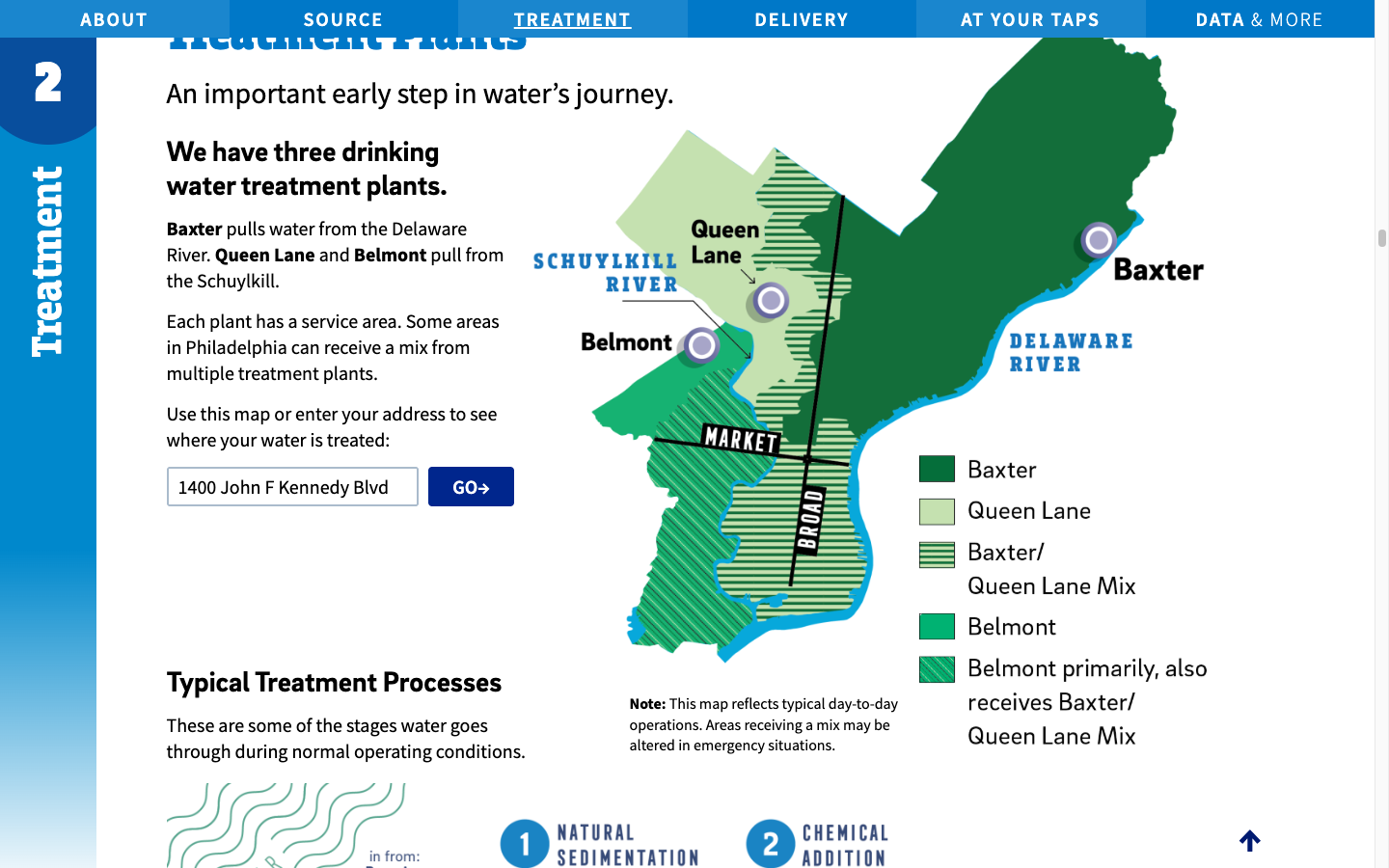
Philadelphia is the only report in the cohort that is at once a magazine-grade publication and a designed, interactive website — it sets the ceiling for what a water quality report can be. It prints its own bad news instead of burying it — a PFOA running annual average of 7.3 ppt, above the 4 ppt federal limit the report says applies from 2029 — and pictures ppm, ppb and ppt with an Olympic-pool comparison. It gives up half a point only on timeliness: its lead and copper results date from 2022, and the report notes that testing is done every 3 years.
- •A true interactive microsite, not a PDF — a four-chapter water-journey narrative with a scroll-linked watershed map.
- •An address lookup that shows which treatment plant — or mix of plants — serves your area, on a color-coded service-area map.
- •PFAS charted against the state limits, with a PFOA running annual average as high as 7.3 ppt printed beside the EPA's 4 ppt limit, which the report says applies from 2029.
Tucson Water
Tucson, AZ · PDF report
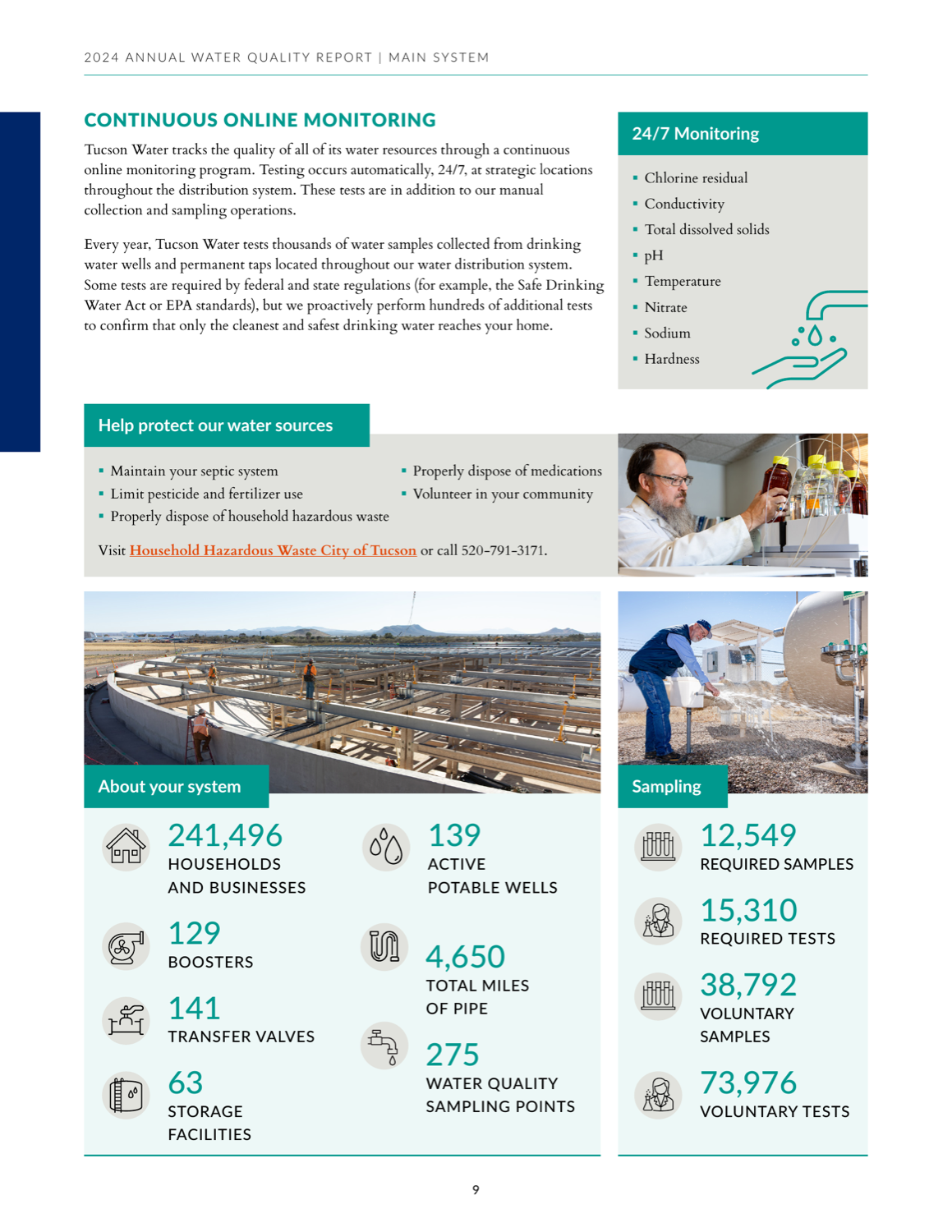
- •The most rigorous voluntary-monitoring story in the cohort: 38,792 voluntary samples against 12,549 required.
- •Discloses a missed-monitoring violation in plain language, naming the six parameters and how it was closed.
DC Water
Washington, DC · PDF report
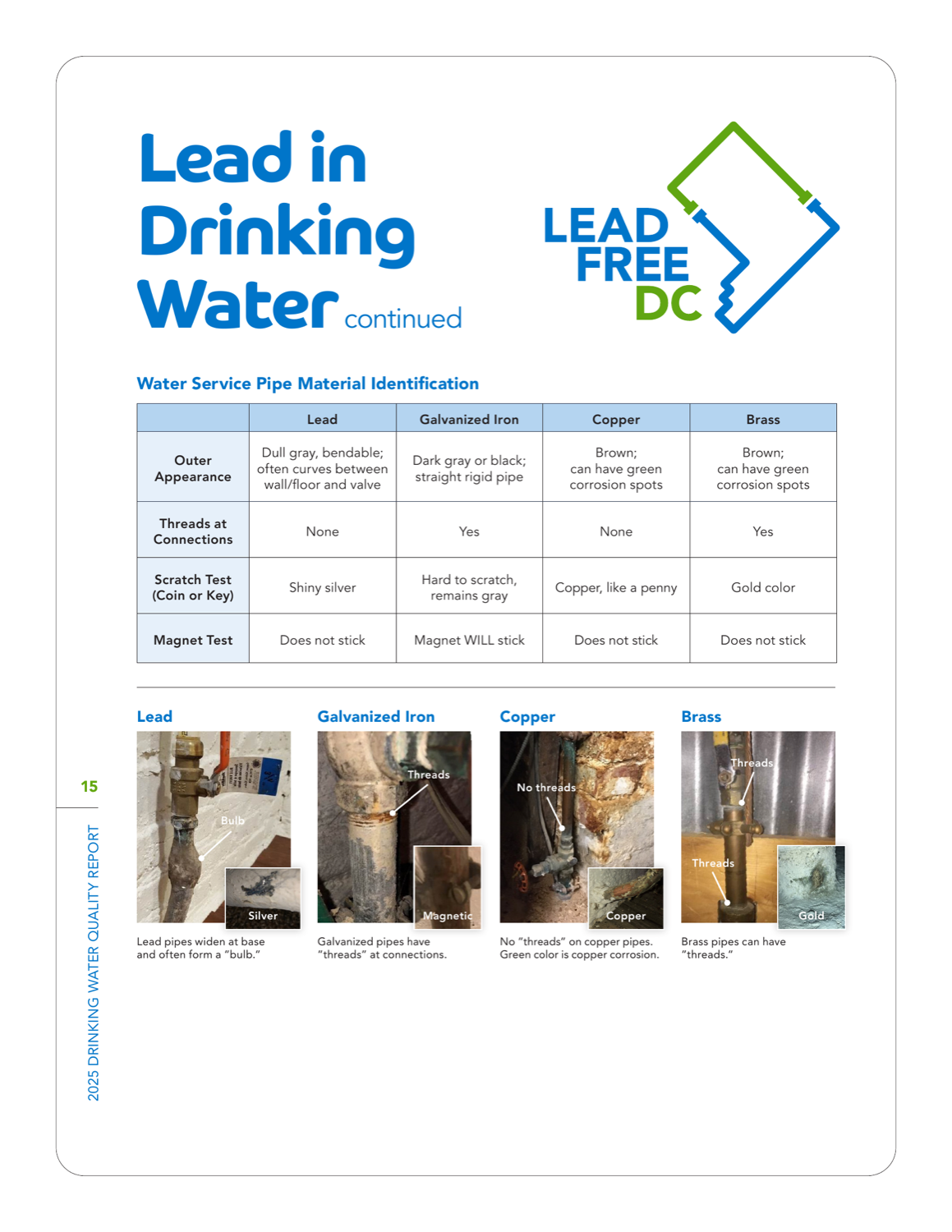
- •The best lead-pipe self-identification content anywhere: a scratch-and-magnet test matrix with annotated photos of lead, galvanized iron, copper and brass pipes.
- •Voluntary PFAS results shown against the new EPA limits, plus per-site UCMR5 data.
Denver Water
Denver, CO · Web report
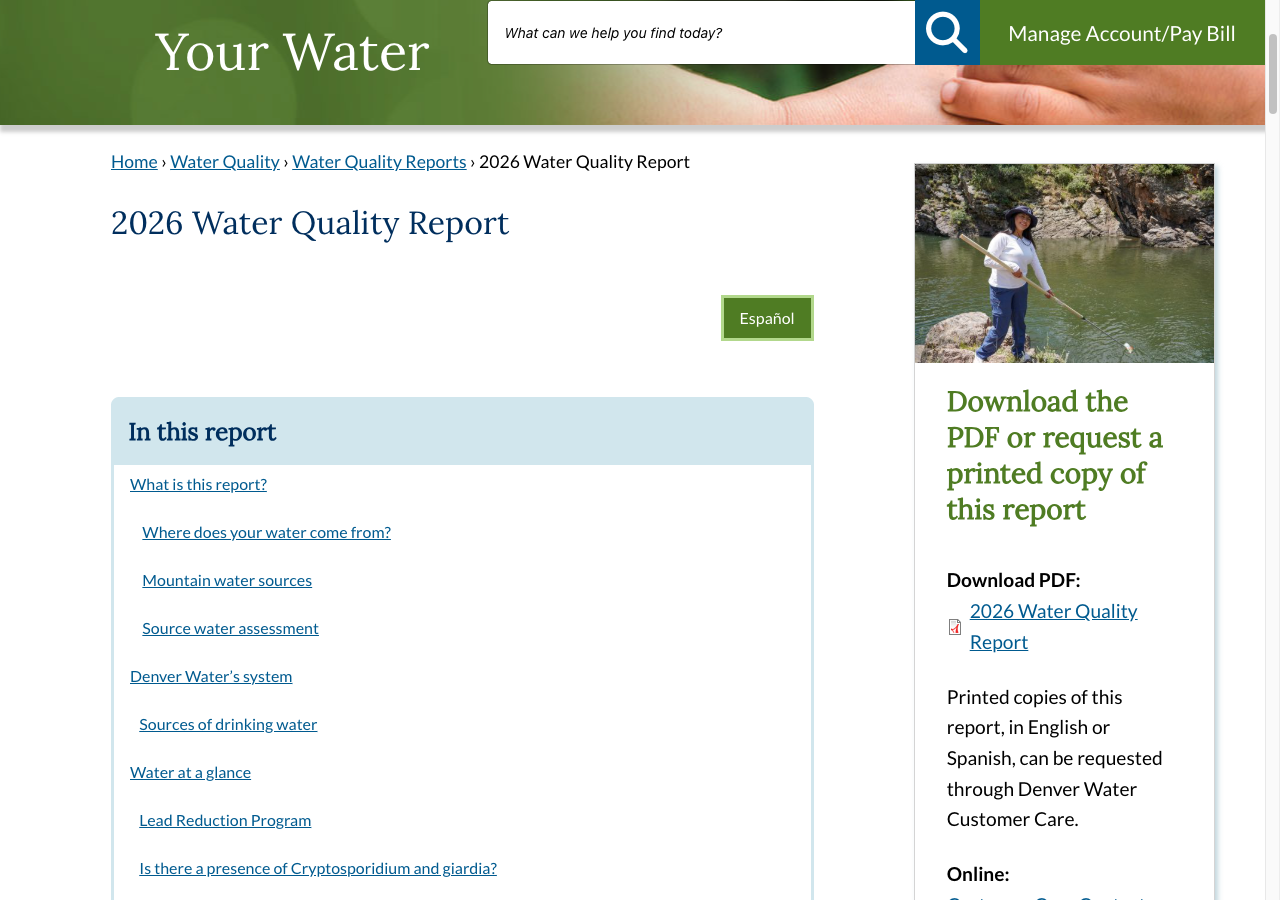
- •A genuine HTML report alongside the PDF — jump-link navigation, accordion sections, and per-plant results.
- •Explains the monitoring requirement it missed in a plain-language Q&A: what happened, how it affected water quality, what was done.
Mount Pleasant Waterworks
Mount Pleasant, SC · PDF report
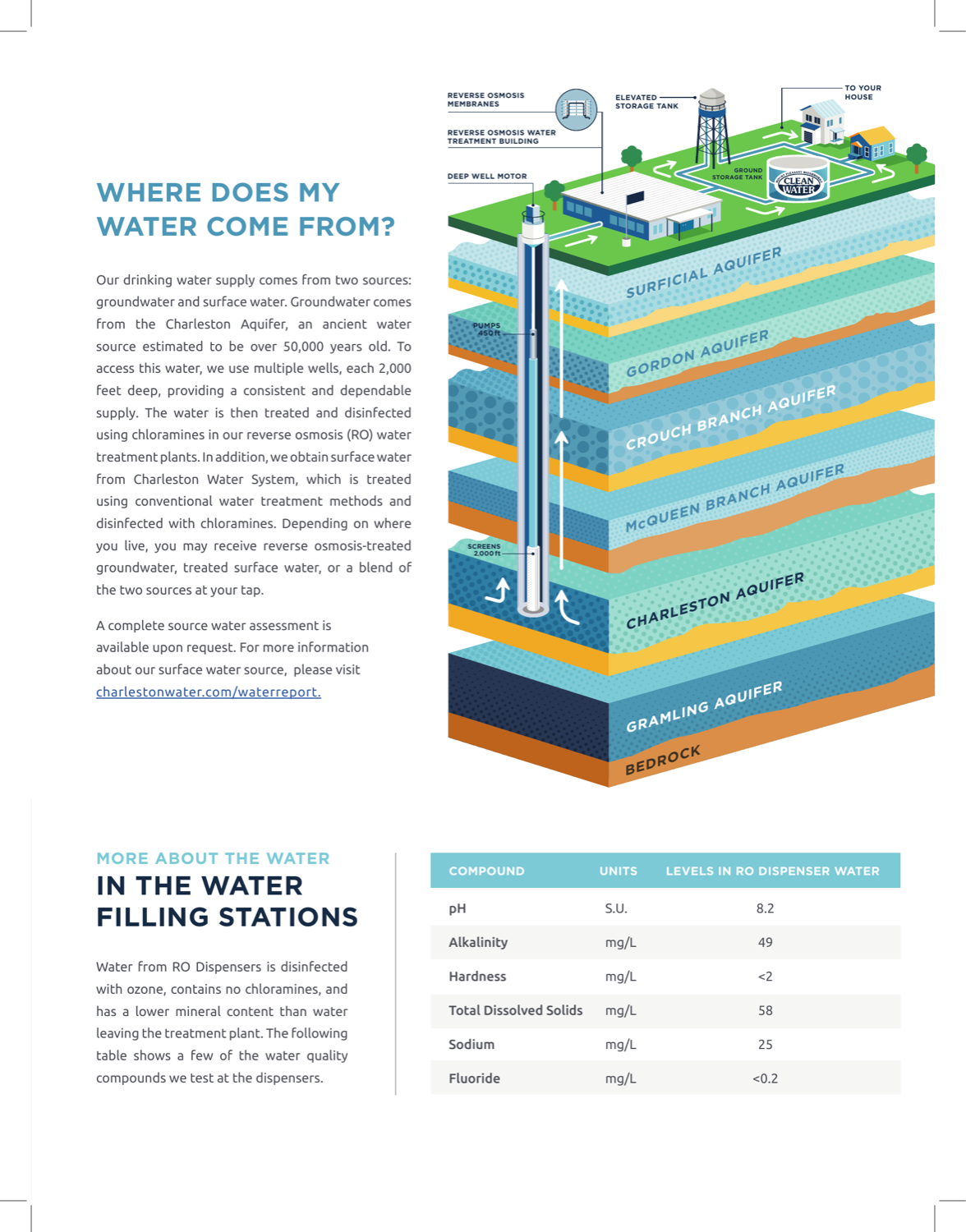
- •The most editorial print piece in the cohort: a custom isometric aquifer cross-section and an illustrated treatment panorama.
- •Lists its UCMR 5 PFAS values and is candid about the system's history.
Greenville Water
Greenville, SC · PDF report
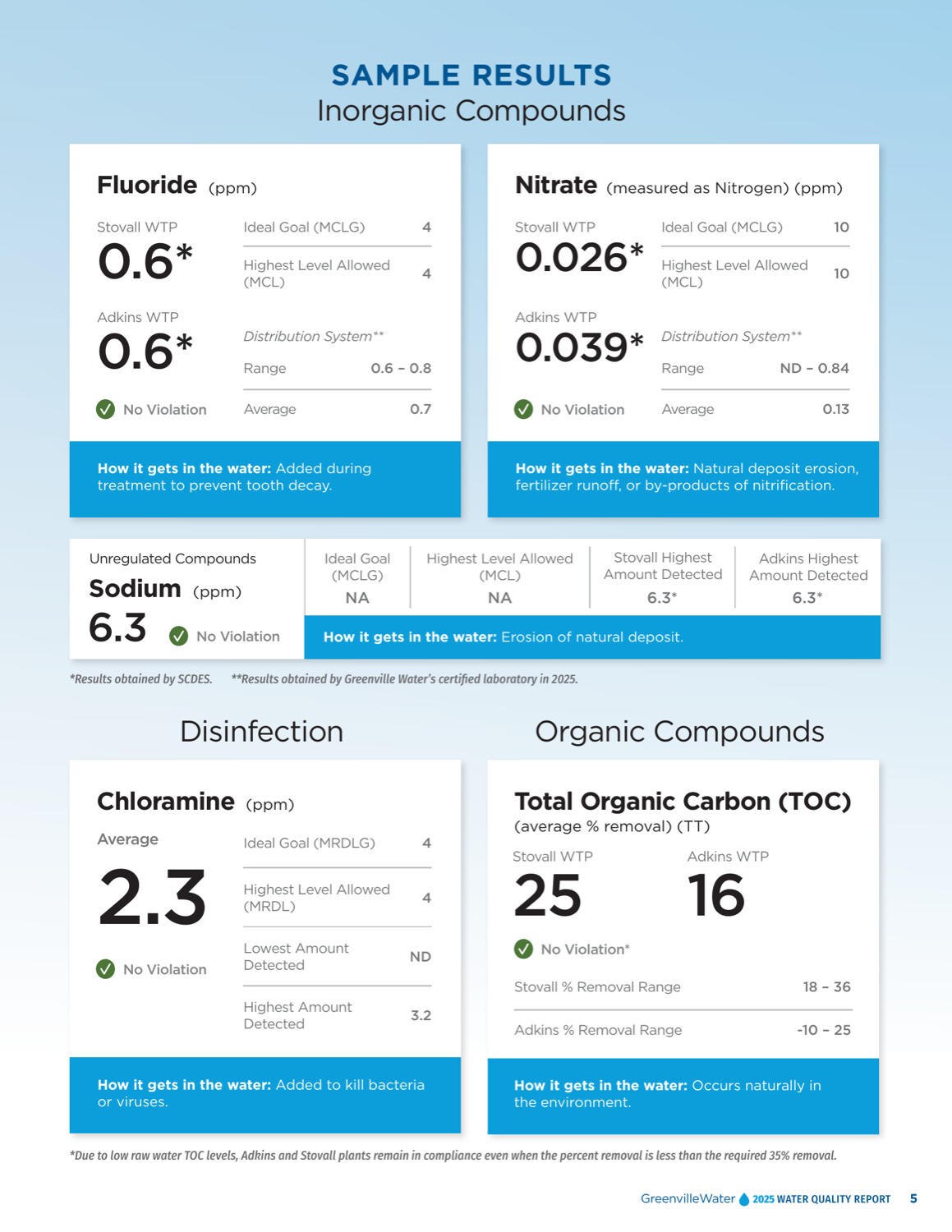
- •Abandons the regulatory table entirely: every contaminant is a big-number card showing the result and how it gets in the water, most with the goal and limit.
- •Relabels MCLG/MCL as 'Ideal Goal' and 'Highest Level Allowed' so a layperson can read it.
City of Grants Pass
Grants Pass, OR · PDF report
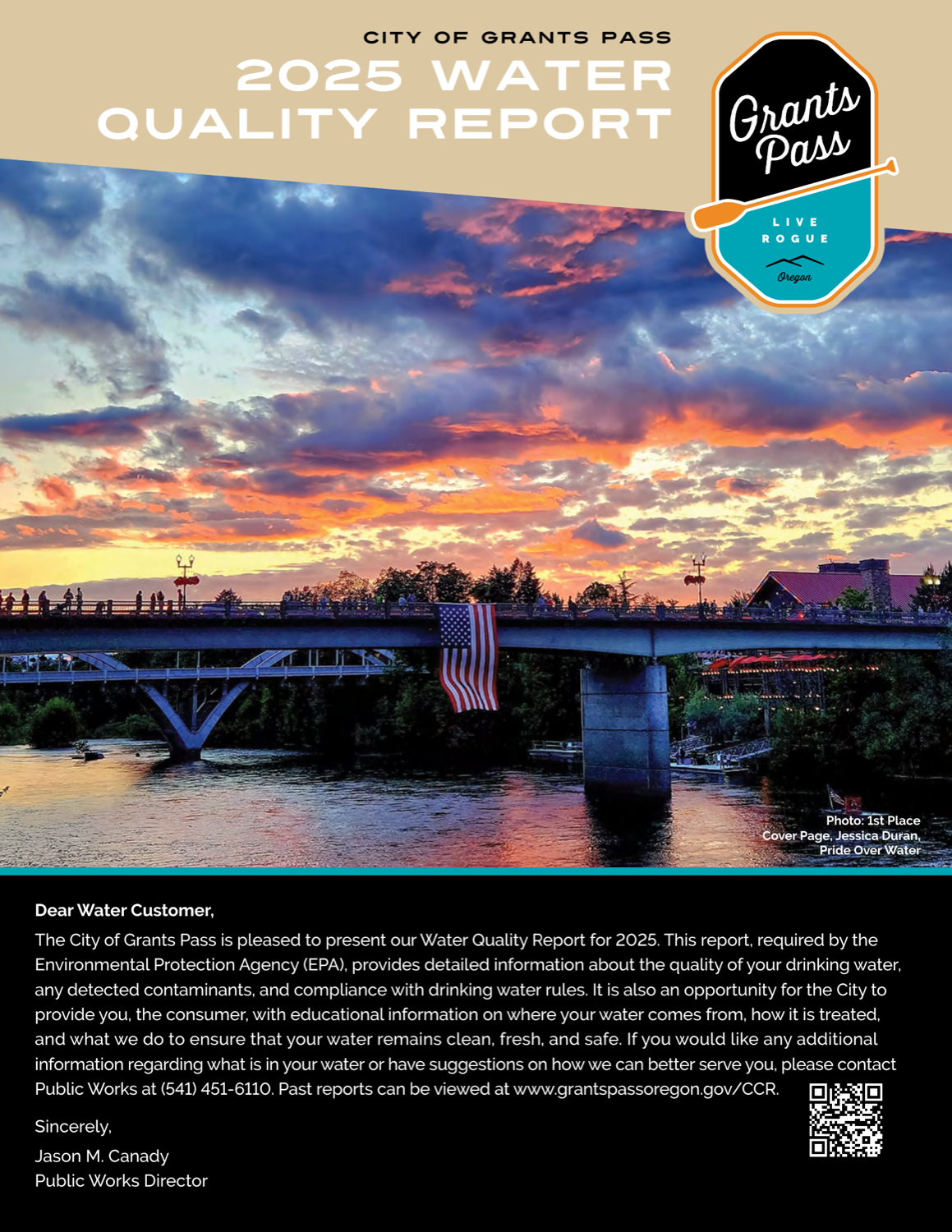
- •Resident photo-contest art direction — the first-place photo runs across the full width of the cover, the second-place photo on page 2.
- •A monthly-usage bar chart with a temperature color band.
San Francisco Public Utilities Commission
San Francisco, CA · PDF report
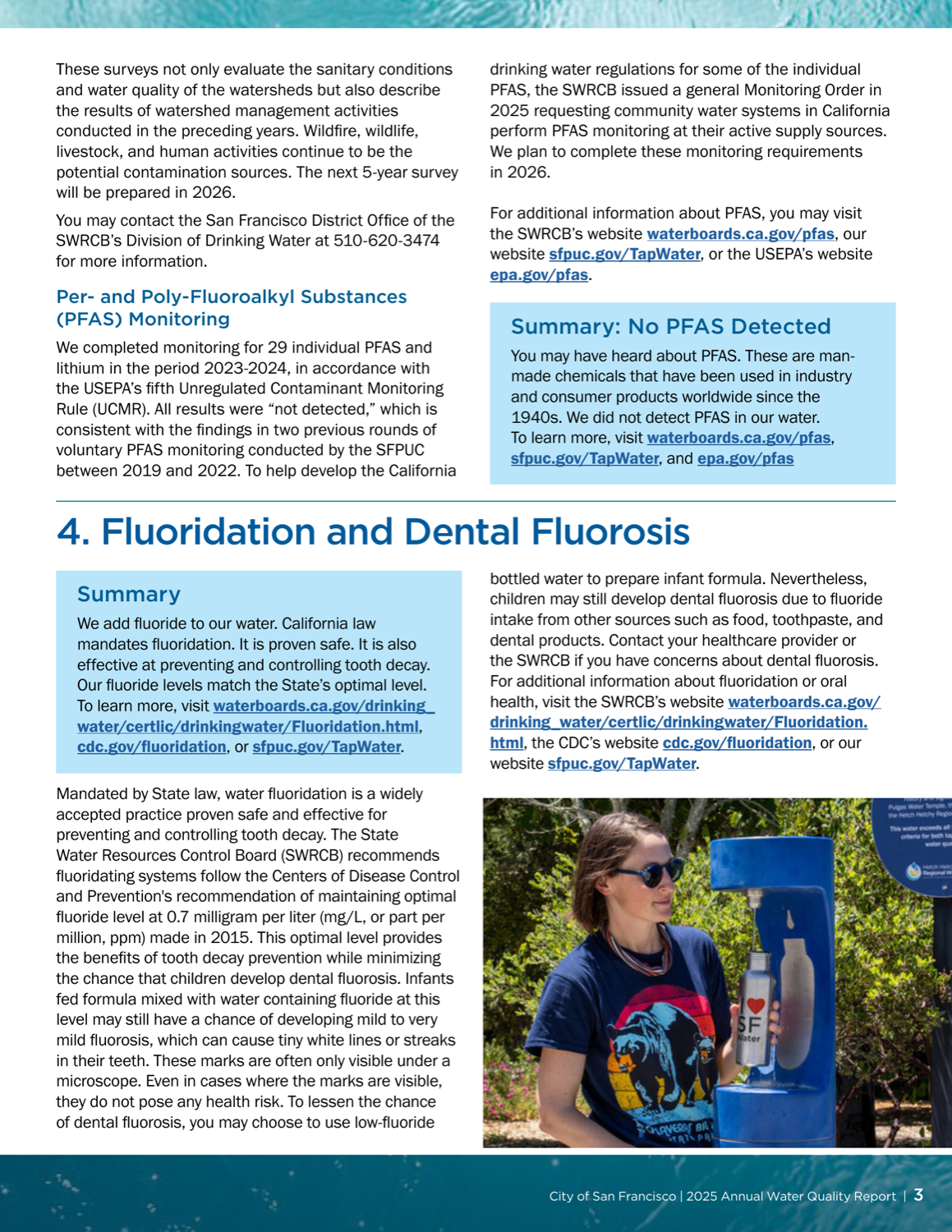
- •Plain-language 'Summary' boxes in five of its seven numbered sections.
- •Discloses a turbidity monitoring lapse in honest, plain English.
WSSC Water
Laurel, MD · PDF report
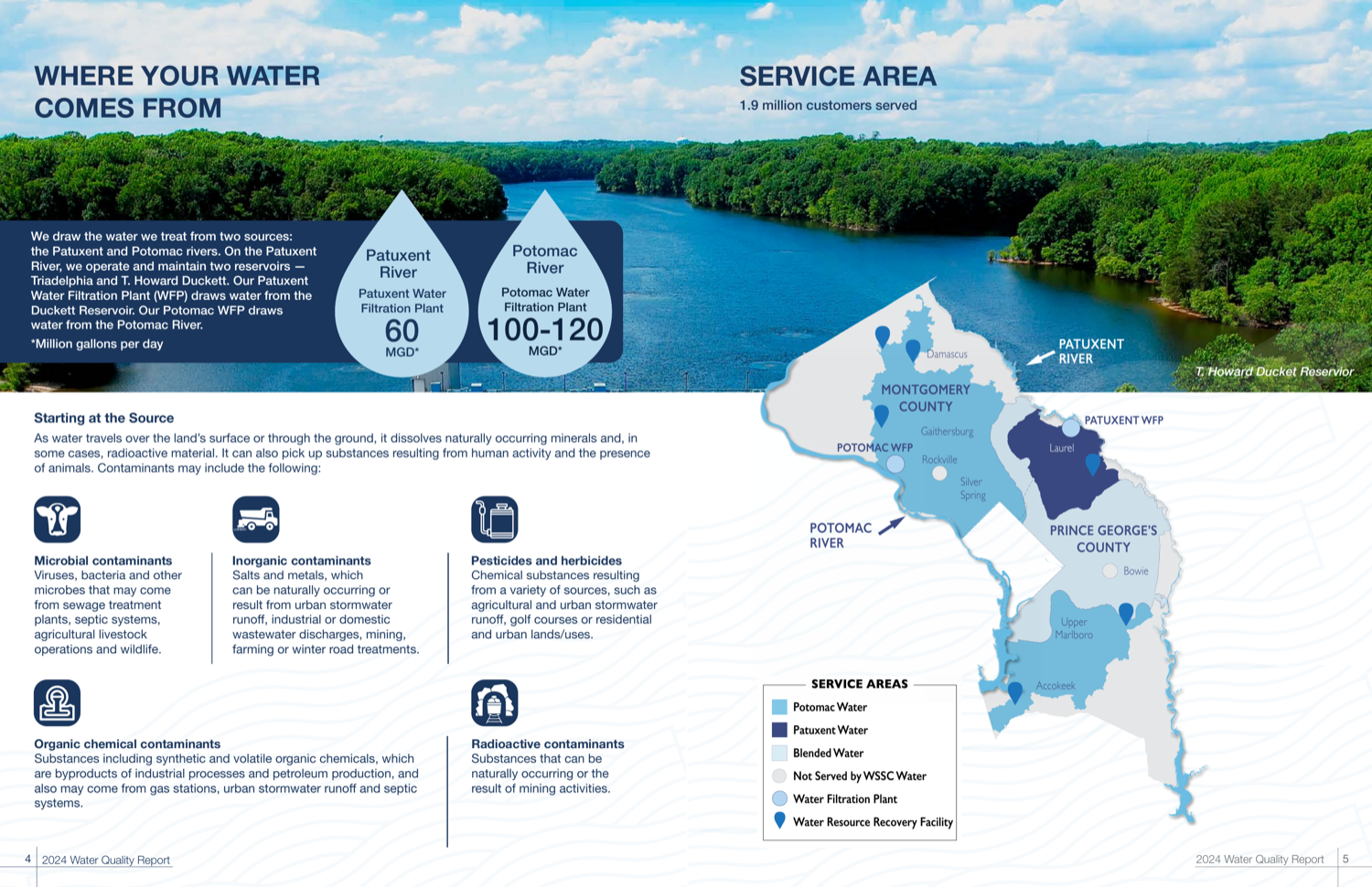
- •Corporate-magazine spreads with water-drop stat callouts and a custom service map of Potomac, Patuxent and blended water.
- •Voluntary PFAS testing since 2020, monthly since September 2022, with detected values shown against the limits.
East Bay Municipal Utility District
Oakland, CA · PDF report
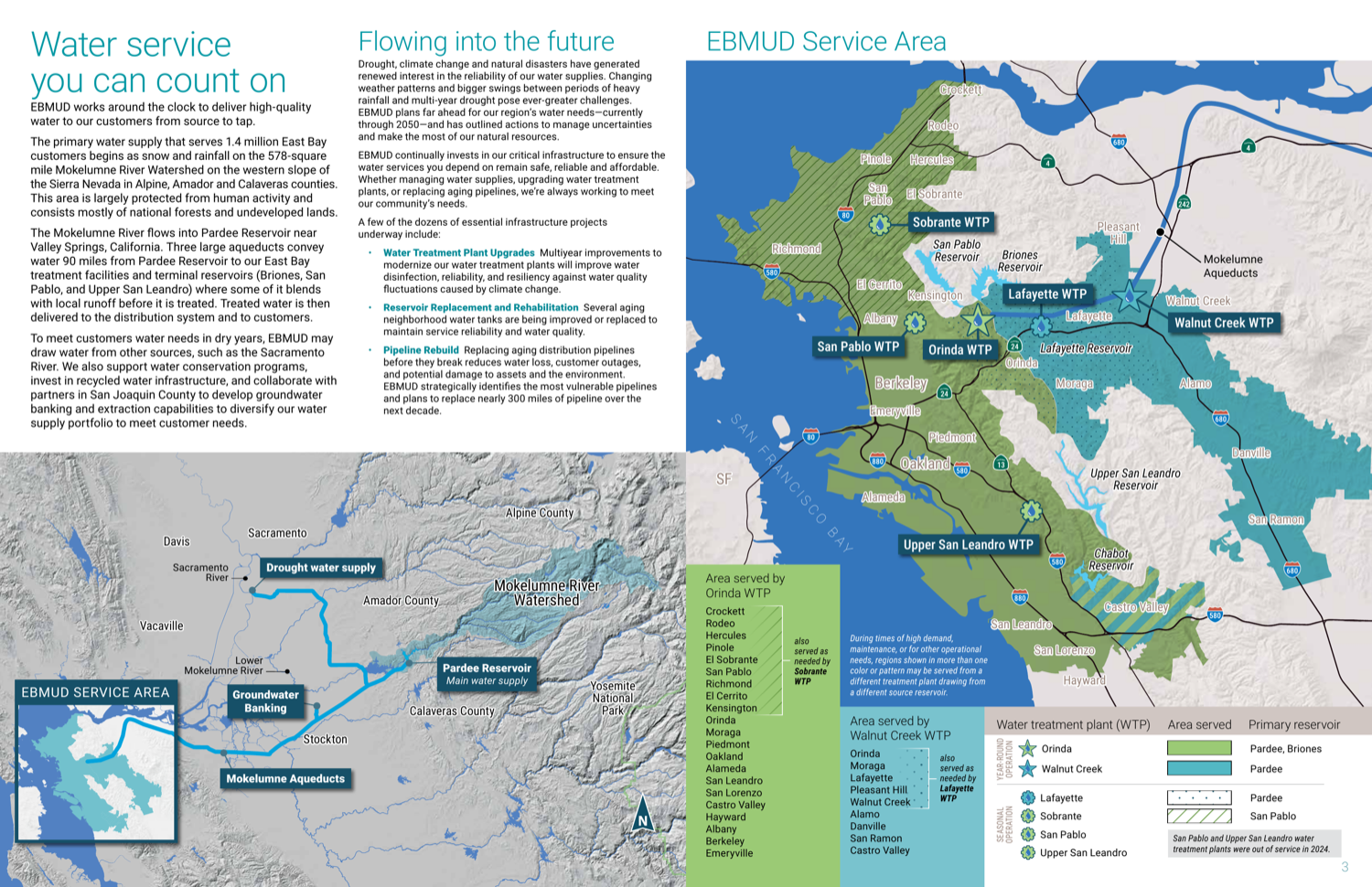
- •The smartest table architecture in the cohort: a four-table taxonomy (health / aesthetics / unregulated / customer-interest) keyed to a color-coded service map.
- •A numbered six-step 'how to read the tables' walkthrough with an annotated sample.
What a report that respects you looks like
The best reports share the same handful of moves: they chart contaminants against the limits instead of burying them in a table, they show trends over years, they translate every term, and they disclose their own bad news in plain language. Once you know what to look for, you can judge any utility's report in a few minutes.
How to read your water quality reportWhat even the best report can't tell you
Every report on this list describes the water leaving the treatment plant and moving through the mains. None of them can see your building's plumbing, which is where lead usually enters. Look up your own utility to see what it reports, and if your water shows lead, PFAS, or disinfection byproducts, we can help you match a filter to it.
Recognized? Display your badge
Every honoree has a free, static badge that links back to its scorecard. Open your utility's page to copy it.
Philadelphia Water Department, display your badge
Free to use. Both versions link back to this page so residents can see how the report was scored. Paste either one where you list your recognitions; use the text link if your site strips images.
Independent and free. Displaying the badge does not affect rank. If any detail of your score is off, email hello@tapwaterdata.com and we will review the source and correct it.
We're scoring more utilities.
Get the next edition of the scorecard, plus what we learn reading water reports, in your inbox.
Free forever. Unsubscribe anytime. We never share your email.
Frequently asked questions
- Is this pay-to-play?
- No. No utility paid for placement, and displaying a badge is free and does not affect rank. TapWaterData earns affiliate revenue elsewhere on the site; that revenue is firewalled from this ranking.
- How did you score the reports?
- We read one published edition of each utility's water quality report page by page and scored it on five pillars — plain-language clarity, contaminant transparency, information design, digital accessibility, and timeliness — using an identical rubric. Each honoree's scorecard, and the also-reviewed list, names and links the edition we read. The full methodology and weights are published and dated.
- Why isn't my city's utility listed?
- We reviewed 25 utilities in this first edition, weighted toward larger systems and reports with a reputation for design. We are expanding the cohort; if your utility belongs in it, tell us.
- What is the EPA's 2027 CCR rule?
- The EPA's Consumer Confidence Report Rule revisions take effect January 1, 2027 and require reports to be more readable, delivered electronically, and more accessible. Our rubric rewards utilities already meeting that bar.
- Our utility was recognized — can we display the badge?
- Yes. Open your utility's page and copy the badge code, or the plain text link if your site strips images. It is free and links back to your scorecard. If any detail of your score is off, email hello@tapwaterdata.com and we will review the source and correct it.
Also reviewed in the 2026 cohort (15 more)
We read these reports too. They did not place among this year's honorees, most often because the data arrives as a dense table or a download rather than a report built to be read. We score on improvement, not blame, and welcome a second look as reports are updated.
- Austin Water — Austin, TX
Scored edition: Annual Water Quality Report 2025 (2025 data).
- Medford Water — Medford, OR
Scored edition: 2025 Consumer Confidence Report (2025 data).
- New York City DEP — New York, NY
Scored edition: New York City Drinking Water Supply and Quality Report 2024 (2024 data). By the time this ranking was published on June 13, 2026, New York City DEP had already published its New York City Drinking Water Supply and Quality Report 2025 (2025 data), which was not scored.
- Akron Water Supply — Akron, OH
Scored edition: 2025 Akron Water Supply Bureau Drinking Water Consumer Confidence Report (2025 data).
- City of Burlingame Water — Burlingame, CA
Scored edition: Burlingame 2024 Water Quality Report (2024 data). City of Burlingame Water has also published its Burlingame 2025 Water Quality Report (2025 data), which was not scored.
- City of Richmond — Richmond, TX
Scored edition: 2024 Water Quality Report (2024 data). City of Richmond has since published its 2025 Water Quality Report (2025 data), which was not scored.
- Seattle Public Utilities — Seattle, WA
Scored edition: 2024 Drinking Water Quality Report (2024 data). Seattle Public Utilities has also published its A Championship Season for Seattle: 2025 Drinking Water Quality Report (2025 data), which was not scored.
- LADWP — Los Angeles, CA
Scored edition: Drinking Water Quality Report 2024 (2024 data). LADWP has since published its Drinking Water Quality Report 2025 (2025 data), which was not scored.
- San Jose Water — San Jose, CA
Scored edition: 2024 Consumer Confidence Report (2024 data). San Jose Water has also published its 2025 Consumer Confidence Report (2025 data), which was not scored.
- Fayetteville PWC — Fayetteville, NC
Scored edition: Water Quality Report 2025 (2025 data).
- Louisville Water — Louisville, KY
Scored edition: 2024 Water Quality Report (2024 data). By the time this ranking was published on June 13, 2026, Louisville Water had already published its 2025 Water Quality Report (2025 data), which was not scored.
- San Diego Public Utilities — San Diego, CA
Scored edition: 2024 Annual Drinking Water Quality Report (2024 data). San Diego Public Utilities has since published its 2025 Annual Drinking Water Quality Report (2025 data), which was not scored.
- City of Redmond — Redmond, OR
Scored edition: Water Quality Report 2024 (2024 data). City of Redmond has also published its Annual Water Quality Report, Reporting Year 2025 (2025 data), which was not scored.
- Massachusetts Water Resources Authority — Boston, MA
Scored edition: 2024 Drinking Water Test Results (2024 data). Massachusetts Water Resources Authority has also published its 2025 Drinking Water Test Results (2025 data), which was not scored.
- Honolulu Board of Water Supply — Honolulu, HI
Scored edition: 2025 BWS Water Quality Report (2024 data). Honolulu Board of Water Supply has also published its BWS Water Quality Report, June 2026 (2025 data), which was not scored.
Independence. No utility paid for placement and displaying a badge is free and does not affect rank. TapWaterData earns affiliate revenue from filter recommendations elsewhere on this site; that revenue is firewalled from this ranking, which judges utilities and recommends no products.
Corrections. Scores are drawn from each utility's own published report and public EPA data. If a utility believes a detail is wrong, it can email hello@tapwaterdata.com; we review the source, correct it, and date the change in the corrections log. Methodology version 2026.1, published June 13, 2026.
Get the Weekly Water Brief
One email a week on water testing, treatment, and what water-quality data means for your home.
One email a week. Unsubscribe anytime.