Greenville Water
Greenville, South Carolina
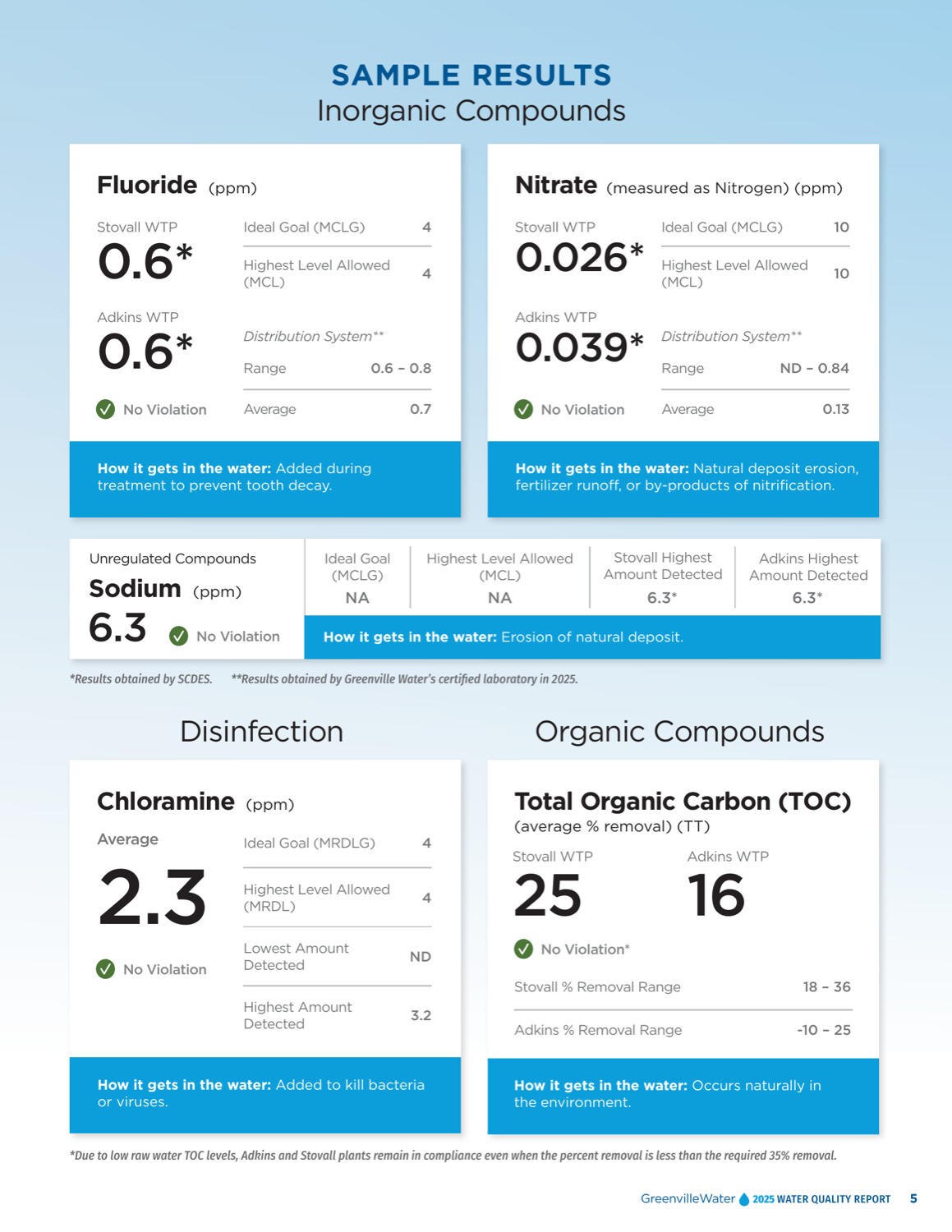
Greenville throws out the regulatory table and rebuilds each contaminant as a plain-language card — the result and how it gets in the water, with the goal and limit on most cards. It is the most readable report in the cohort. The trade-off is breadth: its results cover 11 contaminants, and PFAS appears only as a paragraph saying none of the 29 PFAS chemicals or lithium were detected.
Scored edition: 2025 Water Quality Report (2025 data).
- Corrected September 13, 2026: Each scorecard now names and links the exact report edition we scored, and notes any newer edition the utility has published. Some report links had pointed to pages that have since moved on to a newer edition.
- Corrected September 13, 2026: The scorecard said every contaminant card shows the value, the goal and the limit, that no other report dares to drop the regulatory table, and that the card format surfaces fewer contaminants than a full table would. Some cards carry no goal or limit; the comparison with other reports is withdrawn; and the report does not indicate that results were left out — it reports 11 contaminants and states that none of the 29 PFAS chemicals or lithium were detected. Its transparency score is reviewed in a separate entry.
- Corrected September 13, 2026: Greenville Water's transparency score changed from 3 to 4 (74 to 79/100; still Silver, still #6). The lower score rested on the claim that its cards leave out contaminants a full table would show, which the report does not support. It shows lead and copper against the action level and reports its PFAS testing as a not-detected statement, the pattern of other reports scored 4.
What their report looks like
How it scored, pillar by pillar
Weighted across five pillars for a 79/100 overall. Each note explains why this report earned that score.
Plain-language clarity25% of score
The most readable in the cohort — it relabels MCLG/MCL as “Ideal Goal” and “Highest Level Allowed” and uses hot-tub, Olympic-pool, and six-acre-lake analogies for the units.
A 5/5 looks like: Every term is translated, units are made tangible (e.g. an Olympic-pool analogy), and each section opens with what it means for you.
Contaminant transparency25% of score
Shows lead and copper against the action level — including one household above it, with a note that a repeat sample came back below — but its PFAS testing appears only as a paragraph saying none of the 29 PFAS chemicals or lithium were detected.
A 5/5 looks like: PFAS, lead and any exceedances are shown with real values against the limits, and problems are disclosed plainly rather than buried.
Information design20% of score
The strongest pure information design here — every contaminant is a big-number card showing the result and how it enters the water, and most also show the goal and the limit.
A 5/5 looks like: Contaminant data is visually encoded — charts against limits, multi-year trends, comparisons a layperson reads at a glance.
Digital accessibility & delivery20% of score
Delivered as a PDF with no responsive web-native version.
A 5/5 looks like: A responsive web-native report with navigation, charts, and an address lookup — not just a PDF.
Timeliness & completeness10% of score
Results for 11 contaminants, with its PFAS and lithium sampling summarized as none detected.
A 5/5 looks like: The most recent data year, with a complete contaminant panel including unregulated/emerging compounds.
marks the cohort average across all 25 reviewed reports.
What it does best
- Abandons the regulatory table entirely: every contaminant is a big-number card showing the result and how it gets in the water, most with the goal and limit.
- Relabels MCLG/MCL as 'Ideal Goal' and 'Highest Level Allowed' so a layperson can read it.
- Illustrated hot-tub / Olympic-pool / six-acre-lake analogies for the units.
Where it falls short
The card format is the most readable in the cohort, but its results cover 11 contaminants, and its PFAS testing appears only as a not-detected paragraph.
How it compares
Greenville Water's report ranks #6 of 25 reviewed utilities, with a report-clarity score of 79/100 against a cohort median of 69. That places it in the top 24%.
See the full leaderboardWhat even this report can't tell you
A report describes the water leaving the plant, not what reaches your tap — your building's plumbing is where lead usually enters.
See Greenville's water data
Greenville Water, display your badge
Free to use. Both versions link back to this page so residents can see how the report was scored. Paste either one where you list your recognitions; use the text link if your site strips images.
Independent and free. Displaying the badge does not affect rank. If any detail of your score is off, email hello@tapwaterdata.com and we will review the source and correct it.
Get the Weekly Water Brief
One email a week on water testing, treatment, and what water-quality data means for your home.
One email a week. Unsubscribe anytime.