Philadelphia Water Department
Philadelphia, Pennsylvania
Philadelphia is the only report in the cohort that is at once a magazine-grade publication and a designed, interactive website — it sets the ceiling for what a water quality report can be. It prints its own bad news instead of burying it — a PFOA running annual average of 7.3 ppt, above the 4 ppt federal limit the report says applies from 2029 — and pictures ppm, ppb and ppt with an Olympic-pool comparison. It gives up half a point only on timeliness: its lead and copper results date from 2022, and the report notes that testing is done every 3 years.
Scored edition: 2024 Drinking Water Quality Report (2024 data). Philadelphia Water Department has since published its 2025 Drinking Water Quality Report (2025 data), which was not scored.
- Corrected September 13, 2026: Each scorecard now names and links the exact report edition we scored, and notes any newer edition the utility has published. Some report links had pointed to pages that have since moved on to a newer edition.
- Corrected September 13, 2026: The scorecard said the report charts its highest PFOA result against the EPA's 4 ppt limit; its PFAS chart plots running averages against the state limits, and the 7.3 ppt figure sits beside the EPA's 4 ppt limit — which the report says applies from 2029 — in the data table. It also said every term and unit is translated, each chapter opens with what the data means for you, contaminants are visually encoded in multi-year trends, the address lookup maps each home to one of three plants, and a glossary closes the report. The report defines its terms in a glossary that comes before the data tables and pictures ppm, ppb and ppt; four of its charts carry a 'What this means for you' note; lead is its only multi-year chart; and some areas receive water from a mix of plants. The half point it loses on timeliness is its lead and copper results, last tested in 2022. Scores are unchanged.
- Corrected September 13, 2026: Scores reviewed after these corrections and kept: Denver Water's transparency (5), because its 2026 report shows lead and PFAS results against the limits and explains its missed monitoring requirement plainly; San Francisco's transparency (4), matching other reports that give PFAS as a not-detected statement; Tucson Water's digital accessibility (2), the score every PDF-only report received; and Philadelphia's clarity (5). East Bay MUD's score is for the 2024-data report that was read, which its scorecard notes had already been replaced when the ranking was published.
What their report looks like
How it scored, pillar by pillar
Weighted across five pillars for a 99/100 overall. Each note explains why this report earned that score.
Plain-language clarity25% of score
A glossary defines the report's regulatory terms and the units are made tangible — an Olympic-pool analogy turns ppm/ppb/ppt into something physical — and its PFAS, turbidity, residual-chlorine and lead charts each carry a 'What this means for you' note.
A 5/5 looks like: Every term is translated, units are made tangible (e.g. an Olympic-pool analogy), and each section opens with what it means for you.
Contaminant transparency25% of score
It shows the numbers including the bad news: its PFAS table prints a PFOA running annual average as high as 7.3 ppt beside the EPA's 4 ppt limit, which the report says applies from 2029, and lead is shown as a 2016–2022 trend against the federal action line.
A 5/5 looks like: PFAS, lead and any exceedances are shown with real values against the limits, and problems are disclosed plainly rather than buried.
Information design20% of score
Key results are drawn against their limits — PFOA and PFOS, turbidity, residual chlorine, and a 2016–2022 lead chart — alongside a scroll-linked watershed map; the remaining results sit in data tables.
A 5/5 looks like: Contaminant data is visually encoded — charts against limits, multi-year trends, comparisons a layperson reads at a glance.
Digital accessibility & delivery20% of score
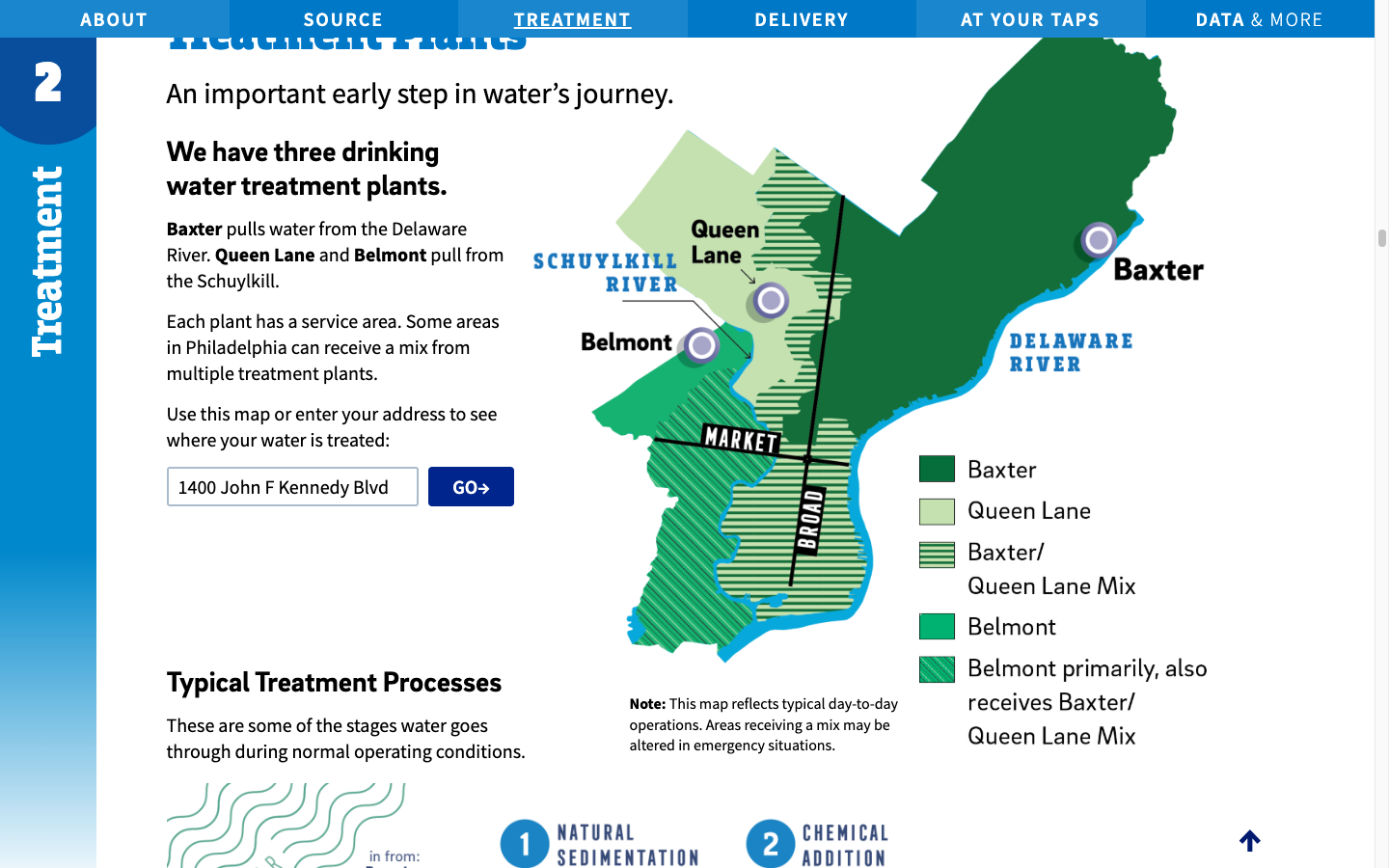
A true responsive, web-native microsite — a four-chapter narrative with navigation and an address lookup that shows which treatment plant, or mix of plants, serves your area — not a PDF.
A 5/5 looks like: A responsive web-native report with navigation, charts, and an address lookup — not just a PDF.
Timeliness & completeness10% of score
A broad panel including PFAS and emerging compounds; just short of perfect because its lead and copper results date from 2022 (the report notes testing is done every 3 years).
A 5/5 looks like: The most recent data year, with a complete contaminant panel including unregulated/emerging compounds.
marks the cohort average across all 25 reviewed reports.
What it does best
- A true interactive microsite, not a PDF — a four-chapter water-journey narrative with a scroll-linked watershed map.
- An address lookup that shows which treatment plant — or mix of plants — serves your area, on a color-coded service-area map.
- PFAS charted against the state limits, with a PFOA running annual average as high as 7.3 ppt printed beside the EPA's 4 ppt limit, which the report says applies from 2029.
- A multi-year lead trend (2016–2022) with the federal action line drawn on it, plus an Olympic-pool analogy for ppm/ppb/ppt.
Where it falls short
Even the strongest report in the country still carries a text-heavy glossary, and the data tables — while excellent — remain the densest part of the document.
How it compares
Philadelphia Water Department's report ranks #1 of 25 reviewed utilities, with a report-clarity score of 99/100 against a cohort median of 69. No report in the cohort scored higher.
See the full leaderboardWhat even this report can't tell you
A report describes the water leaving the plant, not what reaches your tap — your building's plumbing is where lead usually enters.
See Philadelphia's water data
Philadelphia Water Department, display your badge
Free to use. Both versions link back to this page so residents can see how the report was scored. Paste either one where you list your recognitions; use the text link if your site strips images.
Independent and free. Displaying the badge does not affect rank. If any detail of your score is off, email hello@tapwaterdata.com and we will review the source and correct it.
Get the Weekly Water Brief
One email a week on water testing, treatment, and what water-quality data means for your home.
One email a week. Unsubscribe anytime.