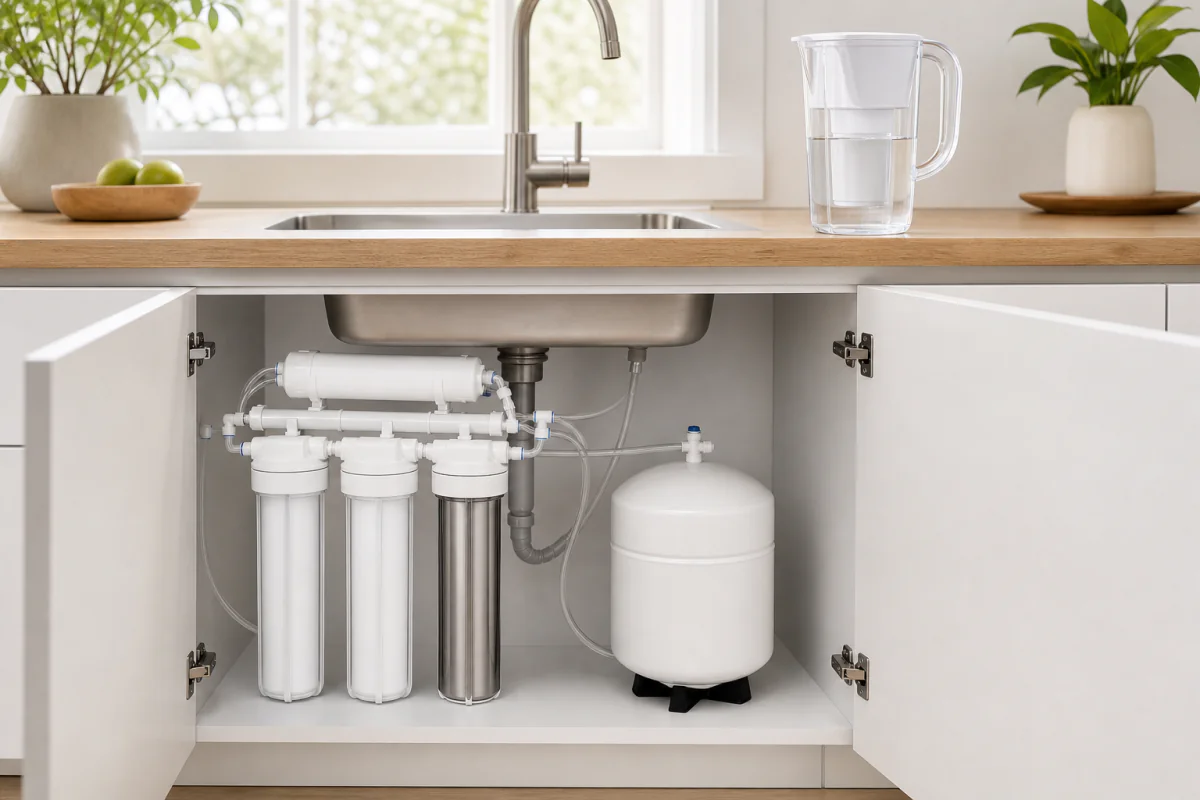
Reverse osmosis removes essentially all microplastics — more than 99% — because its membrane pore size is about 0.0001 µm, thousands of times finer than the smallest microplastic particle (NSF; research report, 2026). A sub-micron carbon-block filter rated at 0.5–1 µm captures nearly all of the microplastic-sized fraction. A standard loose-media pitcher is unreliable for the smallest particles, and boiling removes none of them (WHO, 2019; research report, 2026). So the honest answer to "which filter removes microplastics" isn't a brand — it's a pore size, and two technologies clear the bar.
That distinction matters because "removes microplastics" is one of the most-marketed and least-certified claims in the filter aisle. Microplastics reduction can be independently certified — under NSF/ANSI 401, which verifies a ≥85% reduction of 0.5–1-µm particles (WC&P, 2022; NSF). But very few consumer filters actually carry that listing, so most "removes microplastics" language on a box rests on the manufacturer's own in-house testing, not a third party's. Knowing the difference between a physical pore size, a third-party certification, and a marketing claim is the whole decision — and it's what keeps you from overpaying for a filter that isn't verified to do the one job you bought it for.
This guide covers the physics of particle size versus pore size, what each filter type actually does, the certification truth behind the marketing, and how to choose by your own situation. It is a decision guide, not a catalog — when you're ready to compare specific products and prices, our microplastics filter comparison lists the picks side by side.
✅ How to filter microplastics — the short version:
- Reverse osmosis is the most complete removal. Its ~0.0001-µm membrane is thousands of times finer than the smallest microplastic, so it removes essentially all of them (>99%) — the only home technology that reliably reaches nanoplastic scale (NSF; research report, 2026).
- Sub-micron carbon block catches nearly all the microplastic-sized fraction. Filters rated 0.5–1 µm physically block particles at that size, without the wastewater or plumbing of RO (research report, 2026).
- Standard loose-media pitchers are unreliable for the smallest particles. Coarse granular carbon may trap larger pieces but lets the finest through; boiling removes none at all (WHO, 2019).
- The certification to look for is NSF/ANSI 401 — not NSF/ANSI 244. NSF/ANSI 401 verifies ≥85% reduction of 0.5–1-µm particles as an emerging-contaminant claim; NSF/ANSI 244 is a microbial standard, not a microplastics one (WC&P, 2022; ANSI, 2019).
- Most "removes microplastics" claims are manufacturer-tested. Very few consumer filters carry the NSF/ANSI 401 microplastics claim, so match the physics (sub-micron or RO) first and treat uncertified claims as unverified (research report, 2026).
Compare specific microplastics filters side by side — pitcher, under-sink, and reverse osmosis picks with prices and specs.
You might be wondering whether a guide that keeps pointing at reverse osmosis is just a setup to sell you the priciest system. Here's the honest version: for a renter on chlorinated city water who mainly wants microplastic-sized particles out of drinking water, a sub-micron carbon-block pitcher does the job at a fraction of RO's cost and hassle — no plumbing, no wastewater. Our comparison table below deliberately includes a whole-house filter and a gravity countertop unit that we earn nothing on, and it flags every product where the microplastics claim is manufacturer testing rather than an NSF/ANSI 401 certification. The recommendation depends on your water and your household, not on what pays the most.
Why does particle size decide which filter works?
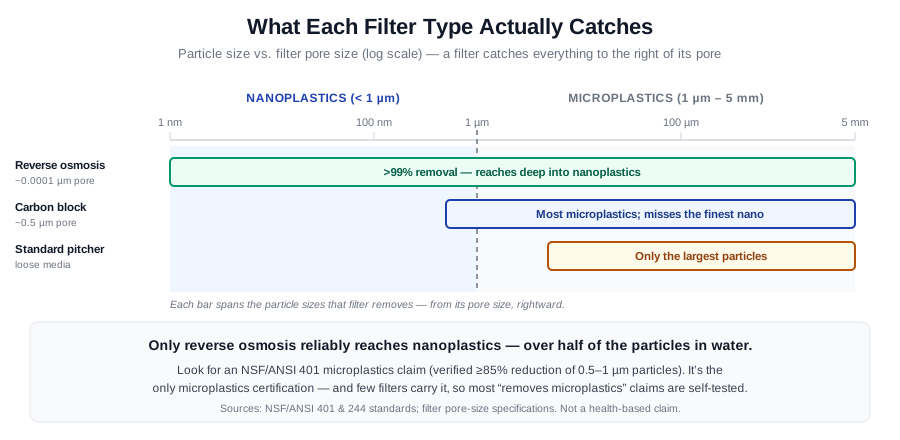
Microplastics are a size problem before they are a chemistry problem, so a filter's pore size — how small a particle it physically blocks — is the property that matters. The paired study behind this week's research measured particles across a range of 300 nm to 42.3 µm, and found that more than half of all particles detected were nanoplastics, the sub-micron fraction (Hart & Lenhart, Science of the Total Environment, 2025). A filter that stops 10-µm particles but lets 500-nm particles through is missing most of what's actually there.
That is why pore size, not media type or brand, is the honest specification to shop on. A reverse osmosis membrane has an effective pore size of roughly 0.0001 µm — small enough to reject dissolved salts, which are far tinier than any plastic particle — so microplastics are simply too large to pass (NSF; research report, 2026). A sub-micron carbon block rated at 0.5–1 µm physically strains particles at that size and larger, capturing the microplastic-sized fraction and much of the coarser nanoplastic range. A standard loose-granular pitcher has no tight, uniform pore structure at all; it relies on adsorption to a carbon bed, which is unreliable for the smallest particles.
One thing pore size does not fix: boiling. Microplastics are solid particles, not volatile chemicals, so heat does not remove them from the water (WHO, 2019; research report, 2026). If a method doesn't physically separate particles by size or trap them on a membrane, it isn't reducing microplastics — it's just heating them.
What does each filter type actually remove?
Reverse osmosis is the most complete option and the only one that reliably reaches nanoplastic scale. Because the membrane pore size (~0.0001 µm) is thousands of times smaller than the smallest microplastic, RO removes essentially all of them — >99% — along with dissolved contaminants like arsenic, nitrate, and most PFAS that carbon can't touch (research report, 2026). The trade-offs are real: RO needs under-sink installation, produces a few gallons of reject water per gallon filtered, and refills a storage tank slowly. If your goal is maximum removal and you own the tap you're installing it on, it's the technology that fits.
Sub-micron carbon block and hollow-fiber filters are the strong no-plumbing middle. A block rated at 0.5–1 µm physically captures nearly all microplastic-sized particles while its activated carbon handles chlorine, taste, and some chemical contaminants (research report, 2026). These come as pitchers, countertop units, and under-sink cartridges, so a renter or a budget-minded buyer can get strong microplastic removal without RO's installation or wastewater. What they don't do is reach the smallest nanoplastics as completely as RO, and they don't remove dissolved salts.
Standard pitchers and whole-house sediment filters each solve a narrower slice. A standard loose-media pitcher — the basic granular-carbon kind — may trap larger microplastic pieces but is unreliable for the finest particles, so it's a weak choice if microplastics are your specific concern. A whole-house filter with a sediment stage catches the coarse fraction across every tap and shower, which addresses exposure beyond drinking water, but its typical 5-µm sediment rating misses the smallest particles — so it's best paired with a point-of-use sub-micron or RO filter for the water you actually drink.
A gravity countertop unit sits between these: it needs no plumbing and uses a sub-micron media bed, so it captures the larger fraction well, but its microplastics performance rests on manufacturer and independent lab testing rather than an NSF listing, and gravity flow is slow. The practical read is that no single format is "best" — RO is most complete, a sub-micron pitcher is the easiest strong option, and whole-house and countertop units cover situations the others don't. The table below maps the split.
| Filter type | Typical pore size | Microplastic removal | NSF/ANSI 401 microplastics claim? | Typical cost |
|---|---|---|---|---|
| Reverse osmosis (under-sink) | ~0.0001 µm | >99% (essentially all, incl. nanoplastics) | Not on most consumer units; RO is NSF/ANSI 58 | ~$200–$400 + ~$55/yr filters |
| Sub-micron carbon block (under-sink) | ~0.5 µm | Nearly all microplastic-sized particles | Rare; some units NSF/ANSI 401 for other emerging contaminants | ~$150–$250 + ~$130/yr filters |
| Sub-micron carbon block (pitcher) | ~0.5–1 µm | Nearly all; less complete at nanoplastic scale | Very few carry it; most are manufacturer-tested | ~$40–$100 + ~$60–$90/yr filters |
| Hollow-fiber membrane (pitcher) | ~0.5–1 µm | Nearly all microplastic-sized particles | Very few carry it; most are manufacturer-tested | ~$45–$75 + ~$70/yr filters |
| Gravity countertop (sub-micron media) | Sub-micron | Manufacturer-tested; strong for larger fraction | No NSF listing on typical units (independent testing) | ~$200–$330 + ~$15/yr filters |
| Whole-house (sediment + carbon) | ~5 µm sediment | Coarse fraction only; misses smallest | No microplastics certification | ~$800+ + ~$40/yr filters |
| Standard loose-media pitcher | Coarse (no tight pore) | Unreliable for smallest particles | No | ~$25–$40 + ~$40/yr filters |
| Boiling (for comparison) | N/A | None — heat doesn't remove particles | N/A | N/A |
| Bottom line | Match pore size to particle size | RO for all; sub-micron for nearly all | NSF/ANSI 401 exists but is rarely carried | $25–$800+ |
Sources: pore-size and removal figures from the Week 16 research report (verified 2026-07-10), which draws on NSF filter physics, WHO (2019), and Hart & Lenhart (2025); NSF/ANSI 401 microplastics claim from WC&P (2022) and NSF; representative price and filter-cost ranges from our microplastics filter comparison (2026). How we compiled this: our data and methodology.
What does "removes microplastics" actually certify?
Here is the part the marketing skips: microplastics reduction can be independently certified, but the standard is NSF/ANSI 401, not the one you'll often see cited. NSF/ANSI 401 covers "emerging and incidental contaminants," and in 2022 a microplastics claim was added to it — a verified ≥85% reduction of 0.5–1-µm particles, tested by NSF, IAPMO, or WQA (WC&P, 2022; NSF). It is an emerging-contaminant claim, deliberately not a health claim, because the health evidence on microplastics is still association rather than proof (WHO, 2019).
Two cautions keep this honest. First, NSF/ANSI 244 is not the microplastics standard — it is a supplemental microbiological filtration standard for bacteria, viruses, and cysts (ANSI, 2019). You will see NSF/ANSI 244 described as "the microplastics standard" in places, including on some product pages; that is a factual error. The microplastics claim lives on NSF/ANSI 401. Second, very few consumer filters actually carry the NSF/ANSI 401 microplastics claim, so most "removes microplastics" language you'll read is the manufacturer's own testing, not a third party's (research report, 2026).
That doesn't make manufacturer testing worthless — a sub-micron carbon block with a credible in-house particle-reduction test is still physically capturing microplastic-sized particles by pore size. It does mean you should read the claim precisely. If a product page shows an NSF/ANSI 401 listing with a microplastics claim, that's third-party verified. If it says "removes 99.9% of microplastics" with no certifier named, that's a manufacturer figure — often accurate for the physics, but unverified. The same logic applies to any filter cert: the certification is a verified reduction to a threshold, not a health guarantee, a point we cover in full in do filter certifications match the EPA health goal?.
How do I choose a microplastics filter for my situation?
The right filter depends on how much you want removed, whether you can install one, and what you'll spend — so match the scenario, not a universal "best."
- If you rent or want the lowest cost: a sub-micron carbon-block or hollow-fiber pitcher needs no plumbing and captures nearly all microplastic-sized particles at 0.5–1 µm. It's the sensible starting point for most households whose only concern is microplastics in drinking water (research report, 2026).
- If you want maximum removal and own your home: an under-sink reverse osmosis system removes essentially all microplastics, including nanoplastics, plus dissolved contaminants a pitcher can't reach. Accept the installation and the reject-water trade-off in exchange for the most complete result (research report, 2026). See our under-sink filter overview and reverse osmosis overview for how those installs work.
- If your water also has arsenic, nitrate, or PFAS: reverse osmosis is the technology that covers those and microplastics in one system; a carbon pitcher won't reduce dissolved arsenic or nitrate. Check your utility's report first — look up your city — so you're buying for what's actually in your water.
- If you're worried about shower and whole-home exposure: a whole-house sediment-plus-carbon stage handles the coarse fraction at every tap, but its ~5-µm rating misses the smallest particles — pair it with a point-of-use sub-micron or RO filter for drinking water (research report, 2026).
- If a product only claims "removes microplastics" with no certifier named: treat it as manufacturer-tested. It may still work by pore size, but confirm the sub-micron or RO rating rather than trusting the headline percentage.
The through-line: buy to the pore size that matches the particle size you care about, confirm any certification claim on the certifier's listing, and don't pay for RO if a sub-micron pitcher answers your actual question.
Not sure what else is in your water? → Look up your city's latest report before you buy, so you match the filter to what's actually there — not just microplastics.
Reading this from a different angle?
- Want the science, not the shopping? Read are there microplastics in my tap water? — how much is really there, why the numbers disagree, and what the health evidence does and doesn't show.
- Weighing bottled water instead? Read bottled vs. tap water — bottled runs about 3× higher than treated tap by particle count, so switching to bottled isn't the fix it's sold as.
- Buying a filter for more than microplastics? Read choose a filter from your own water data and what "EPA approved" really means on a filter box.
- Want to verify a claim yourself? Compare specific picks and prices on our microplastics filter comparison.
Methodology and disclosure
This guide draws on the Week 16 microplastics research report (verified against primary sources on July 10, 2026), which is itself anchored in WHO's 2019 "Microplastics in drinking-water" assessment, the peer-reviewed Hart & Lenhart study (Science of the Total Environment, 2025) for the ~3×-by-count and 300 nm–42.3 µm figures, NSF and WC&P (2022) for the NSF/ANSI 401 microplastics claim (≥85% reduction, 0.5–1 µm), and the ANSI standard listing for NSF/ANSI 244 (microbiological, not microplastics). Pore-size and removal figures reflect filter physics as documented in that report. Disclosure. This comparison considered eight filter categories, including a whole-house system and a gravity countertop unit that TapWaterData does not earn commission on, and it flags every product whose microplastics claim is manufacturer testing rather than NSF/ANSI 401 certification. Recommendations are scored by our published methodology — 50% contaminant coverage, 30% Amazon rating, 20% affordability — independent of commission rate. Amazon and brand-direct links in our filter comparison are affiliate links that earn TapWaterData a commission at no additional cost to you. Full methodology: our data page.