
"EPA approved" is not a real designation, and "EPA registered" is almost as misleading. EPA states directly that "while EPA does not endorse specific units, the Agency does set and enforce national standards for the tap water provided by public water systems" (EPA, Filtration Facts, 2005). EPA regulates the water your utility delivers — more than 90 contaminants under enforceable national rules (EPA, n.d.) — but it does not review the pitcher, faucet, or under-sink unit you buy to clean that water further. There is no EPA stamp that means "this filter removes lead."
That distinction costs money and leaves a contaminant in your glass. If you buy a filter believing an "EPA" mark vouches for lead removal, you may have bought a unit certified only for taste and odor — or for nothing measurable. The label that does the work is a third-party certification to an NSF/ANSI standard: 42 for aesthetics, 53 for health-related contaminants like lead, 58 for reverse-osmosis systems, and 401 for emerging compounds (NSF, 2025).
This guide decodes the marks on a filter box: which ones verify contaminant removal, which ones verify nothing of the sort, and how to match the right certification to the contaminant in your own water. The fastest starting point is your tap — look up your city to see what your utility reports, then read the box against that.
✅ What "EPA approved" does — and doesn't — tell you about a filter:
- EPA does not approve or certify filters. EPA "does not endorse specific units"; its registration of a filter "is not an endorsement of the product or its performance" (EPA, Filtration Facts, 2005).
- An "EPA Establishment Number" is a pesticide-device label. It appears when a filter makes an antimicrobial claim (usually silver, to slow microbe growth inside the cartridge); it "does NOT … imply EPA product approval, registration, certification, or endorsement" (EPA, Pesticide Devices).
- FIFRA does not review devices before sale. Pesticide devices, including these filters, are not required to undergo premarket review or registration before being sold (EPA, Pesticide Devices).
- NSF/ANSI 53 is the health mark. It carries over 50 contaminant-reduction claims, including lead, Cryptosporidium, VOCs, and chromium (NSF, 2025); NSF/ANSI 42 covers only aesthetics like chlorine and taste/odor.
- PFAS reduction is now certified under 53 and 58. The old Protocol P473 was folded into those standards, and 2022 updates created a "Total PFAS" claim and lowered the combined PFAS limit from 70 ppt to 20 ppt (NSF, 2024).
See which NSF certification matches each contaminant, then pick a filter from your own water data — buy to the NSF cert that covers what's actually in your tap.
You might be wondering whether this is a setup to push you toward an expensive system. It is not. For many households on chlorinated city water with nothing flagged beyond taste and chlorine, a single NSF/ANSI 42 pitcher is the correct, cheapest answer. The point of this guide is the opposite of upselling: it's to stop a misleading label from selling you the wrong filter — and EPA's own words are the evidence.
What does "EPA approved" actually mean on a filter?
It means nothing official, because the designation does not exist. EPA sets enforceable national limits on the tap water your utility delivers — its drinking-water rules cover more than 90 contaminants (EPA, n.d.) — but those rules govern the utility's output, not the consumer filter you attach afterward. EPA is explicit: "While EPA does not endorse specific units, the Agency does set and enforce national standards for the tap water provided by public water systems" (EPA, Filtration Facts, 2005).
The closest real thing is an EPA registration, and EPA tells you outright not to read it as a quality signal. In the same guide, EPA writes that its registration "(unlike that of NSF, WQA, or UL) is not intended to guide consumers in selecting a water treatment device, and is not an endorsement of the product," and adds that "registration is not an endorsement of the filter or its performance" (EPA, Filtration Facts, 2005). Even when a filter is genuinely connected to EPA through a registration, EPA is the first to say that connection does not vouch for what the filter removes.
If you see "meets EPA standards" or a reference to an EPA drinking-water rule on a box, read it precisely. EPA's National Primary Drinking Water Regulations are "legally enforceable primary standards and treatment techniques that apply to public water systems" (EPA, n.d.) — they describe the water your utility must deliver, not a test the filter passed. A filter cannot "meet" a tap-water rule, because the rule isn't written about filters. So when a label leans on the letters "EPA," treat it as marketing until you find a separate third-party certification mark.
Why does a filter carry an "EPA Establishment Number" at all?
Because it makes an antimicrobial claim — and that pulls it into a different EPA program entirely. Under the Federal Insecticide, Fungicide, and Rodenticide Act (FIFRA), a water-treatment unit becomes a "pesticide device" when it claims to "kill, inactivate, or suppress growth of fungi, algae, bacteria, viruses, or cysts" (EPA, Pesticide Devices). The most common way a filter triggers this is by using silver — a bacteriostatic agent — to slow microbe growth inside the cartridge itself. That is a hygiene claim about the filter media, not a contaminant-removal claim about your water.
When a product is regulated as a FIFRA device, two things follow. First, "devices must be produced in an EPA-registered establishment," and the resulting EPA Establishment Number "must be visible on the outer packaging" (EPA, Pesticide Devices). Second — and this is the part the marketing leans on — EPA states that an "establishment number on device packaging does NOT indicate that the product has been reviewed for safety or efficacy by EPA, nor does it imply EPA product approval, registration, certification, or endorsement" (EPA, Pesticide Devices).
It's worth separating two numbers that look alike. A compliant device "will include an EPA Establishment Number on the label … It will not include an EPA Registration Number, which would only be found on registered pesticide products" (EPA, Pesticide Devices). An establishment number identifies where the device was made; a registration number (which these filters don't carry) identifies a reviewed pesticide product. Neither one tells you the filter reduces lead, arsenic, or PFAS.
The deeper reason the establishment number proves so little is structural. EPA notes that under FIFRA, devices are not required "to undergo premarket review and registration before being sold and distributed, as it does for pesticides" (EPA, Pesticide Devices). A filter can carry an EPA Establishment Number having never been tested by EPA for whether it removes a single regulated contaminant.
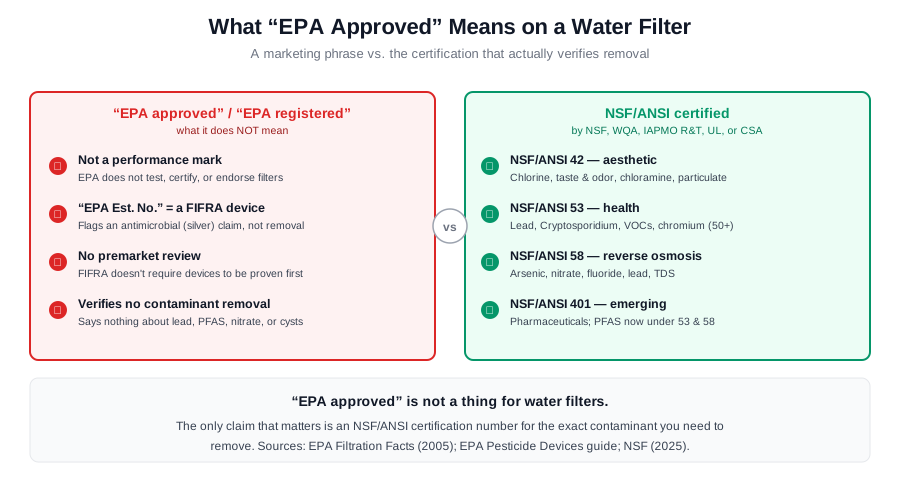
One useful corollary: a filter that limits its claims to taste, odor, or sediment and does not claim to purify water or mitigate microorganisms is "generally not considered pesticidal" under FIFRA (EPA, Pesticide Devices). So the presence or absence of an EPA Establishment Number tells you about a filter's antimicrobial marketing — not its contaminant performance.
Which mark actually verifies that a filter removes a contaminant?
A certification to an NSF/ANSI standard, issued by an independent accredited body. EPA itself points consumers here rather than to EPA: on its page identifying filters certified to reduce PFAS, the agency directs buyers to accredited third-party certifiers — NSF, WQA, IAPMO R&T, UL, and CSA Group — and notes plainly that "any mention of trade names, manufacturers or products does not imply an endorsement by … the U.S. Environmental Protection Agency" (EPA, 2024). The performance verification lives with the certifier, not the regulator.
The four NSF/ANSI standards split cleanly by what they promise. NSF/ANSI 42 covers aesthetic effects — non-health contaminants such as "chlorine, taste and odor, chloramine, particulate, iron, manganese, zinc, and total dissolved solids" (NSF, 2025). A pitcher certified only to NSF/ANSI 42 can make your water taste better without being verified to reduce a single health-related contaminant.
NSF/ANSI 53 is the health standard. It "offers over 50 contaminant reduction claims," with popular ones including "lead, Cryptosporidium, VOCs, and chromium" (NSF, 2025). This is the certification that matters most for the contaminant households worry about first — lead — and it's verified against a defined challenge, not a vague promise. NSF/ANSI 58 covers point-of-use reverse-osmosis systems; it requires a TDS-reduction claim and offers optional verified claims for "arsenic … nitrate/nitrite, fluoride, hexavalent and trivalent chromium, lead, cadmium, barium, copper, selenium, perchlorate, radium 226/228," and more (NSF, 2025). NSF/ANSI 401 addresses "up to 15" emerging compounds detected at trace levels, including prescription drugs, over-the-counter medications, herbicides, and pesticides (NSF, 2025).
The critical detail: a certification mark names a standard number and specific claims. "NSF certified" alone is weaker than "NSF/ANSI 53 certified for lead reduction," because a product can be certified to 42 (aesthetics) and still carry an "NSF" badge. Read for the number and the named contaminant, and confirm it on the certifier's public product listing — EPA notes consumers "can purchase filters that have been tested by an accredited third-party certification body" (EPA, 2024).
What does each mark you see on the box really tell you?
The table below maps the common label claims to what they actually certify, what they do not mean, and example contaminants involved. The pattern is consistent: marks with "EPA" in them verify regulatory scope or antimicrobial hygiene; the NSF/ANSI marks are the only ones that verify a filter reduces a named contaminant.
| Label / mark you see | What it actually certifies | What it does NOT mean | Example contaminants involved |
|---|---|---|---|
| "EPA approved" | Nothing — not a real EPA designation for filters (EPA, 2005) | That EPA tested, certified, or endorsed the filter for any removal | None verified |
| "EPA registered" | A registration EPA says is "not an endorsement of the product or its performance" (EPA, 2005) | A performance guarantee, or a selection guide for buyers | None verified |
| EPA Establishment Number | The device was made in an EPA-registered establishment (FIFRA device rule) (EPA, Pesticide Devices) | "EPA product approval, registration, certification, or endorsement" (EPA, Pesticide Devices) | Antimicrobial agent (commonly silver) inside the filter, not water contaminants |
| "Meets EPA standards" / EPA NPDWR | References a tap-water rule for utilities covering 90+ contaminants (EPA, n.d.) | That the filter itself passed a test — the rule governs utilities, not filters | None verified (utility-side rule) |
| NSF/ANSI 42 | Reduction of aesthetic, non-health contaminants (NSF, 2025) | Reduction of any health-related contaminant like lead | Chlorine, taste and odor, chloramine, particulate, iron, manganese, zinc, TDS |
| NSF/ANSI 53 | Reduction of health-related contaminants — over 50 claims (NSF, 2025) | Aesthetic-only certification; check the named claim | Lead, Cryptosporidium, VOCs, chromium |
| NSF/ANSI 58 | Point-of-use reverse-osmosis performance; required TDS claim + optional claims (NSF, 2025) | That a basic carbon filter does the same job | Arsenic, nitrate/nitrite, fluoride, lead, chromium, radium 226/228, perchlorate, TDS |
| NSF/ANSI 401 | Reduction of up to 15 emerging/trace compounds (NSF, 2025) | Coverage of regulated basics like lead unless also 53-certified | Prescription drugs, OTC medications, herbicides, pesticides |
| "Total PFAS" claim (under 53/58) | Verified PFAS reduction; combined limit lowered from 70 ppt to 20 ppt in 2022 (NSF, 2024) | A separate "P473" mark — P473 was retired into 53/58 | PFOA, PFOS, PFHpA, PFHxS, PFNA, PFBS |
| Summary: what verifies removal? | Only NSF/ANSI 42, 53, 58, or 401 with a named claim | Any mark containing "EPA" does not verify filter contaminant removal | Match the standard to your tap's contaminant |
Sources: EPA, Water Health Series: Filtration Facts (EPA 816-K-05-002, 2005); EPA, Pesticide Devices: A Guide for Consumers; EPA, How EPA Regulates Drinking Water Contaminants (n.d.); EPA, Identifying Drinking Water Filters Certified to Reduce PFAS (2024); NSF, NSF/ANSI 42, 53 and 401 and NSF/ANSI 58 standard summaries (2025); NSF, Forever Chemicals and the Advancement of Filtration Standards (2024). Row-selection method: our data and methodology.
How do you match the right certification to your water?
Start from what's actually in your tap, then pick the standard that names it — never the reverse. If your utility's report and your home situation point only to chlorine taste and odor, NSF/ANSI 42 is sufficient and cheapest (NSF, 2025). If lead is the concern — an older home, a lead or unknown service line, or a child in the household — the mark to require is NSF/ANSI 53 certified for lead reduction, because lead is one of its named health claims (NSF, 2025).
If your water carries contaminants that carbon doesn't remove, the standard shifts to reverse osmosis. NSF/ANSI 58 systems carry optional verified claims for arsenic, nitrate/nitrite, fluoride, chromium, perchlorate, and radium 226/228 (NSF, 2025) — contaminants more common in groundwater and private wells. This is where buying to the wrong standard fails quietly: a carbon pitcher certified to NSF/ANSI 53 will not reduce nitrate, and only an RO system verified under 58 addresses it.
PFAS deserve a specific note, because the certification history confuses buyers. NSF developed Protocol P473 in response to the EPA's 2016 70-ppt PFOA/PFOS health advisory; in 2017 those claims were incorporated into NSF/ANSI 53 (activated carbon and anion exchange) and NSF/ANSI 58 (reverse osmosis), and 2022 updates created a "Total PFAS" claim and lowered the combined PFAS limit from 70 ppt to 20 ppt (NSF, 2024). A current PFAS-reducing filter is certified under 53 or 58, not under the retired P473 — if a box still touts "P473," it's citing a standard that has been folded in.
Two scenarios cover most households. On chlorinated city water with nothing flagged beyond aesthetics, an NSF/ANSI 42 (or 42+53) pitcher or faucet filter is the right category. If your report or a lab test shows arsenic, nitrate, fluoride, or radium above non-zero detection, that's an NSF/ANSI 58 reverse-osmosis decision — and "EPA approved" on a carbon pitcher does nothing for any of them.
Why is the "EPA approved" label so common if it means so little?
Because it borrows authority the agency never granted, and the underlying EPA programs are easy to blur. EPA does set and enforce real national drinking-water standards covering more than 90 contaminants for public water systems (EPA, n.d.), so "EPA" reads as a safety authority to most shoppers. Marketing attaches that halo to a consumer product EPA never reviewed — and because EPA's review of the utility's water and its establishment-number role for antimicrobial devices both exist, the claim feels plausible without being true.
The establishment-number path is the most common source of confusion. A filter that uses silver to keep its media from growing bacteria genuinely earns an EPA Establishment Number under FIFRA's device rule — that part can be accurate. The leap happens when packaging implies the number signals contaminant removal, which EPA explicitly denies: the number does not "imply EPA product approval, registration, certification, or endorsement" (EPA, Pesticide Devices).
This is why EPA's own guidance is the most useful thing a skeptical buyer can carry. The agency tells you in writing that its registration "is not intended to guide consumers in selecting a water treatment device" (EPA, 2005) and points you to NSF, WQA, IAPMO R&T, UL, and CSA Group for performance certification (EPA, 2024). When the regulator says "don't use my mark to choose, use theirs," the buyer's job is to do exactly that.
The takeaway for reading a box: an "EPA" mark answers a question you didn't ask — was this made in a registered establishment? does the utility's water meet federal limits? The question you did ask — does this filter reduce the contaminant in my water? — is answered only by an NSF/ANSI 42, 53, 58, or 401 certification naming that contaminant.
💡 Pick a filter from your own data. Look up your city to see what your utility reports, then choose a filter from your own water data — match an NSF/ANSI certification to the contaminant you actually have, and skip anything that leads with "EPA approved." :::
Reading this from a different angle?
- Want the broad overview? Read who regulates your drinking water — EPA vs. FDA vs. state vs. utility.
- Worried about kids specifically? Read who actually protects your kid's drinking water.
- Want the upstream picture? Read what your water utility is responsible for, what happens at the treatment plant, and where US tap water comes from.
Sources and disclosure
This guide draws on EPA primary sources — the Water Health Series: Filtration Facts (EPA 816-K-05-002, 2005); Pesticide Devices: A Guide for Consumers; How EPA Regulates Drinking Water Contaminants (n.d.); and Identifying Drinking Water Filters Certified to Reduce PFAS (2024) — alongside the published NSF/ANSI 42, 53, 58, and 401 standard summaries from NSF (2025) and NSF's Forever Chemicals and the Advancement of Filtration Standards (2024).
Disclosure. This comparison considered filters across the NSF/ANSI 42, 53, 58, and 401 certification classes, including options TapWaterData does not earn commission on — for example, Multipure (sold brand-direct) and EPA's own published list of certified PFAS-reduction technologies. Recommendations are scored by our published methodology — 50% contaminant coverage, 30% Amazon rating, 20% affordability — independent of commission rate. Amazon and brand-direct links in this article are affiliate links that earn TapWaterData a commission at no additional cost to you. Specifications were pulled June 2026. More about our data and how we work.