Your annual water-quality report cannot tell you which filter to buy — because it measures the wrong place. Utilities sample most contaminants at the treatment plant or a system entry point, and lead at only a small set of representative homes, not your tap (EPA, 40 CFR 141.23; 141.86). A report can show everything in compliance while your specific faucet runs high on lead from your own service line. The report grades the system; the filter decision is about your water.
To pick a filter that isn't a waste of money, you need two things the report only half-answers: your source type (surface water or groundwater, which predicts which contaminants are even plausible) and your tap's actual contaminants (which often takes your own test). Those two inputs map to exactly one NSF/ANSI certification — and buying the wrong certification is how households end up with a $40 pitcher that can't touch their arsenic, or a $400 reverse-osmosis system they never needed.
This guide turns utility data into a filter decision: why the report falls short, what to find out first, what each NSF certification actually removes, and how source type points to a category and a realistic price. If you want your numbers in front of you, look up your city to see your source and most recent report, then compare filters by certification.
✅ How to turn your water data into a filter choice:
- Your water report can't name your filter. Utilities sample at the plant and a few representative homes, not your tap (EPA, 40 CFR 141.23; 141.86) — so the report describes the system, not what to install.
- Source type narrows the category. Surface-water cities usually need NSF/ANSI 53 carbon for lead and disinfection byproducts; groundwater cities often need NSF/ANSI 58 reverse osmosis for arsenic, nitrate, or PFAS (NSF/ANSI 53; 58).
- One contaminant points to one certification. NSF 42 = taste and chlorine; 53 = lead (≥99.3% from a 150 ppb challenge), cysts, VOCs, byproducts; 58 reverse osmosis = arsenic (≥97%), nitrate, PFAS to below 4 ppt; 401 = emerging contaminants (NSF/ANSI standards).
- PFAS and lead need verification, not assumption. A filter only reduces PFOA and PFOS if it's specifically certified for it — confirm it on the NSF directory, not the box (NSF/ANSI 53, 2019 revision).
- Match the spend to the need. A $40 NSF 53 pitcher solves a chlorinated-city lead problem; a $400 reverse-osmosis system is right only when arsenic, nitrate, uranium, or PFAS show up — guessing wrong wastes 5–10× the appropriate cost.
Find the filter matched to your water → — scored by our published methodology, not by commission.
You might be wondering whether this is the usual filter-industry pitch to upsell you into reverse osmosis. It isn't. For most households on chlorinated city water with lead at the tap and nothing else flagged, a single $40 NSF 53 pitcher solves the problem — and we'll say so. The recommendation depends on what's actually in your water, not on what earns the biggest commission.
Why can't your water report tell you which filter to buy?
A Consumer Confidence Report is a compliance document, not a buying guide — and the gap is structural. Most regulated contaminants are sampled at the plant or a system entry point, before the water travels through the distribution mains, your service line, and your home's plumbing (EPA, 40 CFR 141.23). The numbers describe the utility's output, not the water at your sink.
The contaminants that matter most for filter shopping are exactly the ones the report handles least like your tap. Lead and copper are sampled at customers' taps, but only at a small, rotating set of representative homes — as few as 5, up to 100 by system size — and reported as one system-wide 90th-percentile figure (EPA, 40 CFR 141.86). If your house has a lead service line or old fixtures and your neighbor's doesn't, the system can pass while your faucet runs high. Disinfection byproducts are reported as a yearly average across distribution sites, not a reading from your kitchen (EPA, 40 CFR 141.621).
And the two contaminants people most want a filter for are often missing entirely. PFAS is only sampled on the EPA's five-year monitoring cycle, and not every system participates (EPA, UCMR 5). Hardness, which decides whether you even want a softener, isn't federally regulated and may not appear at all. So the report can be spotless and still leave the filter question unanswered — because "is the system compliant?" and "what should I put on my tap?" are different questions, measured in different places.
That's why a filter bought straight off the report is a guess. The report is the starting point — learn to read it with our guide to your water-quality report — but the decision needs two more inputs.
What do you actually need to know before buying a filter?
The first input is your source type, which you can get from the report: surface water or groundwater. Source type predicts which contaminants are even plausible at your tap, and that alone rules out most of the filter aisle. Surface-water systems (rivers, lakes, reservoirs) tend toward lead at the tap from premise plumbing, disinfection byproducts, and seasonal taste and odor. Groundwater systems (wells, aquifers) tend toward naturally occurring arsenic, nitrate, radium, uranium, and increasingly PFAS — none of which a basic carbon filter removes.
The second input is your tap's actual contaminants, and this is the part the report can't finish for you. If you have an older home or a lead or unknown service line, a lead test drawn at your faucet is the only way to know your level — the report's system number can't tell you (EPA, 40 CFR 141.86). If you want to know your PFAS exposure and your system wasn't in a monitoring round, that's an independent, state-certified lab test too (EPA, UCMR 5). For a private well, everything is on you — the utility tests nothing.
So before you shop, you want three facts: your source type (from the report), whether you have a lead or unknown service line (from the report's service-line inventory or a tap test), and any contaminant flagged near its limit (from the report). With those, the filter category nearly chooses itself. Our guide to reading test results covers how to interpret a lab panel once you have one.
The point of the two inputs is to stop you buying on fear or on a neighbor's recommendation. A filter is a tool matched to a specific contaminant — not a general-purpose upgrade.
What does each NSF certification actually cover?
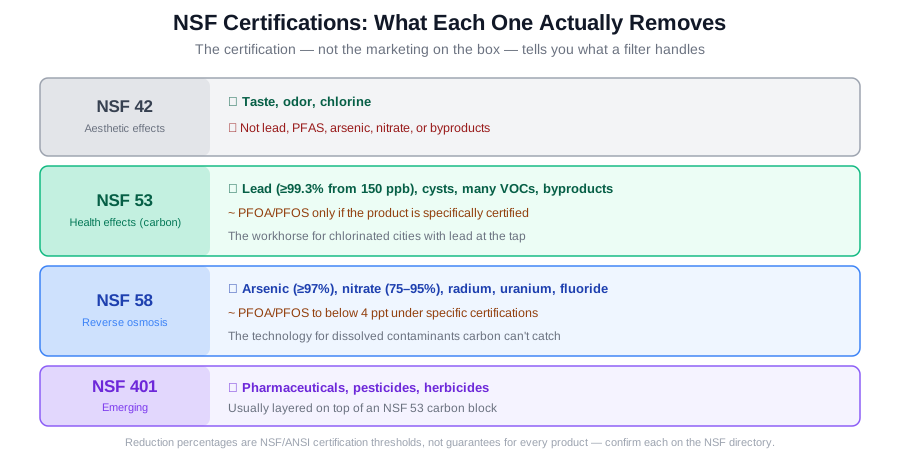
Filters are certified against NSF/ANSI standards, and each standard maps to a different set of contaminants. The certification — not the marketing — is what tells you what a filter removes. Four matter for drinking water.
NSF/ANSI 42 (aesthetic effects) covers taste, odor, and chlorine. It's the floor-level certification on many cheap pitchers, and it does not address lead, byproducts, arsenic, nitrate, or PFAS. NSF/ANSI 53 (health effects) is the workhorse: it certifies lead reduction of ≥99.3% from a 150 ppb challenge water, plus cysts (Cryptosporidium, Giardia), many VOCs, and — only if the product is specifically certified for it — PFOA and PFOS (NSF/ANSI 53). NSF 53 with an explicit PFOA/PFOS claim is the cheapest filter category that addresses PFAS.
NSF/ANSI 58 (reverse osmosis) is the technology for dissolved contaminants carbon can't catch: it certifies arsenic reduction of ≥97%, nitrate of roughly 75–95%, plus radium, uranium, fluoride, and — under specific certifications — PFOA and PFOS to below 4 ppt (NSF/ANSI 58). NSF/ANSI 401 (emerging contaminants) covers pharmaceuticals, pesticides, and similar compounds, usually layered onto an NSF 53 carbon block. For the full reference, see our guide to NSF water-filter certifications.
| Your source / situation | Contaminants of concern | NSF certification to match | Typical cost |
|---|---|---|---|
| Surface water, chlorinated | Lead at tap, byproducts, cysts, seasonal taste | NSF 53 carbon | $40–200 |
| Surface water, chloraminated | Above + chloramine taste/odor | NSF 53 with catalytic carbon | $100–300 |
| Groundwater, public supply | Arsenic, radium, nitrate, PFAS, hardness | NSF 58 reverse osmosis | $250–600 |
| Surface water + lead service line | Lead at tap (primary), byproducts, cysts | NSF 53 (lead-certified) | $50–250 |
| Private well, agricultural | Nitrate, coliform, pesticides | NSF 58 + disinfection | $400–1,200 |
| Private well, arsenic-prone | Arsenic, radium, uranium | NSF 58 reverse osmosis | $300–600 |
| Within ~5 miles of a PFAS source | PFOA, PFOS, GenX, other PFAS | NSF 53 (PFOA/PFOS-certified) or NSF 58 | $80–600 |
| Whole-house need (taste, sediment) | Source-dependent; not point-of-use risk | NSF 42/53 whole-house or softener | $1,500–4,000 |
| US-typical household | Lead at tap, chlorinated byproducts | NSF 53 carbon block | $40–200 |
Sources: NSF/ANSI Standards 42, 53, 58, and 401 (certification scopes and reduction thresholds); EPA on chloramine prevalence; TapWaterData filter methodology (2026) for cost ranges. Reduction percentages are the certification thresholds, not guarantees for every product — confirm each product on the NSF directory.
Which filter does your source type point to?
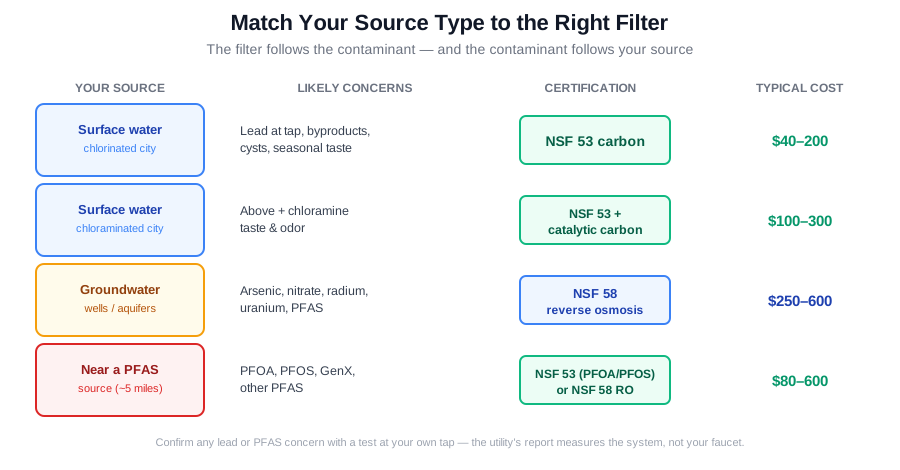
For most surface-water cities on chlorinated water, the answer is an NSF 53 carbon filter, in a pitcher, faucet-mount, or under-sink form. It handles the recurring concerns — lead at the tap from premise plumbing, disinfection byproducts, and cysts — at $40–200. Reverse osmosis here is usually overkill: if your report shows no arsenic, nitrate, uranium, or PFAS above detection, you're paying 5–10× for removal you don't need.
If your city uses chloramine instead of chlorine — more than one in five Americans drinks chloraminated water, including Denver, San Francisco, Boston's MWRA system, and much of Washington, DC (EPA, Chloramines in Drinking Water) — standard carbon underperforms. The right media is catalytic carbon, an activated carbon with surface chemistry that breaks chloramine down; check that an NSF 53 filter specifies it.
For most groundwater cities — common across Florida, Texas, and much of the Southwest — the answer shifts to NSF 58 reverse osmosis, because the recurring concerns are naturally occurring arsenic, nitrate, radium, and PFAS, and standard activated carbon removes none of them (NSF/ANSI 58). This is the one case where the more expensive technology is the correct one, not the upsell. A private well is the same chemistry with no utility safety net, so testing comes first and the filter follows the results.
The throughline: the filter follows the contaminant, and the contaminant follows the source. Match those and a $40 pitcher or a $400 RO system is a precise tool — mismatch them and either one is wasted money.
Does NSF 53 cover PFAS — and how do you check?
Sometimes — but only if the specific product is certified for it. NSF/ANSI 53 added PFOA and PFOS as certifiable contaminants in 2019 (folding in the former standalone P473 protocol), so a filter can carry NSF 53 for lead and cysts yet have no PFAS claim at all (NSF/ANSI 53, 2019 revision). "NSF 53 certified" on the box does not mean PFAS-certified.
The verification is mechanical, and it's worth the two minutes. Search the product on the NSF certified-products directory and confirm that "PFOA & PFOS reduction" appears in the certified-claims list. If it doesn't, the product does not address PFAS regardless of the packaging. The same check applies to reverse-osmosis systems under NSF 58 — confirm the PFOA/PFOS claim, don't assume RO covers it by default.
This is the single most common filter-buying mistake we see: assuming a respected brand or a "NSF certified" label covers PFAS. The certified-claims list is the only source of truth, and it's free to check.
How much should the right filter cost?
The honest range for a point-of-use drinking-water filter is $40 to $600, and where you land depends on the contaminant, not the brand. A chlorinated-city lead concern is solved by a $40–200 NSF 53 carbon filter; an arsenic, nitrate, or PFAS concern needs a $250–600 NSF 58 reverse-osmosis system. Whole-house systems run $1,500–4,000 and address sediment, taste, and hardness across the home — but they are a comfort-and-plumbing decision, not usually a drinking-water-safety one.
Cost of ownership matters more than the sticker, and it's where filters beat bottled water decisively. Over five years for a household of four, an NSF 53 pitcher runs roughly $290–440 all-in (cartridges every ~2 months); an under-sink RO runs $700–900 (pre-filters yearly, membrane every 2–3 years); bottled water runs $1,800–2,400 (TapWaterData methodology, 2026). The filter that matches your water is almost always the cheapest and the most effective option — provided it's matched.
So the buying rule is a scenario, not a ranking: if your report and a tap test show only lead and chlorinated byproducts, buy the $40–200 NSF 53 filter and stop. If they show arsenic, nitrate, uranium, or certified PFAS, step up to NSF 58 reverse osmosis. If they show nothing above detection and you only dislike the taste, an NSF 42 filter is enough. Spending more than your water requires buys peace of mind, not safety.
💡 Ready to choose? Compare filters matched to your contaminants — or look up your city's water first to see what you're filtering for. For the broader picture, read what your water utility is — and isn't — responsible for. :::
How we score filters — and what we earn
This guide draws on NSF/ANSI Standards 42, 53, 58, and 401 for certification scopes and reduction thresholds; EPA primary sources for what utilities measure and where (40 CFR Part 141, including 141.23, 141.86, and 141.621), EPA's Chloramines in Drinking Water and UCMR 5 pages; and the city Consumer Confidence Reports we aggregate across 18,774 U.S. cities.
Disclosure. This comparison considered filters across all four NSF certification classes, including options that TapWaterData does not earn commission on (Multipure and EPA's own list of certified PFAS technologies among them). Recommendations are scored by our published methodology — 50% contaminant coverage, 30% Amazon rating, 20% affordability — independent of commission rate. Amazon and brand-direct links in our filter guides are affiliate links that earn TapWaterData a commission at no additional cost to you. Filter prices and cartridge-life specs are pulled June 2026 from current retail listings; verify pricing at the time of purchase. More about our data and how we work.