A filter certification verifies a reduction to a defined pass threshold, not a reduction to the health goal. NSF/ANSI 53 certifies a lead filter to cut lead from a 150 ppb challenge water down to ≤ 5 ppb in the treated water — a real, verified reduction of more than 96 percent (NSF, 2024). But lead's health-goal MCLG is zero (EPA, 2024). So "certified to reduce lead" and "reduces lead to the health goal" are different claims: the cert proves the filter clears a repeatable test bar, not that your glass reaches zero.
This is the distinction that decides whether a filter cert means what a buyer thinks it means. The pass threshold in an NSF standard is engineered for verification — a fixed challenge concentration in, a measurable maximum allowed out — so two labs can reproduce the same test and agree (NSF, 2024). It is pegged to the enforceable MCL or another reference level, not to the MCLG. For contaminants whose health goal is zero, no certification can verify "reduced to the goal," because you cannot test your way to a guaranteed zero. Reading the cert correctly means reading the pass threshold, not just the word "certified."
This guide explains what an NSF/ANSI certification actually verifies, why the pass threshold differs from the health goal, how the four standards map to contaminants and residual levels, and how to match a cert to your own water. Start with your tap — look up your city to see what your utility reports, then read any filter box against that.
✅ What a filter certification actually verifies:
- A cert verifies a reduction to a pass threshold, not to the MCLG. NSF/ANSI 53 reduces lead from a 150 ppb challenge to ≤ 5 ppb (NSF, 2024); lead's health goal is zero (EPA, 2024). "Certified to reduce" is not "reduced to the health goal."
- The pass threshold is pegged to the legal limit or a reference, not the goal. NSF/ANSI 58 reverse osmosis must bring arsenic from 50 ppb to ≤ 10 ppb — the EPA MCL — while arsenic's MCLG is zero (NSF; EPA, 2024).
- For PFAS, the cert pass sits above even the legal limit. The NSF "Total PFAS" claim verifies reduction to ≤ 20 ppt from a challenge near 2,160 ppt (NSF, 2024); the 2024 EPA MCL is 4 ppt and the MCLG is zero. Good filters often do far better, but the cert verifies the 20 ppt bar.
- The cert reaches the health goal only when the goal is non-zero. NSF/ANSI 58 reduces nitrate to ≤ 10 mg/L — which equals both the MCL and the MCLG, so for nitrate the pass threshold is the health goal (NSF; EPA, 2024).
- NSF/ANSI 42 verifies no health claim at all. It covers aesthetics — chlorine, taste, odor, TDS — so a pitcher certified only to 42 is not verified to reduce lead, arsenic, PFAS, or any health-related contaminant (NSF, 2024).
Match a certified standard to what's actually in your water — read your tap's numbers first, then buy to the NSF cert that names them.
You might be wondering whether this is a setup to push you toward an expensive reverse-osmosis system. It is not. For many households on chlorinated city water with nothing flagged beyond chlorine and taste, an NSF/ANSI 42 pitcher is the correct, cheapest answer. The point of this guide is the opposite of upselling: it's to read a certification precisely, so you neither overpay for a system you don't need nor trust a mark that verifies less than you assumed.
What does an NSF/ANSI certification actually verify?
It verifies a specific, repeatable reduction. An NSF/ANSI certification means an accredited third party dosed challenge water with a contaminant at a fixed concentration, ran it through the filter under defined conditions, and confirmed the treated water came out at or below a maximum allowed level — the pass threshold (NSF, 2024). Each contaminant has its own named claim, its own challenge concentration, and its own pass threshold; "NSF certified" without a standard number and a named contaminant is close to meaningless.
The four standards split cleanly by what they promise. NSF/ANSI 42 covers aesthetic, non-health contaminants — chlorine, taste and odor, chloramine, particulate, iron, manganese, zinc, and total dissolved solids (NSF, 2024). NSF/ANSI 53 is the health standard, with over 50 contaminant-reduction claims including lead, Cryptosporidium, VOCs, and chromium (NSF, 2024). NSF/ANSI 58 covers point-of-use reverse-osmosis systems, with one required claim (TDS reduction) plus optional verified claims for arsenic, nitrate, fluoride, and more (NSF, 2024). NSF/ANSI 401 covers up to 15 emerging or trace compounds — pharmaceuticals, herbicides, pesticides — that the EPA does not yet regulate (NSF, 2024).
The key move when reading a box is to find the standard number and the named claim, then confirm it on the certifier's public listing. A filter can carry an "NSF" badge for an NSF/ANSI 42 aesthetic claim and reduce no health-related contaminant at all. "NSF/ANSI 53 certified for lead reduction" is a specific, verifiable claim; "NSF certified" alone is not.
Why isn't the pass threshold the same as the health goal?
Because a pass threshold has to be testable, and a health goal of zero is not. To certify a filter, a lab needs a number it can measure reliably and reproduce — a fixed challenge in, a measurable maximum out (NSF, 2024). A goal of zero can't serve as that bar: you cannot prove water contains exactly none of something to an analytical certainty, and a standard built on "must reach zero" would be unverifiable. So NSF pegs each pass threshold to a concrete reference — usually the EPA's enforceable MCL, sometimes another health benchmark — that a lab can actually confirm.
That choice maps directly onto the MCL/MCLG gap. For a contaminant whose health goal is non-zero and whose legal limit equals it — nitrate, at 10 mg/L for both — the pass threshold can equal the health goal, because the goal is a real, measurable number. For a contaminant whose health-goal MCLG is zero — lead, arsenic, PFAS — the pass threshold sits above the goal by necessity, because zero isn't a test bar. The cert isn't cutting a corner; it's measuring against the only kind of number a test can use.
This is why "certified to reduce" is an honest claim that still doesn't say what some buyers hear. NSF/ANSI 53 certified for lead means the filter verifiably cuts lead to ≤ 5 ppb from a 150 ppb challenge (NSF, 2024). It does not mean your water reaches lead's zero goal — and a well-made filter often reduces far below 5 ppb in practice, but the certification verifies the 5 ppb bar, not the lower real-world result. Reading the cert precisely means holding both facts: the reduction is real and verified, and the pass threshold is above the health goal for any zero-goal contaminant.
How do NSF 42, 53, 58, and 401 map to contaminants and residual levels?
The table maps each common claim to its NSF challenge concentration, its pass threshold (the maximum residual the filter is verified to leave), and the EPA health-goal MCLG for the same contaminant — so you can see, claim by claim, where the verified residual sits relative to the goal.
| Contaminant (claim) | NSF/ANSI standard | Challenge (influent) | Pass threshold (max residual) | EPA health goal (MCLG) | Does the cert verify reaching the goal? |
|---|---|---|---|---|---|
| Lead | 53 (or 58 RO) | 150 ppb | ≤ 5 ppb | 0 | No — pass is above the zero goal |
| PFOA + PFOS (combined) | 53 / 58 | 1,500 ppt | ≤ 20 ppt | 0 (MCL 4 ppt) | No — pass is above the goal and the 4-ppt MCL |
| Total PFAS (7-compound) | 53 / 58 | ~2,160 ppt | ≤ 20 ppt | 0 | No — verifies the 20 ppt bar |
| Arsenic (pentavalent) | 58 (RO) / 53 | 50 ppb | ≤ 10 ppb | 0 | No — pass equals the 10-ppb MCL |
| Nitrate (as N) | 58 (RO) | 30 mg/L | ≤ 10 mg/L | 10 mg/L | Yes — pass equals the MCL, which equals the MCLG |
| Fluoride | 58 (RO) | 8.0 mg/L | ≤ 1.5 mg/L | 4.0 mg/L | Pass is below the 4.0-mg/L MCL (a WHO/Health Canada reference) |
| TDS (required RO claim) | 58 (RO) | 750 mg/L | ≥ 75% reduction | None (aesthetic) | N/A — aesthetic, no health goal |
| Chlorine, taste & odor | 42 | per standard | aesthetic reduction | None (aesthetic) | N/A — no health claim |
| Pattern | 42 aesthetic; 53/58 health; 401 emerging | Fixed test concentration | Pegged to the MCL or a reference | 0 for carcinogens; the limit for nitrate/fluoride | Only when the health goal is a non-zero number |
Sources: NSF/ANSI 42, 53, 58, and 401 standard summaries and certified-product test parameters (NSF, 2024); EPA National Primary Drinking Water Regulations and 2024 PFAS rule for MCLs and MCLGs. The NSF lead pass threshold was lowered from 10 ppb to 5 ppb in 2020; the "Total PFAS" pass was lowered from 70 ppt to 20 ppt in 2022. The NSF fluoride pass of 1.5 mg/L is the WHO/Health Canada reference level, not the EPA MCL of 4.0 mg/L. Nitrate is measured as nitrogen. How this table was assembled: our data and methodology.
Three rows carry the whole lesson. Nitrate is the case where the cert reaches the health goal — its pass threshold (10 mg/L) equals both the MCL and the MCLG, because nitrate's health goal is a non-zero, well-characterized number (NSF; EPA, 2024). Arsenic is the common case — the pass threshold (10 ppb) equals the legal MCL while the health goal is zero, so a certified RO filter brings arsenic to the legal limit, not the goal. PFAS is the case buyers most often misread: the verified pass threshold (20 ppt) sits above even the 2024 EPA MCL of 4 ppt (NSF, 2024; EPA, 2024). A good RO or carbon system frequently reduces PFAS far below 20 ppt — but the certification verifies the 20 ppt bar, so for PFAS especially, the certified number and the health goal are not the same.
What does the cert leave in your glass for lead and PFAS?
For the two contaminants households worry about most, the gap between the certified pass threshold and the health goal is the entire goal — because both have an MCLG of zero. The diagram traces each one from its NSF challenge concentration down to its pass threshold, with the zero health goal marked below.
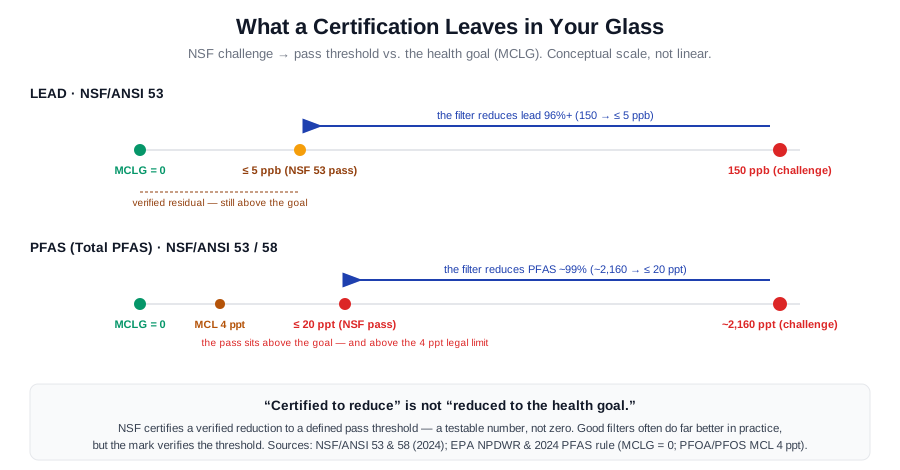
For lead, NSF/ANSI 53 verifies a reduction from a 150 ppb challenge to ≤ 5 ppb — a large, real cut that the standard tightened from 10 ppb to 5 ppb in 2020 (NSF, 2024). The residual the cert guarantees is 5 ppb against a health goal of zero. In practice a quality lead-certified filter usually delivers well under 5 ppb, but the certification's promise is the 5 ppb bar, and the honest read is that "lead-certified" reduces lead substantially, not to zero. Because lead largely enters from your home's own plumbing, a certified filter at the tap you drink from is the right tool — paired with cold water and flushing — when you have a lead or unknown service line.
For PFAS, the NSF "Total PFAS" claim verifies reduction to ≤ 20 ppt from a 7-compound challenge near 2,160 ppt, after the standard lowered the pass from the original 70 ppt to 20 ppt in 2022 (NSF, 2024). That 20 ppt pass threshold sits above the 2024 EPA MCL of 4 ppt and far above the zero goal (EPA, 2024). The practical translation: a PFAS-certified NSF/ANSI 53 or 58 filter is verified to bring PFAS down to 20 ppt, and the better systems go well below that — but "PFAS certified" is not a guarantee of reaching the 4-ppt legal limit, let alone zero. If your water shows PFAS and you want the lowest residual, reverse osmosis (NSF/ANSI 58) is the most effective home technology, and the certifier's listing — not the box copy — is where you confirm the specific claim.
Neither of these is a reason to distrust certification; it is a reason to read it. A certified filter is verified, independent proof of a real reduction. The gap to the health goal is information for sizing your expectation, not a flaw in the mark.
Which contaminants can a filter actually bring to the health goal?
Only the ones whose health goal is a non-zero, measurable number — and only with the right standard. Nitrate is the clean example: its MCL and MCLG are both 10 mg/L, and NSF/ANSI 58 reverse osmosis is verified to bring a 30 mg/L challenge to ≤ 10 mg/L, so a certified RO system can verifiably reach nitrate's health goal (NSF; EPA, 2024). For threshold contaminants like nitrate, "certified to reduce" and "reduced to the health goal" can genuinely coincide.
For zero-goal contaminants — lead, arsenic, PFAS, benzene, uranium — no certification can promise the health goal, because the goal is zero and zero isn't a testable bar (EPA, 2024). What the right standard can do is bring them to the legal limit or below: NSF/ANSI 58 reverse osmosis is the most effective home technology for arsenic, nitrate, uranium, fluoride, and most PFAS, while NSF/ANSI 53 carbon block handles lead, cysts, and many VOCs (NSF, 2024). The realistic goal for these is "as low as a certified technology achieves," which for a good RO system is often well below the legal limit — not a guaranteed zero.
This is also where buying the wrong standard fails quietly. An NSF/ANSI 53 carbon pitcher will not reduce nitrate or arsenic to any verified degree, because those are NSF/ANSI 58 reverse-osmosis claims (NSF, 2024). And an NSF/ANSI 42 pitcher — aesthetic only — verifies nothing for any health contaminant. Matching the standard to the contaminant is the difference between a filter that measurably lowers your real risk and one that only improves taste.
So does "certified to reduce" mean "reduced to safe"?
"Certified to reduce" means a verified reduction to a named pass threshold — a precise, trustworthy claim (NSF, 2024). It does not mean "reduced to the health goal," and for any contaminant with a zero MCLG it cannot, because the pass threshold is a testable number and zero is not. So the accurate read of a cert is: this filter verifiably cuts this contaminant to at most this residual — which is excellent information, as long as you know the residual.
The word "safe" is the one to retire here, the same way it is for "meets EPA standards." A nitrate result certified to ≤ 10 mg/L reaches nitrate's health goal. A lead filter certified to ≤ 5 ppb makes a large, real cut and still leaves a residual above lead's zero goal — usually much lower in practice, but verified only to 5 ppb. A PFAS filter certified to ≤ 20 ppt is verified above even the 4-ppt legal limit. None of these is misleading once you read the pass threshold; all of them are misleading if you read only the word "certified."
The honest posture for a filter buyer mirrors the one for a CCR reader. Certification is the proof you want — independent, third-party, reproducible. The pass threshold tells you where the verified residual sits relative to the health goal, so you can size your expectation and, if the contaminant has a zero goal and you want the lowest residual, reach for the strongest certified technology rather than the cheapest certified one.
How do you match a certification to your water?
Start from what's actually in your tap, then pick the standard that names that contaminant — never the reverse. Pull your report: look up your city for your CCR, and test your own tap for lead if you have an older home or a lead or unknown service line, since the utility's number can't speak for your faucet. Let the detected contaminants pick the standard.
From there the mapping is direct. If only chlorine, taste, and odor are at issue, NSF/ANSI 42 is sufficient and cheapest (NSF, 2024). If lead is the concern, require NSF/ANSI 53 certified for lead reduction, and read its pass threshold as ≤ 5 ppb, not zero. If your water shows arsenic, nitrate, fluoride, uranium, or PFAS, that is an NSF/ANSI 58 reverse-osmosis decision, because carbon won't touch most of them — and for a zero-goal contaminant like arsenic or PFAS, choose the system with the lowest verified residual, not just any cert.
Two scenarios cover most households. On chlorinated city water with nothing flagged beyond aesthetics, an NSF/ANSI 42 (or 42+53) pitcher or faucet filter is the right category and reaching for RO is overkill. If your report or a lab test shows a wide-gap contaminant — arsenic, PFAS, uranium — that is the case for NSF/ANSI 58 reverse osmosis, with the understanding that even RO brings those toward the legal limit, not to a certified zero. Match the standard to the contaminant, read the pass threshold, and the certification does exactly what it promises.
💡 Pick a filter from your own data. Look up your city to see what your utility reports, then match a certified standard to your tap — and read the pass threshold, not just the word "certified." :::
Reading this from a different angle?
- Want the broad overview? Read what's the difference between MCL and MCLG? → — the legal-limit-versus-health-goal gap these pass thresholds are pegged to.
- Worried about kids specifically? Read why pediatric and public-health limits are stricter than the EPA's → — where pediatric numbers sit relative to these certs.
- Reading filter marketing? Read what "EPA approved" means on a water filter → — why only an NSF/ANSI mark verifies removal at all.
Sources and disclosure
This guide draws on NSF primary sources — the published NSF/ANSI 42, 53, 58, and 401 standard summaries and the test parameters (challenge concentrations and pass thresholds) that NSF-certified products must reproduce — alongside the EPA's National Primary Drinking Water Regulations and 2024 PFAS rule for the MCL and MCLG values, and the city Consumer Confidence Reports we aggregate across 18,774 U.S. cities.
Disclosure. This comparison considered filters across the NSF/ANSI 42, 53, 58, and 401 certification classes, including options TapWaterData does not earn commission on — for example Multipure (sold brand-direct) and the public NSF, WQA, and IAPMO R&T certifier directories. Recommendations are scored by our published methodology — 50% contaminant coverage, 30% Amazon rating, 20% affordability — independent of commission rate. Amazon and brand-direct links in our Filter Buyer guides are affiliate links that earn TapWaterData a commission at no additional cost to you; this guide names certification classes rather than linking products. Certification details were pulled June 2026. More about our data and how we work.