Your water utility is one of roughly 50,000 community water systems that together deliver tap water to about 90% of Americans (EPA, Information About Public Water Systems). Under the Safe Drinking Water Act, it is legally responsible for treating that water to meet enforceable limits on more than 90 contaminants, testing for them on fixed schedules, telling you what it found once a year, and warning you fast when something goes wrong (EPA, NPDWR). That is a real and demanding job — and most U.S. utilities do it well.
What surprises most people is where the job stops. A utility's legal responsibility runs from the source water to its treatment plant, through the distribution mains, and up to a boundary near your property line — not to your faucet. The pipe from that boundary into your house, and the plumbing inside it, is mostly yours. So is the single most important question you probably have: is the water at my sink safe to drink?
This guide maps that boundary: what your utility must do, what it tests continuously versus barely at all, why a clean annual report doesn't describe the water at your tap, and when a problem is the utility's to fix versus yours to test for. The fastest place to start is your own system — look up your city to see your utility, its source water, and its most recent water-quality report.
✅ What your utility is — and isn't — responsible for:
- Treatment and testing, up to a point. Your utility must meet enforceable EPA limits on more than 90 contaminants and monitor for them on set schedules (EPA, NPDWR).
- Its responsibility ends before your faucet. Most compliance samples are taken at the plant or system entry point, not your tap — so a clean Consumer Confidence Report doesn't measure the water at your sink (EPA, 40 CFR 141.23).
- Lead is the shared-boundary exception. Utilities must inventory lead service lines and, under the 2024 rule, replace them within 10 years — but the line crosses onto private property, and full replacement can require the owner's consent (EPA LCRI, 2024).
- Continuous on a few things, periodic on most. Turbidity and disinfectant residual are watched continuously at the plant; nitrate, arsenic, and PFAS are checked only yearly, every few years, or once every five years (EPA, Surface Water Treatment Rules; EPA, UCMR 5).
- You own the last mile. For lead or PFAS at your specific tap — or any private well — only an independent certified-lab test answers the question; the utility neither samples it nor is responsible for it (EPA, 40 CFR 141.86).
Look up your city's water → — the fastest way to know who is responsible for your water.
You might be wondering whether this is a setup to sell you a filter or to alarm you about your water utility. It is neither. Most U.S. utilities deliver water that meets every EPA limit, and the goal here is narrow: show you exactly where their job ends and yours begins, so you know which questions only you can answer.
What is your water utility legally required to do?
Under the Safe Drinking Water Act, a community water system carries four core duties. The first is treatment: it must deliver water that meets the National Primary Drinking Water Regulations — legally enforceable limits and treatment techniques covering more than 90 contaminants across seven categories, from microbes to disinfection byproducts to selected PFAS (EPA, NPDWR). These are the hard standards; missing one is a violation, not a preference.
The second is monitoring and reporting: the utility must sample for regulated contaminants on contaminant-specific schedules and report the results to its state regulator. The third is the Consumer Confidence Report (CCR) — the annual water-quality report it must deliver to every customer by July 1 each year (EPA, 40 CFR 141.155). Starting in 2027, systems serving more than 10,000 people must publish it twice a year (EPA, CCR Rule Revisions, 2024).
The fourth duty is public notification, and it is tiered by urgency. If there is potential for immediate harm — an E. coli detection, a failed treatment barrier, a boil-water situation — the utility has 24 hours to notify people who may drink the water (EPA, Public Notification Rule; 40 CFR 141.202). A problem that exceeds a standard but doesn't pose an immediate risk triggers a Tier 2 notice within 30 days; lower-priority issues are Tier 3, within a year (EPA, 40 CFR 141.203).
Notice what is — and isn't — on that list. Your utility must make the water leaving its system meet federal limits and must tell you when it fails. It is not required to guarantee the water at your particular faucet, to test your home's plumbing, or to remove contaminants the EPA hasn't set a standard for. Those gaps are exactly where homeowner responsibility begins.
Where does your utility's responsibility actually end?
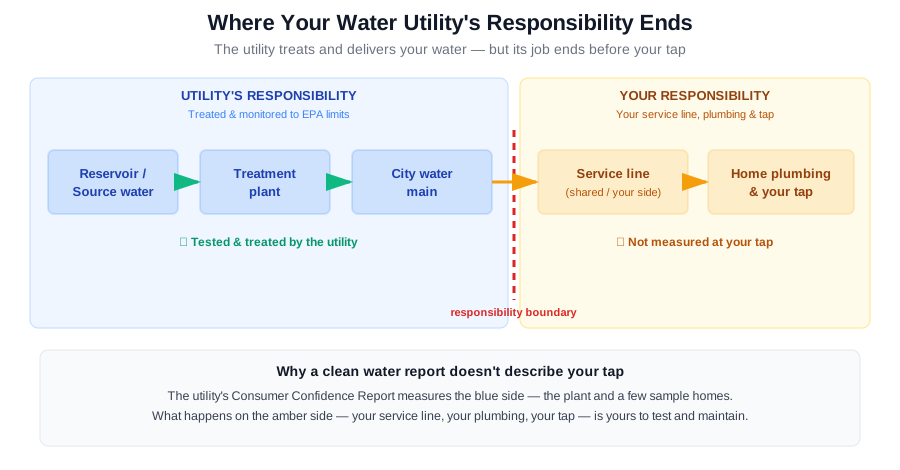
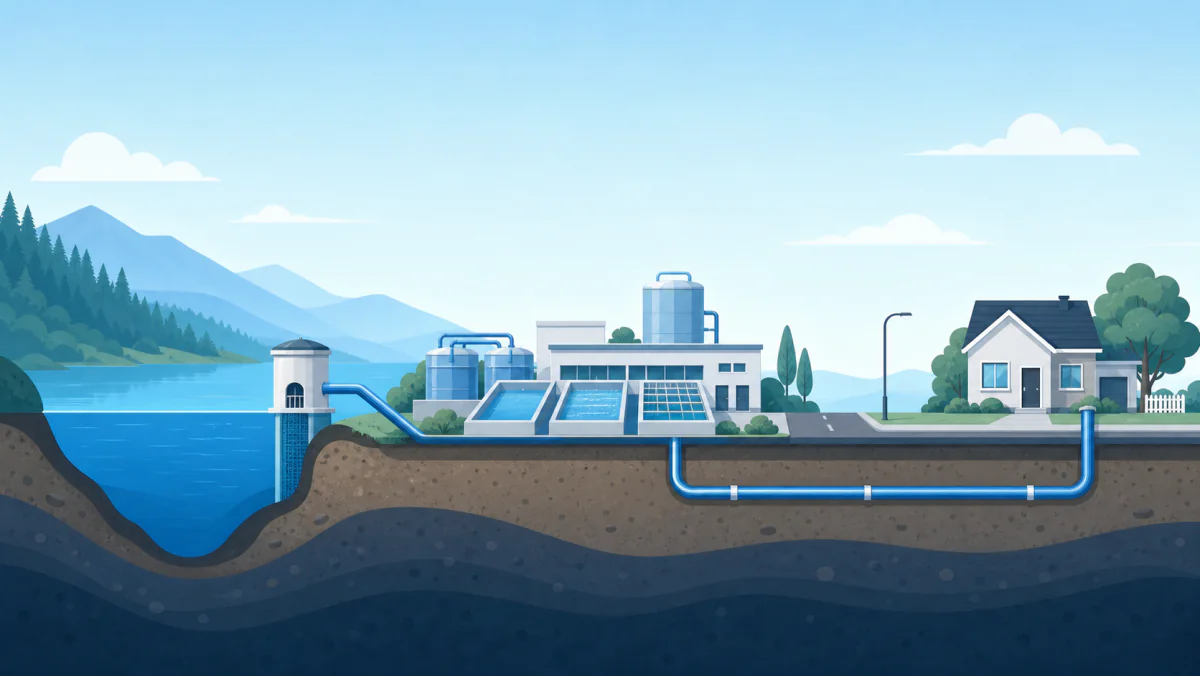
Picture the path water takes: reservoir or well → treatment plant → distribution mains under the street → a service line branching off toward your house → your home's internal plumbing → the faucet. A utility owns and maintains the system through the mains. The service line — "the pipe that connects your home to the water main" — is the contested stretch (EPA, Basic Information About Lead in Drinking Water).
Historically, that service line has had two parts: a system side (utility-owned, from the main to a boundary near your property line or curb stop) and a customer side (privately owned, from there to the house). The EPA's own replacement rules use exactly this language — a lead line counts as fully replaced only when "the entire length of the service line (both customer side and system side)" is non-lead (EPA, LCRI service-line inventory fact sheet, 2024). Where the boundary sits, and who pays for which half, is set by state and local ordinance, so it genuinely varies city to city.
This is why lead is the awkward exception to the "utility's job ends at the property line" rule. The EPA estimates that up to 9 million homes are still served through legacy lead pipes (EPA, October 2024). The 2024 Lead and Copper Rule Improvements (LCRI) require systems to identify and replace lead service lines within 10 years, with the clock running from the November 1, 2027 compliance date (EPA, LCRI, 2024). For the first time, that obligation generally includes the privately owned customer side — but because the utility is working on your property, it may need your consent to do the work, and "reasonable effort" to reach you is defined as at least four attempts by at least two methods (EPA, LCRI service-line inventory fact sheet, 2024).
Everything past the service line is unambiguously yours: your internal plumbing, your faucets and fixtures, and any filter you install. If those contain lead solder or brass, they can add lead after the water has left the utility's control entirely — which is why lead "is typically the most significant source" of lead in tap water in homes that still have it (EPA). The utility can deliver water that corrodes nothing on its way to your curb and still not control what happens in the last few feet.
What does your utility test continuously, and what does it barely test at all?
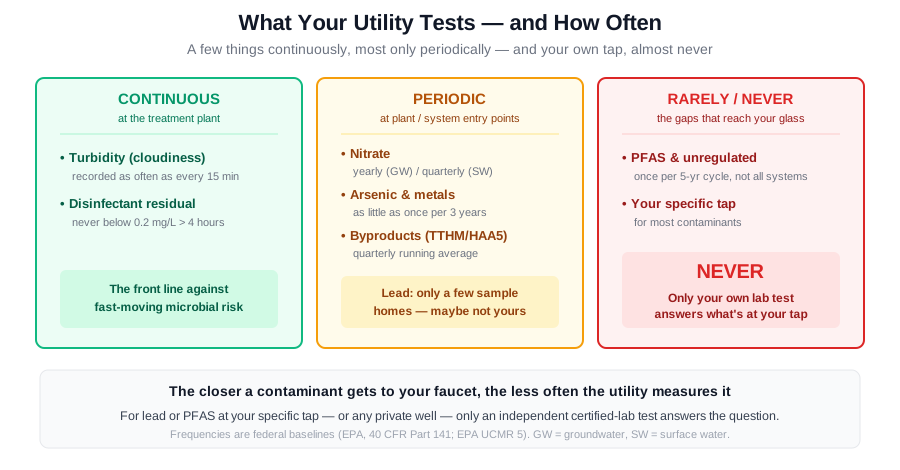
Here is the fact that reframes everything: your utility does not test for most contaminants very often, and almost never at your house. Monitoring runs on three very different clocks.
A handful of things are watched continuously at the treatment plant because they're the front line against acute, fast-moving risk. At a conventional surface-water plant, turbidity (cloudiness, a proxy for whether filtration is working) must stay at or below 0.3 NTU for 95% of the combined filter-effluent readings each month, and each individual filter is monitored continuously, with results recorded every 15 minutes; the disinfectant residual entering the distribution system is monitored continuously and can't drop below 0.2 mg/L for more than four hours (EPA, Surface Water Treatment Rules; 40 CFR 141.74).
Most regulated chemicals are checked only periodically, at the plant or a system entry point — not at homes. Nitrate is sampled annually for groundwater systems and quarterly for surface-water ones (EPA, 40 CFR 141.23(d)). Arsenic and most other inorganic contaminants are sampled as little as once every three years for a groundwater system (EPA, 40 CFR 141.23(c)). Disinfection byproducts like total trihalomethanes (limit 0.080 mg/L) and haloacetic acids (0.060 mg/L) are judged on a running annual average across distribution-system sites — a yearly average of four quarters, not a reading from your kitchen (EPA, Stage 2 DBP Rule; 40 CFR 141.621).
And a large category is not routinely tested at all. Unregulated contaminants — including most PFAS — are sampled only on the EPA's five-year Unregulated Contaminant Monitoring Rule cycle, and not every system participates. The current round, UCMR 5, covers 30 contaminants (29 PFAS plus lithium) over 2023–2025 (EPA, UCMR 5). The one exception that is sampled in homes — lead and copper — is collected at customers' kitchen or bathroom cold-water taps, but only at a small, population-scaled set of representative houses, from as few as 5 to as many as 100 sites depending on system size (EPA, 40 CFR 141.86). Your home is probably not one of them.
| What your utility checks | How often it's tested | Where the sample is taken | Does it reflect your tap? |
|---|---|---|---|
| Turbidity (cloudiness) | Continuously (recorded ≤ every 15 min) | Treatment plant, filter effluent | No — plant output |
| Disinfectant residual | Continuously | Plant + distribution points | Partly (system-wide) |
| E. coli / total coliform | Monthly (most systems) | Distribution system | Partly (system-wide) |
| Nitrate | Annually (GW) / quarterly (SW) | System entry point | No — entry point |
| Arsenic & most inorganics | As little as once per 3 years (GW) | System entry point | No — entry point |
| TTHM / HAA5 (byproducts) | Quarterly, as a running annual average | Distribution sites (averaged) | No — averaged, not your tap |
| Lead & copper | Every 6 months to 3 years | A sample of customers' home taps | Only if your home is a chosen site |
| PFAS & other unregulated | Once per 5-year UCMR cycle, not all systems | System entry point | No — entry point |
| Your specific kitchen tap, for most contaminants | Never | — | No — only your own lab test answers this |
Sources: EPA Surface Water Treatment Rules guide and 40 CFR 141.74 (continuous parameters); 40 CFR 141.23 (nitrate, inorganics); 40 CFR 141.621 (DBP running annual average); 40 CFR 141.86 (lead/copper at representative taps); EPA UCMR 5 (unregulated/PFAS). Frequencies are federal baselines; states may require more.
Why doesn't a clean water report mean your tap is clean?
A Consumer Confidence Report can show every contaminant below its limit and still not describe the water you actually drink — because of where those numbers come from. Most of them reflect compliance samples taken at the plant or a system entry point, before the water travels through miles of distribution mains, your service line, and your home's plumbing (EPA, 40 CFR 141.23). The report grades the utility's output, not your faucet's input.
Even the contaminants tested closer to homes are reported as system-wide figures, not your address. Disinfection byproducts are a locational annual average across the distribution system (EPA, 40 CFR 141.621). Lead and copper come from a rotating set of representative high-risk homes, summarized as a 90th-percentile number for the whole system (EPA, 40 CFR 141.86). If your house has a lead service line or old fixtures and your neighbor's doesn't, the system can pass while your specific tap runs high.
It's worth being precise about what the lead number even means. The lead action level — currently 0.015 mg/L, dropping to 0.010 mg/L when the LCRI takes effect on November 1, 2027 — is a corrosion-control trigger for the system, not a health-based safety line for your glass (EPA, LCRI, 2024). The health-based goal for lead is zero, because no amount is considered beneficial. So "the system met the lead action level" is a statement about utility-wide treatment performance, not a clean bill of health for your kitchen.
None of this means the CCR is useless — it's the best single snapshot of your system, and learning to read it is worth 15 minutes (see our guide to reading your water-quality report). It means the report answers the utility's question ("is our system in compliance?") and not yours ("is the water at my sink safe for my household?"). Those are different questions, measured in different places.
Who actually runs your water utility — and what if it's doing a poor job?
"Your water utility" is less uniform than it sounds. The roughly 50,000 community water systems are mostly small: more than 92% serve 10,000 or fewer people (EPA). Many are city departments answerable to a council; others are private or investor-owned companies, regional authorities, or special water districts with their own boards. Size matters more than ownership for reliability — a small system with one operator has far less margin than a metro utility, which is part of why compliance capacity varies so widely across those 50,000 systems.
Whatever the structure, the Safe Drinking Water Act gives you defined leverage. Enforcement runs through your state: under SDWA, states and tribes hold "primacy" — the primary authority to inspect utilities and act on violations (EPA, SDWA). Your state drinking-water program, not the EPA in Washington, is usually the body that actually responds to a struggling utility.
As a customer, you have specific rights you can use rather than just complain. You're entitled to the annual CCR and to timely public notices when standards are missed (EPA, Public Notification Rule). Under the LCRI, you can ask your utility for its service-line inventory to find out whether the line to your house is lead, galvanized, or unknown (EPA, LCRI, 2024). And you can escalate documented problems — repeated violations, missing notices, a lead line left unaddressed — to your state primacy agency.
So if your utility is doing a poor job, the path isn't guesswork. Read the CCR, request the service-line inventory, document what you see, and contact the state program named in your report. If the issue is system-wide — a violation, a boil-water notice, a treatment failure — that is squarely the utility's (and the state's) to fix.
When should you call your utility, and when should you test your own water?
The dividing line is the same boundary as before: call the utility for anything that belongs to the system; test independently for anything that belongs to your tap.
Call your utility when the signal is about the water coming to you. Discolored, rusty, or cloudy water; a sudden taste or odor change across the whole house; low or lost pressure; or any boil-water notice or public advisory — these point to the mains, treatment, or distribution, which are the utility's responsibility (EPA, Public Notification Rule). They can tell you whether it's a known main break or flushing event, and they're obligated to notify you of genuine health risks within the tiered timelines above.
Test your own water — through an independent, state-certified lab — when the question is about your specific tap, because that's the part the utility doesn't measure. The clearest cases:
- Lead, if you have an older home or a lead/unknown service line. The CCR's system number can't tell you your tap's level; only a sample drawn at your faucet can (EPA, 40 CFR 141.86).
- PFAS, if you want to know your household's exposure. Unless your system happened to be in a UCMR round, your utility likely hasn't tested for it (EPA, UCMR 5).
- Any private well. Wells fall entirely outside the utility's responsibility and outside SDWA — testing is 100% on the owner.
A simple rule of thumb: if the problem would affect your whole street, it's a phone call to the utility. If the answer depends on your house's own pipes and fixtures, it's a lab test. Once you know what's actually at your tap, our guide to water test results and filter resources help you decide whether to act — and matching a certified filter to a specific contaminant is the only filter decision worth making.
💡 Look up your city, then check your last mile. See your utility, its source, and the latest report — then, if you have an older home or a lead or unknown service line, test your own tap for what the report can't measure. :::
Sources and disclosure
This guide draws on EPA primary sources: the National Primary Drinking Water Regulations; the 2024 Lead and Copper Rule Improvements and its service-line inventory fact sheet; the Surface Water Treatment Rules; the Stage 2 Disinfectants and Disinfection Byproducts Rule; the Public Notification and Consumer Confidence Report rules; the Fifth Unregulated Contaminant Monitoring Rule (UCMR 5); and the monitoring requirements in 40 CFR Part 141 — alongside the city Consumer Confidence Reports we aggregate across 18,774 U.S. cities. TapWaterData earns affiliate commission on filters recommended in our Filter Buyer guides. This guide contains no affiliate links. More about our data and how we work.