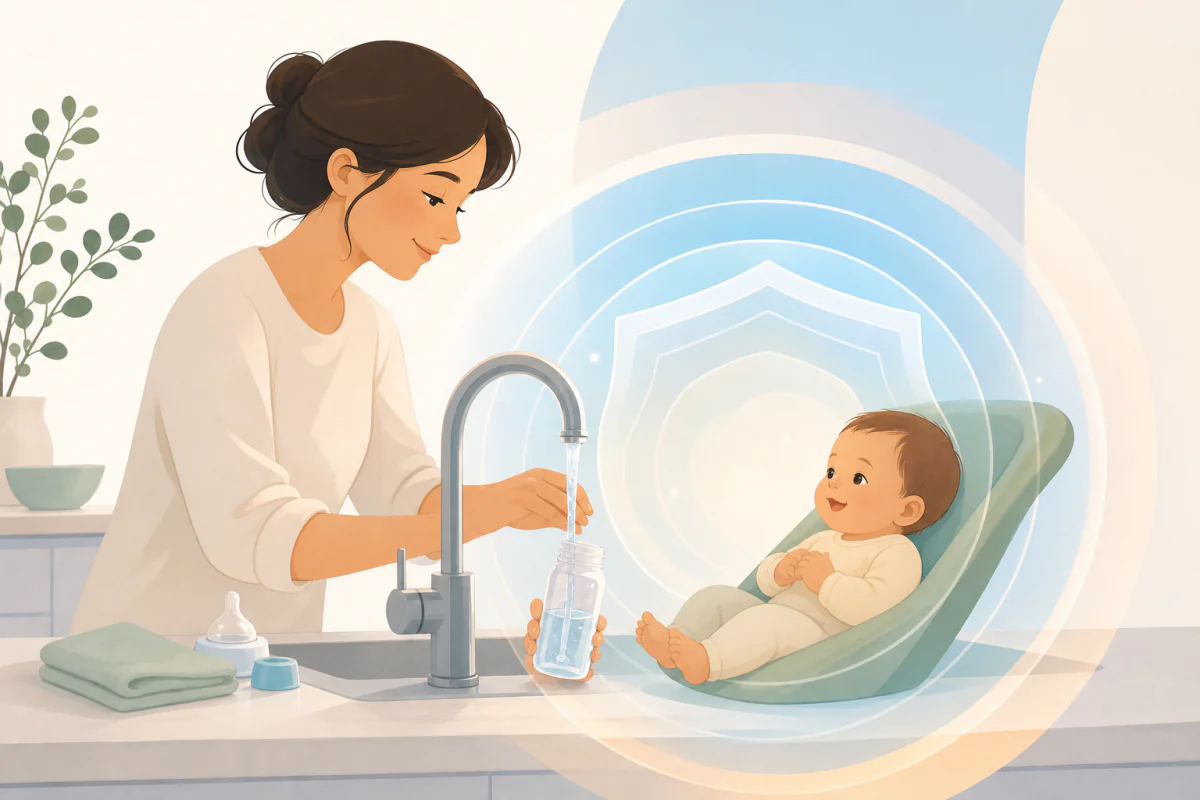
Four layers protect the water your child drinks. The EPA sets national, legally enforceable limits on more than 90 contaminants (EPA, n.d.); your state enforces them as the primacy agency (EPA, 2025); your utility treats and tests the water to meet them; and then — the layer most parents never think about — you control everything past the property line. That last layer matters most for a child, because the contaminant that most often reaches a baby's bottle comes from home plumbing, not the source: infants who consume mostly mixed formula can receive 40 percent to 60 percent of their exposure to lead from drinking water (EPA, 2024).
That figure is the reason this guide exists. A child's body is not a small adult's. The same nitrate level that is harmless to you can cause an acute condition in an infant under six months; the same lead exposure CDC calls "no safe level" lands hardest on a developing brain (CDC, 2024). Which of those risks is even plausible at your tap depends on your source water and your home — and the only person positioned to close the last gap is the parent holding the bottle.
This guide maps all four layers and what a parent does when the chain breaks at home. The fastest place to start is your own system — look up your city to see your utility, its source water, and its most recent water-quality report.
✅ Four layers protect your child's water — and the last one is yours:
- The chain stops at your property line. EPA, your state, and your utility protect the water up to a boundary near your home; the plumbing past it — and your child's bottle — is yours (EPA, 2024).
- Lead is the home-plumbing risk for babies. Infants on mostly mixed formula can get 40-60% of their lead exposure from water, and CDC has identified no safe blood lead level in children (EPA, 2024; CDC, 2024).
- Nitrate is the source-water risk for infants. The federal limit is 10 mg/L as nitrogen; above it, infants under six months can develop "blue baby syndrome" (EPA, 40 CFR 141.62(b); ATSDR, 2017).
- Formula prep is where source and plumbing meet. Use cold water, flush the tap first, and consider low-fluoride water for reconstituted formula (EPA, 2024; AAP; CDC, 2024).
- A private well has no layer above you. More than 23 million U.S. households rely on private wells the federal government does not regulate — testing is entirely the owner's job (EPA, 2024; CDC, 2024).
Look up your child's water → — the fastest way to know which risks are even possible at your tap.
You might be wondering whether this is a setup to scare you about your child's water or sell you a filter. It is neither. Most U.S. utilities deliver water that meets every federal limit, and for most families on treated city water with no lead plumbing, the tap is fine for a baby. The goal here is narrow: show you which of the genuine pediatric risks could apply to your home, so you spend worry only where the data says it belongs.
Who actually protects your child's drinking water?
Four parties share the job, in a fixed order. First, the EPA: under the Safe Drinking Water Act — enacted in 1974 and amended in 1986 and 1996 — the agency sets national, health-based standards for drinking water and has regulations for more than 90 contaminants in the form of maximum contaminant levels and treatment-technique rules (EPA, n.d.). The EPA does not itself test your water; it writes the rules.
Second, your state. The EPA delegates primary enforcement — "primacy" — to states and tribes that adopt regulations no less stringent than the federal ones (EPA, 2025). As of the 2023 national compliance report, 49 states, 5 territories, and the Navajo Nation hold primacy; Wyoming is the only state where the EPA still runs the program directly, and the District of Columbia is implemented directly by the EPA too (EPA, 2023). So the agency that responds to a struggling utility is almost always your state program, not Washington.
Third, your utility — one of more than 148,000 public water systems nationwide (EPA, 2024). It treats the water to meet the federal limits, samples on fixed schedules, and sends every household an annual Consumer Confidence Report. (If your child drinks bottled water instead, that falls to a fourth federal layer: the FDA regulates bottled water as a packaged food, and its quality standards must be no less stringent than the EPA's tap-water limits (FDA, Bottled Water Everywhere; CDC, 2024).)
Fourth — and most important for a child — is you. The utility's legal responsibility ends at a boundary near your property line, not at your faucet. Everything past it is the household's: the service line, the internal plumbing, the fixtures, and the water that goes into a bottle. The three layers above you make the water safe up to the curb; only you can answer whether it is still safe at the sink.
Why does a child face risks an adult doesn't?
A child is not protected by simply meeting an adult's threshold, because the same dose lands differently on a smaller, developing body. Two contaminants make this concrete.
For lead, the CDC is unambiguous: "no safe blood lead level in children has been identified," and even low levels are associated with developmental delays, difficulty learning, and behavioral issues — effects that can be permanent (CDC, 2024). Parents sometimes read the "reference value" of 3.5 µg/dL as a safe line. It is not: the CDC's blood lead reference value is a screening tool, set at the 97.5th percentile of U.S. children ages 1-5 to flag kids with higher-than-typical levels — "not health-based and not a regulatory standard" (CDC, 2021/2022). The same caution applies to the EPA's lead action level (15 µg/L, dropping to 10 µg/L under the 2024 rule): it is a treatment trigger for the system, not a safe level for a glass.
For nitrate, the vulnerability is age-specific and acute. The federal limit is 10 mg/L measured as nitrogen (EPA, 40 CFR 141.62(b)). Above it, "high levels of nitrate and nitrite are most serious for infants," interfering with the oxygen-carrying capacity of a baby's blood in a condition the EPA calls blue baby syndrome — acute, developing over a period of days, with shortness of breath and blueness of the skin (EPA, 2024). The ATSDR's health profile for nitrate and nitrite identifies young bottle-fed infants (1-3 months) and infants under six months as particularly susceptible, partly because a newborn's higher stomach pH and still-immature blood enzymes favor the conversion that causes it (ATSDR, 2017). The EPA set the 10 mg/L limit specifically to protect these infants.
The pattern holds across contaminants: legal limits are written for the general population, and the youngest household members sit at its sensitive edge. That is why "the system passed" and "this water is right for my baby" are not the same statement.
Where can the chain break for a child — and what does a parent do?
The diagram below traces the four layers and marks the four places the chain most often breaks for a child: an older home's lead service line, daycare or school plumbing, a private well with no layer above it, and formula preparation, where source water and home plumbing meet in a single bottle.
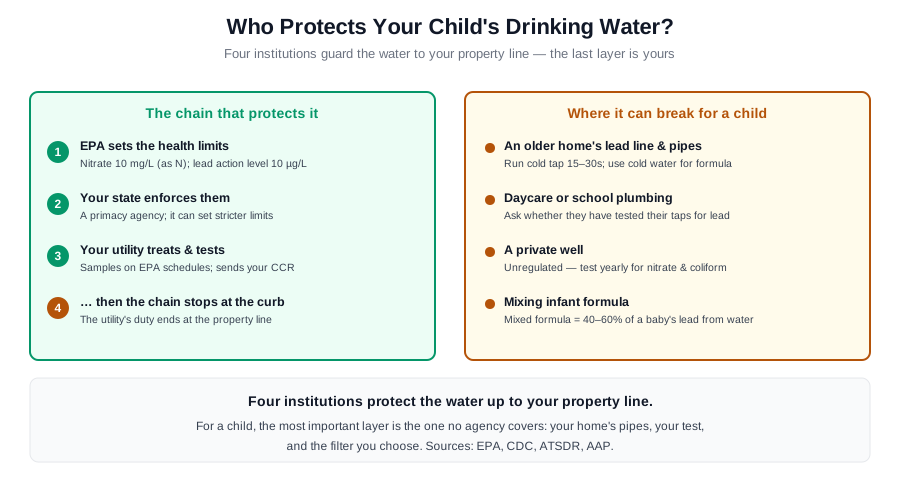
The first break is home plumbing in an older house. The EPA banned new lead pipes in 1986, yet up to roughly 9 million homes are still connected through legacy lead service lines (EPA, 2024). The 2024 Lead and Copper Rule Improvements — finalized October 8, 2024 — require systems to identify and replace those lines within 10 years, generally including the privately owned portion, with the first program year starting November 1, 2027 (EPA, 2024). Until your line is replaced, the parent actions are the EPA's own: use only cold water for drinking, cooking, and making baby formula, and flush the pipes before drinking by running the tap, a shower, or a load of dishes (EPA, 2024).
The second break is daycare or school plumbing. A facility that serves its own water to children can be its own regulated system — a non-transient non-community water system, like a school or office with its own supply (EPA, 40 CFR 141.2) — but a daycare on city water is just another customer past the utility's property line, with the same old-fixture risk as a home. The parent action is to ask: does the center use a filter certified for lead at the tap children drink from, and when were its fixtures last checked?
The third break is a private well, where no protective layer sits above the family at all. The Safe Drinking Water Act "does not cover private drinking water sources," and the EPA's rules "do not apply to privately owned wells" (CDC, 2024); the owner is responsible for delivering safe water (EPA, 2024). For a household with a baby, the CDC's baseline is to test at least once a year for total coliform bacteria, nitrate, total dissolved solids, and pH — with nitrate the priority before an infant is on formula (CDC, 2024).
How should a parent prepare formula and bottles safely?
Formula preparation is where the source-water layer and the home-plumbing layer meet inside one bottle, so it deserves its own routine. The good news is that the precautions are simple and the same for most families.
For lead, follow the cold-water-and-flush rule above plus the AAP's two specifics: never use water from the hot-water faucet to make a bottle, because lead is likely to be highest in hot water; and if the cold tap has sat unused more than six hours (overnight, or during a workday), let it run 15 to 30 seconds first (AAP, Lead in Tap Water & Household Plumbing). These steps matter because mixed-formula infants can draw 40-60% of their lead exposure from the water itself (EPA, 2024).
For nitrate, the rule is conditional, not universal. If you are on city water, your utility tests for nitrate and reports it; a result well under 10 mg/L means the source-water risk to your infant is not in play. If you are on a private well, test for nitrate before your baby is on formula and again if anything upstream changes (CDC, 2024). If a nitrate result is at or near the 10 mg/L limit, do not use that water for an infant's formula — and note that boiling does not help, because it concentrates nitrate rather than removing it (ATSDR, 2017).
For fluoride, the concern is mild and cosmetic, not acute. The U.S. recommended level in community water is 0.7 mg/L, the amount needed to reliably prevent cavities (CDC, 2024). Powdered or concentrate formula mixed with fluoridated water, if it is a baby's main food, "may increase the chance of dental fluorosis" — faint white marks on the teeth (CDC, 2024). If that concerns you, the CDC suggests using low-fluoride bottled water some of the time to mix formula; ready-to-feed formula avoids the question entirely.
| Concern | Why it matters more for a child | Who's responsible | What a parent can do |
|---|---|---|---|
| Lead (home plumbing) | Mixed-formula infants get 40-60% of lead exposure from water; no safe blood level identified | You — the line/fixtures past the property boundary are yours (utility must replace lead lines within a 10-year window beginning Nov 2027) | Use cold water only; flush 15-30 sec after 6+ hrs; consider an NSF/ANSI 53 lead filter |
| Nitrate (source water) | Infants <6 months can develop blue baby syndrome above 10 mg/L | Utility (tests + treats); you, if on a private well | Check your CCR; on a well, test before formula; never use water near 10 mg/L for an infant; do not boil |
| Fluoride (added) | Reconstituted formula + fluoridated water may raise dental fluorosis risk | Utility (sets ~0.7 mg/L); you, for formula prep | Use low-fluoride bottled water some of the time, or ready-to-feed formula |
| Microbial (cysts/bacteria) | Young immune systems are more vulnerable to acute illness | Utility (continuous treatment); you, on a private well | Heed any boil-water notice; on a well, test annually for total coliform |
| PFAS (source water) | Developing bodies are a sensitivity concern in long-term studies | Utility (tests on EPA's schedule); you, for your specific exposure | If of concern locally, use an NSF/ANSI 53 or 58 filter certified for PFAS reduction |
| Daycare / school water | Children spend hours there; old fixtures carry the same lead risk as a home | The facility (its own system if self-supplied; otherwise a utility customer) | Ask about lead-certified filtration at the taps children use |
| Private well (all of the above) | No federal or, usually, state layer protects the family | You, entirely | Follow the CDC annual panel: coliform, nitrate, TDS, pH; add local contaminants |
| Bottled water (if used) | Marketed as "purer," but a different regulator and rules | FDA (as a packaged food) | Treat it as one option, not automatically safer than tested tap |
| Summary — your household | The youngest household members sit at the sensitive edge of every limit | Three layers protect the water to your curb; the last layer is the parent | Match each action to what your CCR or well test actually shows |
Sources: EPA (lead formula-exposure share, cold-water/flush guidance, LCRI, nitrate MCL, fluoride level, private wells); CDC (no safe blood lead level, fluorosis/low-fluoride guidance, well-testing panel, bottled-water oversight); ATSDR health profile for nitrate and nitrite, 2017; AAP HealthyChildren (hot-water/flush guidance); NSF/ANSI 53 and 58 (filter certifications). See our data and methodology for how this table was assembled. Federal limits protect the general population; children sit at the sensitive edge.
When should you call your utility, and when should you test your own water?
The dividing line is the property boundary: call the utility for anything about the water coming to you, and test independently for anything about your specific tap, because that is the part no agency measures.
Call your utility when the signal is system-wide. Discolored or cloudy water, a sudden taste or odor change across the whole house, a pressure drop, or any boil-water notice point to the source, treatment, or distribution mains — the utility's responsibility, and the thing it is obligated to warn you about. If you have an infant and a boil-water advisory is in effect, follow it precisely; young immune systems are more vulnerable to the microbial risks those notices address.
Test your own water through an independent, state-certified lab when the question depends on your house. The clearest pediatric cases:
- Lead, if you have an older home or a lead or unknown service line. Your utility's system-wide number cannot tell you your tap's level; only a sample drawn at your faucet can (EPA, 40 CFR 141.86). Under the new rule you can also ask your utility for its service-line inventory to learn whether your line is lead.
- Nitrate, if you are on a private well and have or expect an infant. This is the test to run before a baby is on formula (CDC, 2024).
- Any private well, on the CDC's annual schedule — coliform, nitrate, total dissolved solids, and pH — because no layer above you is testing it (CDC, 2024).
Once you know what is actually at your tap, the next decision is whether — and which — filter to add. That choice should be driven by the specific contaminant your test or CCR shows, matched to a filter independently certified for it (for example, NSF/ANSI 53 for lead, NSF/ANSI 58 reverse osmosis for nitrate), not by marketing. Our guide to choosing a filter from your own water data walks through that match.
💡 Start with your own water. Look up your city to see your utility, its source, and its latest report — then, in an older home or on a private well, test your own tap for the lead or nitrate a child is most sensitive to. :::
Reading this from a different angle?
- Want the broad overview? Read EPA vs. FDA vs. state vs. utility: who's actually responsible for your water →
- Ready to pick a filter? Read why "EPA approved" on filter marketing means almost nothing →
- Newer to the topic? Start with what your water utility is responsible for →
Sources and disclosure
This guide draws on EPA primary sources (the Safe Drinking Water Act and its regulations, the 2024 Lead and Copper Rule Improvements, the nitrate MCL at 40 CFR 141.62, lead-in-water and formula guidance, and the recommended fluoride level), CDC sources (no-safe-blood-lead-level guidance, the blood lead reference value, fluoridation FAQ, and private-well testing guidance), the ATSDR health profile for nitrate and nitrite (2017), American Academy of Pediatrics guidance via HealthyChildren.org, FDA bottled-water oversight, and NSF/ANSI 53 and 58 filter standards — alongside the city Consumer Confidence Reports we aggregate across 18,774 U.S. cities. Pediatric and medical statements here are drawn only from the CDC, ATSDR, and AAP; this guide is informational and is not medical advice for an individual child. TapWaterData earns affiliate commission on filters recommended in our Filter Buyer guides. This guide contains no affiliate links, but it links to our Filter Buyer guides, which do. More about our data and how we work.