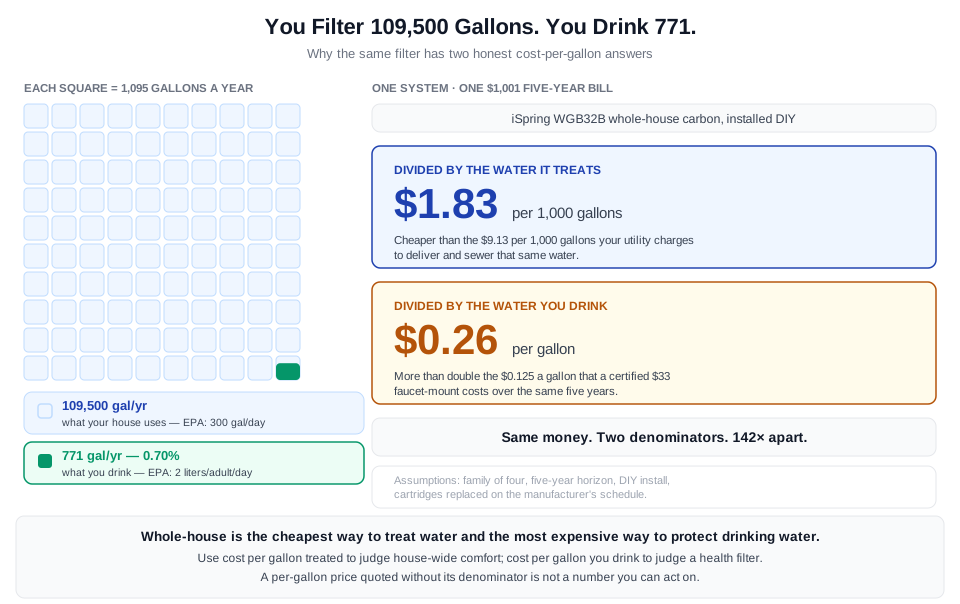
Filtering every gallon that enters your house costs about $1.83 per 1,000 gallons — cheaper than the roughly $9.13 per 1,000 gallons the average US household pays to have that water delivered and sewered (EPA WaterSense, 2026). Measured per gallon treated, that makes whole-house carbon the least expensive filtration you can buy. Measured per gallon you actually drink, the same system costs about $0.26 a gallon — more than double what a $33 faucet-mount costs, and the highest figure in this comparison (TapWaterData five-year model, 2026). Both numbers are correct; they differ by 142× because they divide the same money by two different denominators.
That gap is the whole decision. A household uses more than 300 gallons of water a day (EPA WaterSense, 2026) but drinks only about 2.1 gallons of it — under 1% (EPA, 2018). A whole-house system is priced to treat the 300; a drinking-water filter is priced to treat the 2. Whichever you buy, the five-year bill is driven less by the purchase price than by replacement cartridges, which run 53% to 95% of the total (TapWaterData five-year model, 2026).
This guide prices nine setups over five years from published cartridge capacities and real retail prices, and shows every assumption so you can redo the math for your own household. Every price, cartridge capacity, and replacement interval below was read off the manufacturer's own product page on July 25, 2026 and cross-checked against our survey of 51 filters sold on Amazon. If you have not yet settled which contaminant you are filtering, start with which filter type removes which contaminant — pricing the wrong technology is the most expensive mistake available.
Key takeaways
- Whole-house is the cheapest filtration per gallon treated and the most expensive per gallon you drink. $1.83 per 1,000 gallons treated versus $0.26 per drinking gallon, from one $1,001 five-year bill (TapWaterData five-year model, 2026).
- You drink under 1% of the water your house uses. EPA assumes 2 liters a day per adult; that is 2.1 gallons a day for a family of four against 300 gallons of household use (EPA, 2018; EPA WaterSense, 2026).
- Cartridges, not the purchase price, are the bill. Replacement media — plus, for reverse osmosis, the water sent to drain — is 53% to 95% of five-year cost in every tier.
- The cheapest certified path to safe drinking water is a $33 faucet-mount. Five-year total $482, or $0.125 per gallon you drink (PUR, 2026).
- Whole-house is bought for scope, not savings. It handles chlorine and sediment at every tap, but it is not the certified route for lead, PFAS, arsenic, or nitrate at the drinking tap (NSF, 2026).
Look up what's actually in your water first → See your city's latest reported results before you price a system — the contaminant decides the technology, and the technology decides the bill.
You might be wondering whether a cost comparison from a site carrying affiliate links will really land on the cheap answer. It lands on a $32.99 faucet-mount as the lowest five-year cost for certified drinking water, and on the $2,219 premium whole-house system as the highest cost per gallon consumed — close to the opposite of what commission-maximizing advice looks like. Our scoring weights contaminant coverage at 50% and affordability at 20%, with no input from commission rate.
What does filtering your tap water actually cost per gallon?
Cost per gallon is the right way to compare filters and the easiest number to state misleadingly, because every filter has two of them. A whole-house carbon system treats everything that enters the building — about 109,500 gallons a year for a family of four, from EPA's 300-gallons-a-day figure (EPA WaterSense, 2026). A pitcher or under-sink filter treats only what you pour, roughly 771 gallons a year using EPA's assumed intake of 2 liters per adult per day (EPA, 2018). Divide the same five-year bill by those two denominators and you get answers 142× apart.
Here is the honest version for the mid-range whole-house setup in this comparison. An iSpring WGB32B costs $470.97 on Amazon as of June 2026, and its three-cartridge replacement pack costs $105.99, rated at 100,000 gallons — which the manufacturer describes as about a year's supply for a family of four (iSpring, 2026). Over five years that is $1,001, or $1.83 per 1,000 gallons treated. For comparison, EPA WaterSense puts the average family's combined water and wastewater bill above $1,000 a year for those same 109,500 gallons, which works out to about $9.13 per 1,000 gallons (EPA WaterSense, 2026). Filtering your water costs about a fifth of what the utility charges to deliver it.
Now the other denominator. That same $1,001 divided by the 3,855 gallons the household will actually drink over five years is $0.26 per gallon. A certified pitcher, at a five-year total of $560, works out to $0.145 per drinking gallon — cheaper per gallon consumed, despite costing 16× less to buy. Neither number is spin. They answer different questions, and a filter comparison that quotes only one of them is not telling you enough to decide.
The practical rule: use cost per gallon treated when you are asking whether whole-house plumbing is worth it for comfort — shower water, skin, sediment, chlorine smell in every room. Use cost per gallon you drink when you are asking what it costs to make your drinking water meet a health standard. Those are separate purchases with separate justifications, and the rest of this guide prices them separately.
Why does the cheapest filter cost the most per gallon?
A $29.50 pitcher and a $470.97 whole-house system look like opposite ends of a budget spectrum. Per gallon of filtered water, they are the opposite of what the sticker suggests: the pitcher runs about $145 per 1,000 gallons, the whole-house system about $1.83 — a 79× difference in favor of the expensive-looking hardware (TapWaterData five-year model, 2026). The reason is not quality. It is that the whole-house system is amortized across 142× more water.
Cartridge economics drive this, and the arithmetic is unforgiving. A Brita Elite filter is rated at 120 gallons or 6 months, and costs $19.99 singly or $16.50 each in a two-pack (Brita, 2026). A family of four drinking 2.1 gallons a day works through 120 gallons in 57 days, so the gallons limit binds long before the calendar does: that is 6.4 filters a year, about $106, not the two filters a year the six-month interval implies (TapWaterData five-year model, 2026). The same effect is why a $30 pitcher can quietly cost more over five years than a $230 reverse-osmosis system.
Run the same test on the other side and the trap inverts. An Aquasana Claryum 3-Stage Max Flow cartridge set is rated 800 gallons or 6 months and costs $91.99 (Aquasana, 2026). A family of four reaches the six-month mark having filtered only about 386 gallons, so the calendar binds: two sets a year, $183.98, for 1,600 gallons of rated capacity against 771 gallons actually used. You pay for roughly twice the capacity you consume.
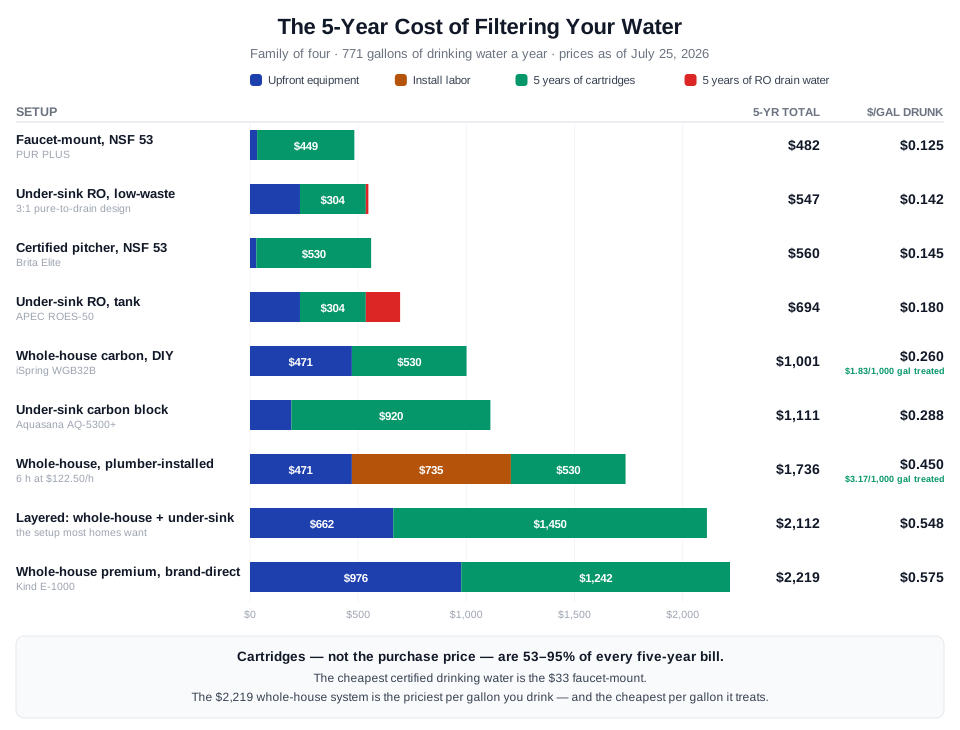
This is why sticker price is a poor guide. Across the five-year models below, recurring costs are 95% of the pitcher's total, 93% of the faucet-mount's, 83% of the under-sink carbon block's, 67% of the tank reverse-osmosis system's, and 53% of the DIY whole-house system's (TapWaterData five-year model, 2026). In every tier, the purchase price is the smaller half of what you will spend — so the number worth checking before you buy is the cartridge's price divided by its rated gallons, not the price on the box.
What does a whole-house system cost to buy, install, and run?
Whole-house equipment is cheaper than most people expect and the installed price is higher, which is why quotes vary so wildly. Across the nine point-of-entry systems in our own price survey, equipment alone runs $209 to $3,153 (TapWaterData price survey, 2026). Contractor-quote data puts a professionally installed whole-house system at $1,500 to $10,000 (Angi, 2026). Both figures circulate as "the cost of a whole-house filter," and mixing them is how a budget gets blown.
Labor explains the gap. Plumbers charge $45 to $200 an hour, and a whole-house install takes four to eight hours or more against one to two hours for a point-of-use system (Angi, 2026). That is $180 to $1,600 in labor for the same box, and doing it yourself saves $200 to $1,000 (Angi, 2026). In our five-year model, the DIY iSpring installation totals $1,001 and the same system professionally installed totals $1,736 — a 73% increase driven entirely by labor, which makes it the single largest swing factor in the whole comparison. Ask for a quote that itemizes equipment separately from labor; a bundled number cannot be compared to anything.
Running costs are steadier. The iSpring three-cartridge pack is $105.99 on Amazon or $125.99 direct, once a year (iSpring, 2026); contractor data puts whole-house maintenance more broadly at $150 to $500 a year (Angi, 2026). Premium brand-direct systems cost considerably more to feed: Kind Water Systems ships replacement filters for its E-1000 every six months at $124.22 a shipment on subscription, or $155.28 without — $248 to $311 a year, two to three times the iSpring pack (Kind Water Systems, 2026). At a $976.46 purchase price, that lands the E-1000 at $2,219 over five years, the highest total here (TapWaterData five-year model, 2026).
One thing the money does not buy is health-contaminant coverage at the tap. Whole-house carbon is certified under NSF/ANSI 42 for chlorine and taste, and some catalytic-carbon units carry NSF/ANSI 53 claims, but a high-flow tank at the point of entry is generally not the certified route for lead, PFAS, arsenic, or nitrate in the water you drink (NSF, 2026). If your report flags one of those, a whole-house system is an addition to a point-of-use filter, not a substitute — which is a scope question, not a savings question.
What does point-of-use filtration cost over five years?
Point-of-use covers pitchers, faucet-mounts, under-sink carbon blocks, and reverse osmosis, and the striking thing is how narrow the cost band is. Every tier lands between $0.125 and $0.288 per gallon you drink, a spread of barely more than 2×, across hardware priced from $29.50 to $230.99 (TapWaterData five-year model, 2026). The meaningful differences between them are not cost — they are which contaminants each is certified to remove.
The cheapest certified option is a faucet-mount. A PUR PLUS unit is $32.99, its filters are rated 100 gallons or 3 months at about $11.65 each in a three-pack, and it carries NSF/ANSI 53 claims for lead, mercury, VOCs, total PFAS, and microplastics (PUR, 2026). At 7.7 filters a year that is $89.87 annually and $482 over five years — $0.125 per drinking gallon, the lowest number in this guide (TapWaterData five-year model, 2026). A certified pitcher such as the Brita Elite, which is NSF-certified to NSF/ANSI 53 for lead reduction (Brita, 2026), comes in at $560 and $0.145 per gallon, and is the better answer if you rent and want nothing attached to the plumbing.
Under-sink carbon costs more than either, mostly because of that calendar-bound cartridge. An Aquasana AQ-5300+ at $191.24 with two $91.99 cartridge sets a year totals $1,111 over five years, or $0.288 per drinking gallon (Aquasana, 2026) — the most expensive point-of-use option, though it buys the broadest carbon-side certification list of the group, covering NSF/ANSI 42, 53, and 401. Reverse osmosis sits in between: an APEC ROES-50 is $230.99, and feeding it costs $60.88 a year using the manufacturer's own parts pricing — a $29.95 pre-filter set, a $14.95 inline carbon post-filter, and a $39.95 membrane amortized across two and a half years (APEC, 2026).
Reverse osmosis is also the only point-of-use tier where the water bill enters the calculation, and that is worth its own section.
How much water and money does reverse osmosis actually waste?
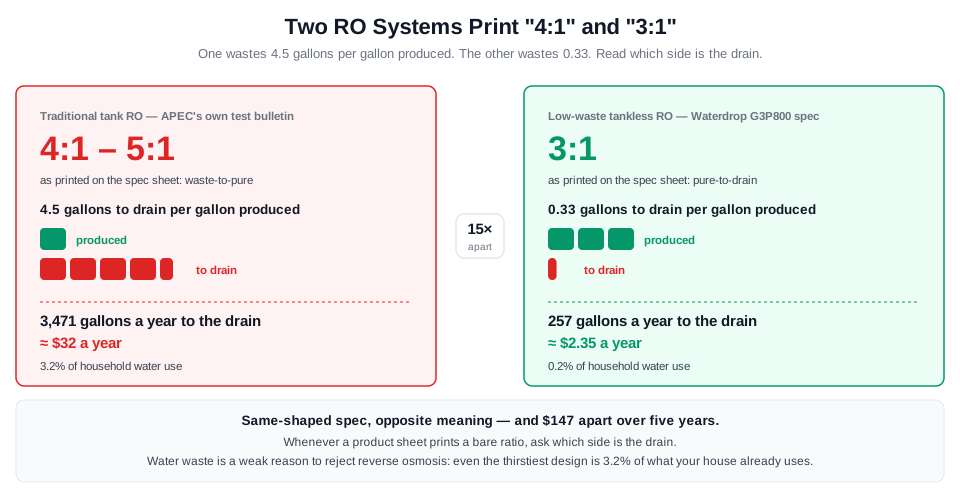
Reverse osmosis sends water to the drain to keep its membrane clear, and the amount depends heavily on the design. APEC's own test bulletin for its tank systems states it plainly: the system "takes 4-5 gallons of waste water to make 1 gallon pure water," so the waste ratio should read 4:1 to 5:1 (APEC, 2026). Waterdrop's tankless G3P800, by contrast, is sold as 3:1 pure to drain — three gallons produced per gallon sent to the drain (Waterdrop, 2026).
Read those two ratios carefully, because they run in opposite directions. One means 4.5 gallons wasted per gallon produced; the other means 0.33 gallons wasted per gallon produced. Two similar-looking specs, about 15× apart in what they actually cost you. Whenever a product sheet prints a bare ratio, the useful question is which side is the drain.
The money is smaller than the reputation suggests. At a 4.5:1 waste ratio, a family of four producing 771 gallons of drinking water a year sends about 3,471 gallons to the drain — 3.2% of household use, or roughly $32 a year at $9.13 per 1,000 gallons (EPA WaterSense, 2026). That takes the APEC system to $694 over five years, or $0.180 per drinking gallon (TapWaterData five-year model, 2026). The same hardware with a 3:1 pure-to-drain design wastes 257 gallons a year, about $2.35, and comes in at $547 and $0.142 per gallon — a $147 saving over five years and roughly 16,000 gallons of water (TapWaterData five-year model, 2026).
So water waste is a real line item and a poor reason to reject reverse osmosis on cost, since 3.2% of household use is a fraction of what a single lawn or a long shower consumes. If you live somewhere with drought restrictions or top-quartile water rates — national water and sewer bills rose 5.1% last year across the 50 largest cities (Bluefield Research, 2026) — the low-waste design is worth the search. If you don't, the difference is about $29 a year.
Which setup costs less for your situation?
The table below prices nine architectures over five years for a family of four, sorted from cheapest to most expensive total. Assumptions are stated so you can substitute your own: drinking water 771 gallons a year (EPA's 2 liters per adult per day), total household use 109,500 gallons a year (EPA's 300 gallons a day), combined water and sewer at $9.13 per 1,000 gallons, cartridges replaced on the manufacturer's "gallons or months, whichever comes first" rule, no discounting, no repairs.
| Setup | Upfront (equipment) | Install | Cartridges $/yr | 5-year total | $ per gallon you drink |
|---|---|---|---|---|---|
| Faucet-mount, NSF 53 (PUR PLUS) | $32.99 | $0 DIY | $90 | $482 | $0.125 |
| Under-sink RO, low-waste 3:1 design | $230.99 | $0 DIY | $61 + $2 water | $547 | $0.142 |
| Certified pitcher, NSF 53 (Brita Elite) | $29.50 | none | $106 | $560 | $0.145 |
| Under-sink RO, traditional tank (APEC ROES-50) | $230.99 | $0 DIY | $61 + $32 water | $694 | $0.180 |
| Whole-house carbon, DIY (iSpring WGB32B) | $470.97 | $0 DIY | $106 | $1,001 | $0.260 ($1.83 per 1,000 gal treated) |
| Under-sink carbon block (Aquasana AQ-5300+) | $191.24 | $0 DIY | $184 | $1,111 | $0.288 |
| Whole-house carbon, plumber-installed | $470.97 | $735 | $106 | $1,736 | $0.450 ($3.17 per 1,000 gal treated) |
| Layered: whole-house + under-sink carbon | $662.21 | $0 DIY | $290 | $2,112 | $0.548 |
| Whole-house premium, brand-direct (Kind E-1000) | $976.46 | $0 DIY | $248 | $2,219 | $0.575 |
| US-typical starting point | $33–$231 | $0 DIY | $61–$106 | $482–$694 | $0.13–0.18 |
Sources: manufacturer replacement-filter pages for Brita, PUR, Aquasana, APEC, iSpring, and Kind Water Systems, retrieved July 25, 2026; hardware prices from TapWaterData's 51-filter price survey (Amazon, June–July 2026); labor rates from contractor-quote market data (Angi, 2026); household water volumes and costs from EPA WaterSense (2026); drinking-water intake from EPA's Drinking Water Standards and Health Advisories tables (EPA, 2018). Prices are ranges as of July 25, 2026 and drift. How we compiled this: our data and methodology.
Reading that against your own situation:
- If your only complaint is chlorine taste and you rent, a certified pitcher or faucet-mount at $482 to $560 over five years is the whole answer (TapWaterData five-year model, 2026). Do not buy plumbing you cannot take with you.
- If your report shows lead or PFAS and you filter one tap, an NSF/ANSI 53 faucet-mount at $482 is the cheapest certified path; an under-sink carbon block costs more but covers a longer claim list (NSF, 2026).
- If arsenic, fluoride, nitrate, or chromium-6 is flagged, you need reverse osmosis — carbon does not remove those at any price (NSF, 2026). Budget $547 to $694, and prefer the low-waste design.
- If the chlorine smell bothers you in every shower, whole-house carbon is the only architecture that fixes it, and at $1.83 per 1,000 gallons it is the cheapest filtration here per gallon treated. Budget $180 to $1,600 for a plumber or do it yourself (Angi, 2026).
- If you want both, the layered setup runs $2,112 over five years, and the point-of-use half is the cheap half. Expect the whole-house stage to handle comfort, not the health claims.
- If you do not know what is in your water, test before you buy. A lab panel costs far less than the wrong $1,700 system.
Know your tier but not your model? → Check what a specific filter is certified to remove, or browse by form factor: whole-house, under-sink, reverse osmosis, faucet-mount, and pitcher.
How do you price this for your own home?
The five-year number is not hard to build, and building it yourself beats trusting a range you found online. Six steps, about half an hour.
- Settle the contaminant question before the cost question. Pull your Consumer Confidence Report or a lab test and identify what you are actually removing, then check which technology can do it in the filter-type matrix. Pricing carbon for a nitrate problem is the most expensive error available.
- Count your gallons, both ways. Household use is roughly 82 gallons per person per day (EPA WaterSense, 2026); drinking water is about half a gallon per person per day on EPA's intake assumption (EPA, 2018). You will need both denominators.
- Read the cartridge rating and find which limit binds. Cartridges are rated in gallons or months, whichever comes first. Divide your annual drinking gallons by the cartridge's rated gallons, compare that against the calendar interval, and use whichever produces more cartridges per year.
- Get the install quote itemized. Equipment and labor must be separate lines, at $45 to $200 an hour and four to eight hours for whole-house work (Angi, 2026). A bundled quote cannot be compared against a second bundled quote.
- Add the drain water if you are pricing reverse osmosis. Multiply your annual drinking gallons by the waste ratio, then by your water and sewer rate — and confirm which side of the printed ratio is the drain.
- Verify the exact model's certification before you pay. A tier only makes a claim possible; the model's NSF, IAPMO, or WQA listing is the proof. Check it in the certification checker.
Ready to put a number on your own water? → Start from your city's reported results, then price the tier your contaminant actually needs.
Reading this from a different angle?
- Haven't picked a technology yet? Start with which filter type removes which contaminant — settle the technology question before the cost question.
- Unsure what the certifications mean? Read what NSF 42, 53, 58, and 401 actually cover.
- Working from your own numbers? See how to choose a filter from your water data, and whether filter certifications meet the EPA health goal.
- Pricing hard water too? The water softener cost guide covers the other point-of-entry purchase — a softener is not a contaminant filter (NSF, 2026).
Methodology and disclosure
This guide draws on EPA WaterSense's household water-use and cost averages, EPA's 2018 Edition of the Drinking Water Standards and Health Advisories Tables for the assumed 2-liter-per-adult daily intake, the NSF/ANSI 42, 53, 58, 401, and 44 standard scopes, manufacturer product and replacement-filter pages for Brita, PUR, Aquasana, APEC, iSpring, Waterdrop, and Kind Water Systems retrieved July 25, 2026, contractor-quote market data from Angi's 2026 dataset for labor rates, and TapWaterData's own price survey of 51 filters scraped from Amazon between June 7 and July 19, 2026. The five-year model and every assumption behind it are reproducible; where a manufacturer's stated cartridge schedule disagreed with our internal cost estimate, we used the manufacturer's figure.
Disclosure. This comparison considered 51 filters across six form factors, including the APEC and Aquasana systems sold brand-direct and the Kind Water Systems units sold direct-to-consumer, which earn TapWaterData little or no commission. Recommendations are scored by our published methodology — 50% contaminant coverage, 30% Amazon rating, 20% affordability — independent of commission rate. Amazon and brand-direct links in our filter guides are affiliate links that earn TapWaterData a commission at no additional cost to you; note that this guide's conclusion — that a $32.99 faucet-mount is the cheapest certified path to safe drinking water, and that the $2,219 premium whole-house system is the most expensive per gallon consumed — points away from our highest-commission products. Full methodology: our data page.