Pediatricians and public-health agencies effectively work from the health goal, not the legal limit — and the two are often far apart. The EPA's enforceable limit (the MCL) is set "as close to the maximum contaminant level goal as is feasible," with feasibility defined around the best available treatment and its cost (42 U.S.C. 300g-1). The health goal itself (the MCLG) is "the level at which no known or anticipated adverse effects on the health of persons occur," with a margin of safety, and for likely carcinogens it is zero (EPA, 2024). Medical guidance for children tends to live near that goal, because a child is not a small adult: per pound of body weight, an infant on formula drinks far more water than you do, and several contaminants do their damage during narrow developmental windows.
The clearest case is nitrate. The EPA's 10 mg/L nitrate limit was not set for the general population's convenience — it was set specifically because higher levels can cause methemoglobinemia, "blue baby syndrome," in infants under six months (EPA, 2024). The limit is the pediatric limit. For other contaminants the health-only number sits dramatically below the legal one: California's Public Health Goal for arsenic, a health-protective level set without cost considerations, is 0.004 ppb against the federal MCL of 10 ppb (California OEHHA, 2024).
This guide explains why a child meets the health goal's logic harder than an adult does, where pediatric and public-health limits actually sit, and what a parent does with the gap. The fastest place to start is your own water — look up your city to see which of these contaminants your utility even reports.
✅ What pediatric guidance actually tracks:
- Medical guidance tracks the health goal, not the legal limit. The MCL is the enforceable limit adjusted for treatment cost; pediatric and public-health benchmarks sit near the non-enforceable MCLG, which is zero for carcinogens (EPA, 2024; 42 U.S.C. 300g-1).
- The nitrate limit is a pediatric limit. The EPA set the 10 mg/L nitrate MCL specifically to protect infants under six months from methemoglobinemia (EPA, 2024) — and boiling concentrates nitrate rather than removing it (EPA, 2024).
- For lead, there is no safe level. The CDC has identified no safe blood lead level in children; its blood lead reference value of 3.5 µg/dL is a screening cutoff, "not health-based and not a regulatory standard" (CDC, 2024).
- Health-only goals sit far below legal limits. California's Public Health Goals — health-protective, set without cost considerations — are 0.004 ppb for arsenic and 0.007 ppt for PFOA, against federal MCLs of 10 ppb and 4 ppt (California OEHHA, 2024).
- For formula, fluoride matters below the legal limit. The legal fluoride MCL is 4.0 mg/L, but the level relevant to infants is far lower — reconstituting formula with fluoridated water may raise the chance of mild dental fluorosis, so the AAP and ADA suggest low-fluoride water some of the time (CDC, 2024; ADA, 2024).
See your utility's most recent report and the contaminants it measures — the fastest way to know which pediatric risks are even possible at your tap.
You might be wondering whether this is a setup to scare you about your baby's water or sell you a filter. It is neither. Most U.S. utilities deliver water that meets every federal limit, and for most families that water is fine for a baby. The goal here is narrow: show you which of the genuine pediatric risks could apply to your home, so you spend worry only where the data says it belongs.
What's the difference between a legal limit and a health goal?
Two numbers govern every regulated contaminant, and only one is enforceable. The MCL (Maximum Contaminant Level) is the legal ceiling your utility must keep the water at or below; the MCLG (Maximum Contaminant Level Goal) is the non-enforceable health goal (EPA, 2024). The Safe Drinking Water Act defines the MCLG as the level "at which no known or anticipated adverse effects on the health of persons occur and which allows an adequate margin of safety" (42 U.S.C. 300g-1). The MCLG is the purer health statement, because cost plays no part in it.
The legal limit is deliberately pulled away from the health goal by feasibility. The statute requires the MCL to be set "as close to the maximum contaminant level goal as is feasible," and defines "feasible" around the best available treatment technology, taking cost into consideration (42 U.S.C. 300g-1). So the enforceable limit is the health goal, adjusted for what every utility in the country can actually achieve and afford. For a likely carcinogen, where "no known safe dose" makes the health goal zero, that adjustment leaves a wide gap between the legal limit and the goal (EPA, 2024).
This is why "meets EPA standards" and "at the level a pediatrician would choose" are different sentences. Compliance means the water is at or below the legal MCL. Pediatric and public-health guidance, freed from the cost calculation, lands closer to the MCLG. The gap between them is exactly the territory parents need to understand — and it is widest for the contaminants that hit children hardest.
Why does the same limit land harder on a child than an adult?
Because the dose is not the same. A limit is a concentration — a contaminant per liter of water — but the harm depends on dose, which is concentration times how much a body takes in relative to its size. An infant who drinks mostly reconstituted formula consumes far more water per pound of body weight than an adult does, so the same legal concentration delivers a larger dose to the child (CDC, 2024). The legal limit is written for the general population; the youngest household members sit at its sensitive edge.
Timing compounds the size effect. Several contaminants act during developmental windows that don't exist for adults. Lead is the clearest: even low exposures are associated with developmental delays and learning and behavioral effects in children, which is why the CDC states there is no safe blood lead level in children (CDC, 2024). Nitrate is acute and age-specific: it is "most serious for infants" under six months, where it interferes with the oxygen-carrying capacity of a baby's blood (EPA, 2024; ATSDR, 2017). These are not adult risks scaled down — they are risks specific to a developing body.
The result is that a single legal limit can be simultaneously protective for an adult and loose for an infant. The EPA acknowledges this directly in how it set the nitrate number: 10 mg/L exists to protect infants, the most susceptible group, not because adults are at risk at 10 mg/L (EPA, 2024). When a contaminant's most sensitive population is children, the legal limit and the pediatric limit converge — and when it isn't, they pull apart.
Where do pediatric and public-health limits actually sit — at the MCL or the MCLG?
Near the MCLG, almost always. The cleanest way to see this is to stack the numbers for one contaminant. Take arsenic, a likely carcinogen: the federal legal limit is 10 ppb, the federal health goal is zero, and California's Public Health Goal — a health-protective level set "based exclusively on public health considerations, without regard to economic cost or feasibility" — is 0.004 ppb (EPA, 2024; California OEHHA, 2024). The health-only number sits essentially on the floor, 2,500 times below the legal limit and right next to the zero goal.
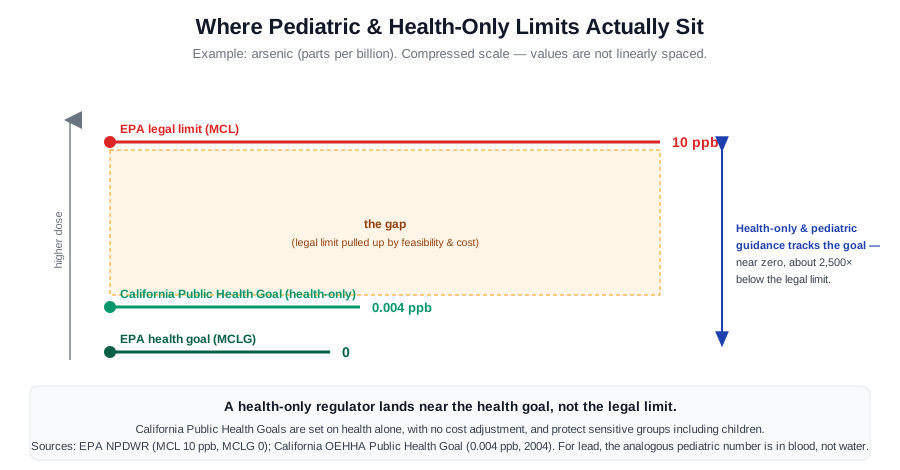
Public Health Goals are the closest thing to a "what would a health-only regulator pick?" number, and they are built to protect sensitive subpopulations. By statute, a Public Health Goal is the level posing no significant health risk over a lifetime, set on public-health grounds alone and including a margin of safety for vulnerable groups (California OEHHA, 2024). They are not enforceable limits and not competing laws — they are the health goal expressed as a concrete number, which is why they cluster near the MCLG: arsenic 0.004 ppb, PFOA 0.007 ppt, PFOS 1 ppt, copper 0.3 mg/L, all far below their federal legal limits (California OEHHA, 2024).
Lead needs a careful caveat here, because its most-cited pediatric number is not a water concentration at all. The CDC's blood lead reference value of 3.5 µg/dL is measured in a child's blood, not in water, and it is a screening tool set at the 97.5th percentile of U.S. children ages 1-5 — "not health-based and not a regulatory standard" (CDC, 2024). It flags children with higher-than-typical exposure; it does not define a safe level, because for lead there is none (CDC, 2024). So for lead, the pediatric posture isn't "stay under a number" — it's "minimize exposure," which tracks the MCLG of zero.
Which contaminants matter most for a child, and what are their gaps?
The contaminants worth a parent's attention are the ones where the gap between the legal limit and the health goal is wide, plus the two where the limit is itself the pediatric limit. The table maps each to its legal limit, its health goal, a stricter health-only or pediatric benchmark, and the parent action — using each contaminant's official unit.
| Contaminant | EPA legal limit | EPA health goal (MCLG) | Stricter health-only / pediatric benchmark | What a parent does |
|---|---|---|---|---|
| Lead | No MCL; action level 15 ppb (→10 under the 2024 LCRI) | 0 | No safe blood lead level; CDC blood reference value 3.5 µg/dL (a blood screening cutoff, not a water limit) | Cold water only, flush after stagnation, NSF/ANSI 53 lead filter; test older homes |
| Nitrate (as N) | 10 mg/L | 10 mg/L (no gap) | The 10 mg/L limit is the infant limit (set for infants under 6 months) | Check your CCR; on a well, test before formula; never use water near 10 mg/L for an infant; do not boil |
| Arsenic | 10 ppb | 0 | California Public Health Goal 0.004 ppb | If detected, NSF/ANSI 58 reverse osmosis; test private wells |
| Fluoride | 4.0 mg/L | 4.0 mg/L (no gap) | U.S. optimal 0.7 mg/L; low-fluoride water for formula (AAP/ADA) | Use low-fluoride water some of the time for formula, or ready-to-feed formula |
| PFOA | 4 ppt | 0 | California Public Health Goal 0.007 ppt | If of local concern, an NSF/ANSI 53 or 58 filter certified for PFAS |
| PFOS | 4 ppt | 0 | California Public Health Goal 1 ppt | Same as PFOA |
| Copper | 1.3 mg/L (action level) | 1.3 mg/L (no gap) | California Public Health Goal 0.3 mg/L | Flush stagnant water; copper comes mostly from home plumbing |
| Uranium | 30 ppb | 0 | California Public Health Goal 0.5 ppb | If detected (common in some wells), reverse osmosis |
| Summary — your household | Set "as close to the goal as feasible," for the general population | 0 for carcinogens; the limit itself for nitrate and fluoride | Health-only goals (PHGs) cluster near the MCLG | Match each action to what your CCR or well test actually shows |
Sources: EPA National Primary Drinking Water Regulations and 2024 PFAS rule (legal limits and MCLGs); EPA 2024 Lead and Copper Rule Improvements (lead action level 15→10 ppb); CDC (no safe blood lead level; blood lead reference value 3.5 µg/dL; nitrate infant risk; optimal fluoride 0.7 mg/L); AAP and ADA (low-fluoride water for formula); California OEHHA Public Health Goals (arsenic, PFOA, PFOS, copper, uranium). Nitrate is measured as nitrogen; the blood lead reference value is a blood concentration, not a water limit. How this table was assembled: our data and methodology. Pediatric statements here are drawn only from CDC, ATSDR, AAP, and ADA.
Two rows show the pattern from both directions. Nitrate and fluoride have no gap between the legal limit and the health goal — but for different pediatric reasons. Nitrate's limit is the infant limit, so a result well under 10 mg/L means the water is at the pediatric target (EPA, 2024). Fluoride's legal limit (4.0 mg/L) guards against skeletal effects, but the level that matters for a formula-fed infant is far lower: reconstituted formula made with fluoridated water as a baby's main food may raise the chance of mild dental fluorosis, which is why the guidance is low-fluoride water some of the time, not the 4.0 mg/L limit (CDC, 2024; ADA, 2024).
Where does lead fit, with "no safe level"?
Lead is the contaminant where the gap is the entire goal, and where a child's exposure is hardest for any agency to see. Lead has no MCL — it is regulated by a treatment technique with an action level of 15 ppb, dropping to 10 ppb under the 2024 Lead and Copper Rule Improvements — and its MCLG is zero (EPA, 2024). The zero is not caution for its own sake: the CDC has identified no safe blood lead level in children, and even low levels are associated with effects that can be permanent (CDC, 2024).
The action level is widely misread as a safe line for a child, and it is the opposite. It is a system-wide statistical trigger: if more than 10 percent of sampled high-risk taps exceed it, the utility must act (EPA, 2024). Your own faucet can sit below the action level and still deliver lead, because the rule measures the system, not your home. And lead largely enters from your home's own plumbing — the service line, solder, and fixtures past the property line — so the utility's compliance number can't speak for the water in your baby's bottle.
This is why pediatric lead guidance is about exposure, not a threshold. The AAP's specifics for formula are concrete: never use hot tap water to make a bottle, because lead is likely highest in hot water; use only cold water; and if the cold tap has sat unused for more than six hours, let it run 15 to 30 seconds first (AAP, 2024). If you have an older home or a lead or unknown service line, the only way to know your tap's level is an independent certified-lab test, and the only filter worth using for lead is one certified to reduce it (NSF/ANSI 53).
So does "meets EPA standards" mean the water is safe for my baby?
"Meets EPA standards" means the water is in compliance — every regulated contaminant is at or below its enforceable legal limit (EPA, 2024). For a household with a baby, that is necessary but not the whole question, because the legal limit is written for the general population and, for carcinogens, still sits above the health goal of zero. So the accurate read is: the water is compliant, and here are the specific contaminants where a pediatrician would want to look closer.
For most families, that closer look is reassuring. If your CCR shows nitrate well under 10 mg/L, the single most infant-specific risk is not in play, because that limit exists to protect infants (EPA, 2024). If your water is chlorinated city water with no lead plumbing and nothing else flagged, it is generally fine for formula with the basic cold-water-and-flush routine. "Compliant" genuinely covers most households most of the time.
The closer look earns its keep in specific situations: an older home or a lead or unknown service line (where lead's zero-gap matters and the utility number can't see your tap), a private well (where no agency tests for you), or a local detection of a wide-gap contaminant like arsenic or PFAS. In those cases, the gap between the legal limit and the health goal is not abstract — it is the reason to test your own water and, if a result warrants it, to filter for the specific contaminant.
What should a parent actually do?
Start by reading your own report against both numbers. Pull your CCR — look up your city to find it — and for each detected contaminant, note whether it has a gap. Nitrate and fluoride safely under their limits are settled for an infant (with the fluoride-for-formula note above). A wide-gap contaminant like arsenic or PFAS detected at a level that concerns you is legal and still above the health goal, which is where a closer look pays off.
From there, match the action to your situation rather than a universal rule. On city water with nothing flagged, the cold-water-and-flush routine for formula is usually all that's needed. With an older home or a lead or unknown line, the move is a certified-lab lead test at your own tap plus an NSF/ANSI 53 lead-certified filter, because the utility's action-level result can't speak for your faucet (EPA, 2024). On a private well, test for nitrate before a baby is on formula and follow the CDC's annual panel, since no layer above you is testing it (CDC, 2024).
The one move that never makes sense is buying a filter — or losing sleep — over a number you haven't read. The gap between the legal limit and the health goal is a tool for spending a parent's attention only where the data says it belongs.
💡 Start with your child's water. Look up your city to pull your utility's most recent report, then read each detected contaminant against both its legal limit and its health goal — no fear, no sales pitch, just what the data says about your child's water. :::
Reading this from a different angle?
- Want the broad overview? Read what's the difference between MCL and MCLG? → — the same gap, without the pediatric lens.
- Ready to pick a filter? Read whether filter certifications match the EPA health goal → — what "certified to reduce" leaves in your glass versus the MCLG.
- Worried about who's responsible? Read who protects your child's drinking water → — the four layers, and the one that's yours.
Sources and disclosure
This guide draws on EPA primary sources (the National Primary Drinking Water Regulations; the SDWA definitions of MCL, MCLG, and "feasible" in 42 U.S.C. 300g-1; the 2024 PFAS rule; and the 2024 Lead and Copper Rule Improvements), CDC sources (no safe blood lead level; the blood lead reference value of 3.5 µg/dL; nitrate infant risk; the optimal fluoride level of 0.7 mg/L), ATSDR's nitrate health profile (2017), American Academy of Pediatrics and American Dental Association guidance on lead and fluoride for infants, and California OEHHA Public Health Goals — alongside the city Consumer Confidence Reports we aggregate across 18,774 U.S. cities. Pediatric and medical statements here are drawn only from the CDC, ATSDR, AAP, and ADA; this guide is informational and is not medical advice for an individual child.
Disclosure. This guide contains no affiliate links, but it links to our Filter Buyer guides, which do contain affiliate links — Amazon and brand-direct links that earn TapWaterData a commission at no additional cost to you. Recommendations there are scored by our published methodology — 50% contaminant coverage, 30% Amazon rating, 20% affordability — independent of commission rate. More about our data and how we work.