Disinfection byproducts (DBPs) are the chemical tradeoff of safe drinking water — and on the math that matters, the tradeoff is worth it. When utilities add chlorine or chloramine to kill the pathogens that once caused cholera and typhoid outbreaks, those disinfectants also react with naturally occurring organic matter to form byproducts. The EPA regulates four families of them, capping total trihalomethanes (TTHMs) at 80 micrograms per liter (µg/L) and the five regulated haloacetic acids (HAA5) at 60 µg/L — limits set in the 1998 Stage 1 rule (EPA, 40 CFR 141.64).
That tradeoff matters because the byproducts carry a small, chronic cancer risk that scales with how much water a whole population drinks over a lifetime. The EPA's own central estimate is that roughly 8,000 of the ~79,000 annual US bladder-cancer cases — about 10% — may be attributable to chlorination byproducts, assuming the epidemiology is causal (Weisman et al., EPA, 2022). That is a population-level, lifetime risk, not an acute one: chlorination still prevents far more illness than its byproducts are estimated to cause.
This guide covers what DBPs are, which ones the EPA regulates, what the health evidence actually says, why your Consumer Confidence Report can under-report them, where your exposure really comes from, and which filters reduce them. The fastest way to see your own numbers is to look up your city and read your utility's most recent TTHM and HAA5 results.
Key takeaways
- DBPs are a tradeoff, not a failure. Chlorination prevents far more illness than its byproducts are estimated to cause; the EPA regulates four families, capping TTHM at 80 µg/L and HAA5 at 60 µg/L since 1998 (EPA, 40 CFR 141.64).
- The cancer signal is real but modest. EPA's central estimate is ~8,000 of ~79,000 annual US bladder cancers may be attributable to DBPs (Weisman et al., 2022) — a chronic, lifetime risk, not an acute one.
- Most exposure is from showering, not drinking. An estimated 25–60% of trihalomethane exposure comes from showering and bathing, and hot water increases it; a bathroom fan cuts modeled inhalation risk about 35% (risk-assessment modeling, 2023).
- Your CCR can hide a spike. Compliance is a running annual average, so a single quarter above 80 µg/L can be averaged below the limit (EPA, 40 CFR 141 Subpart V).
- A standard Brita does not remove them. NSF/ANSI 42 covers chlorine taste only; reducing trihalomethanes needs NSF/ANSI 53 with a VOC claim, reverse osmosis, or distillation (NSF/ANSI).
Look up your city's water → See your utility's TTHM and HAA5 results — the same disinfection-byproduct data your utility is required to report each year.
You might be wondering whether this is another "your tap water is dangerous" article. It isn't. Disinfection is one of the great public-health wins of the last century, and the byproducts are a managed, regulated side effect — not a hidden scandal. The honest question this guide answers is narrower: how much should you actually worry about the TTHM and HAA5 lines on your water report, and what — if anything — is worth doing about them.
What are disinfection byproducts, and why are they in my water?
Disinfection byproducts are the chemicals formed when a disinfectant reacts with organic material already present in source water. Chlorine, chloramine, ozone, and chlorine dioxide are added to drinking water to kill cholera, typhoid, Giardia, and the other pathogens that made untreated water dangerous. They work — but those same disinfectants also react with naturally occurring organic matter, such as decaying leaves, agricultural runoff, and algae, to produce byproducts (EPA, Stage 1/2 DBPR).
More than 700 distinct disinfection byproducts have been characterized in chlorinated water (EPA; peer-reviewed surveys). Only a handful are regulated. The unregulated majority is why this is an active area of research rather than a closed question — but it is not a reason to stop disinfecting, because the alternative is the waterborne disease disinfection was introduced to prevent.
Two variables drive how many byproducts form: how much organic matter is in the source water, and how much disinfectant contact time the water gets. That is why DBP levels are seasonal — warm weather plus more organic matter plus chlorine produces a summer peak — and why surface-water systems generally form more than groundwater systems (EPA). It is also why two houses on the same street can see different numbers if they are served by different utilities.
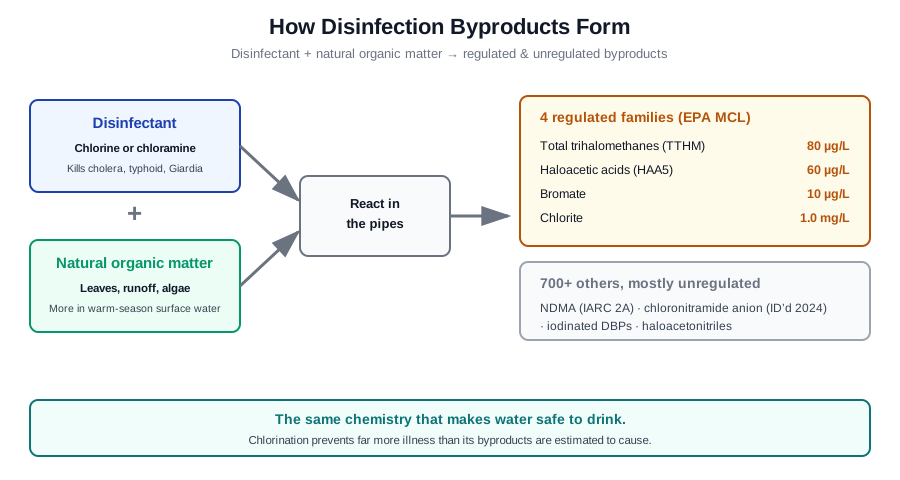
The takeaway: DBPs are not a sign your utility is failing. They are the expected, regulated consequence of the disinfection that makes the water safe to drink in the first place.
Which disinfection byproducts does the EPA regulate?
The EPA enforces a maximum contaminant level (MCL) on four families of disinfection byproducts, plus residual limits on the disinfectants themselves. The four byproduct families and their MCLs are total trihalomethanes (TTHM) at 80 µg/L, the five haloacetic acids (HAA5) at 60 µg/L, bromate at 10 µg/L, and chlorite at 1.0 mg/L (EPA, 40 CFR 141.64). The disinfectant residual limits (MRDLs) are 4.0 mg/L for chlorine and chloramines and 0.8 mg/L for chlorine dioxide (EPA, 40 CFR 141.65).
TTHM and HAA5 are the two you will actually see on a CCR. TTHM is the sum of four trihalomethanes — chloroform, bromodichloromethane, dibromochloromethane, and bromoform. HAA5 is the sum of five haloacetic acids. The practical difference matters for filtering: trihalomethanes are volatile (they evaporate, which is why showering exposes you), while haloacetic acids are non-volatile and tend to be harder to remove. Bromate comes specifically from ozone disinfection of water containing bromide, and chlorite from chlorine-dioxide disinfection — so most chlorinated systems report TTHM and HAA5 but not the other two.
The individual trihalomethanes carry their own EPA health goals, which is where the "no safe level" framing comes from. Chloroform has a maximum contaminant level goal (MCLG) of 0.07 mg/L, dibromochloromethane 0.06 mg/L, while bromodichloromethane and bromoform have an MCLG of zero (EPA, 40 CFR 141.53). A goal of zero does not mean the water is unsafe at the legal limit; it means the EPA could not identify a threshold below which the cancer risk is definitively zero, so the health goal — distinct from the enforceable limit — is set at zero. That gap between the legal MCL and the health-based MCLG is the single most useful concept for reading any water report; we cover it in depth in MCL vs. MCLG.
Are disinfection byproducts in tap water actually dangerous?
The honest answer is that the risk is real, measurable at the population level, and modest at the individual level. Bladder cancer is the strongest and most consistent signal. The EPA's central estimate is that roughly 8,000 of the ~79,000 US bladder-cancer cases each year may be attributable to chlorination disinfection byproducts — about 10% — under the assumption that the epidemiological associations are causal (Weisman et al., EPA, 2022).
To put the strength of that association in perspective: a 2023 dose-response meta-analysis found a roughly linear relationship between trihalomethane exposure and bladder cancer, with a relative risk of about 1.08 per exposure increment, and a stronger signal for the brominated byproduct bromodichloromethane at about 1.33 (2023 meta-analysis). Those are meaningful at the scale of a national population but much smaller than the individual risk from smoking or family history. The EPA, the International Agency for Research on Cancer, and California's OEHHA all classify chloroform, bromodichloromethane, and several haloacetic acids as possible or probable human carcinogens.
For pregnancy, the evidence is suggestive but not settled. Some studies have found small associations between high trihalomethane levels and stillbirth or low birth weight, but the confidence intervals frequently include 1.0 (no effect), and a UK utility intervention that reduced chloroform did not significantly reduce stillbirth. The EPA's own characterization is that, for reproductive and developmental effects, the science is not yet conclusive. Treat it as a reason for reasonable caution, not alarm.
One framing detail keeps the numbers in proportion: the EPA's limits assume someone drinks about 2 liters of water a day for 70 years. The risk the epidemiology measures is long-term and low-level. A short stretch above the MCL — a single bad quarter — is not an acute health event.
Why might my CCR under-report disinfection byproducts?
Your Consumer Confidence Report can show a compliant annual average even during a quarter when your water briefly exceeded the limit — and that is by design, not deception. Under the Stage 2 rule, compliance for TTHM and HAA5 is calculated as a Locational Running Annual Average (LRAA): the average of the most recent four quarters of results at each monitoring site (EPA, 40 CFR 141 Subpart V, §141.621).
Because DBP formation peaks in warm months, a system can post a single summer quarter above 80 µg/L and still meet the standard once that result is averaged with three cooler quarters. The annual number on your CCR is real and accurate — but it can mask the seasonal spike that someone drinking unfiltered tap water in August actually experienced. This is why the byproducts on your CCR sometimes look calmer on paper than the underlying chemistry.
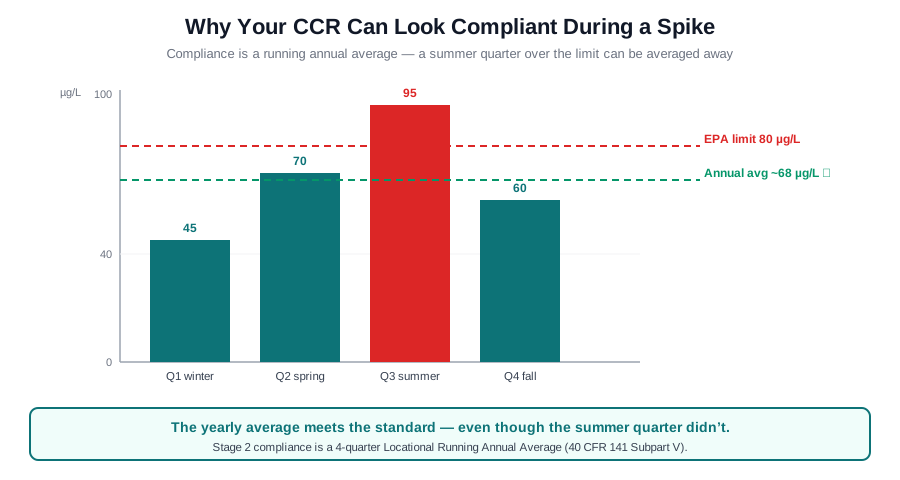
This matters in two ways. First, if your CCR reports TTHM or HAA5 anywhere near the limit on an annual basis, your warm-season peaks are likely higher than that average. Second, a one-quarter exceedance is not the emergency a single scary-looking number can suggest — it is the system being measured at its seasonal worst. The way to see your own utility's reported figures is to read your CCR or look up your city directly.
Where does most of your DBP exposure come from?
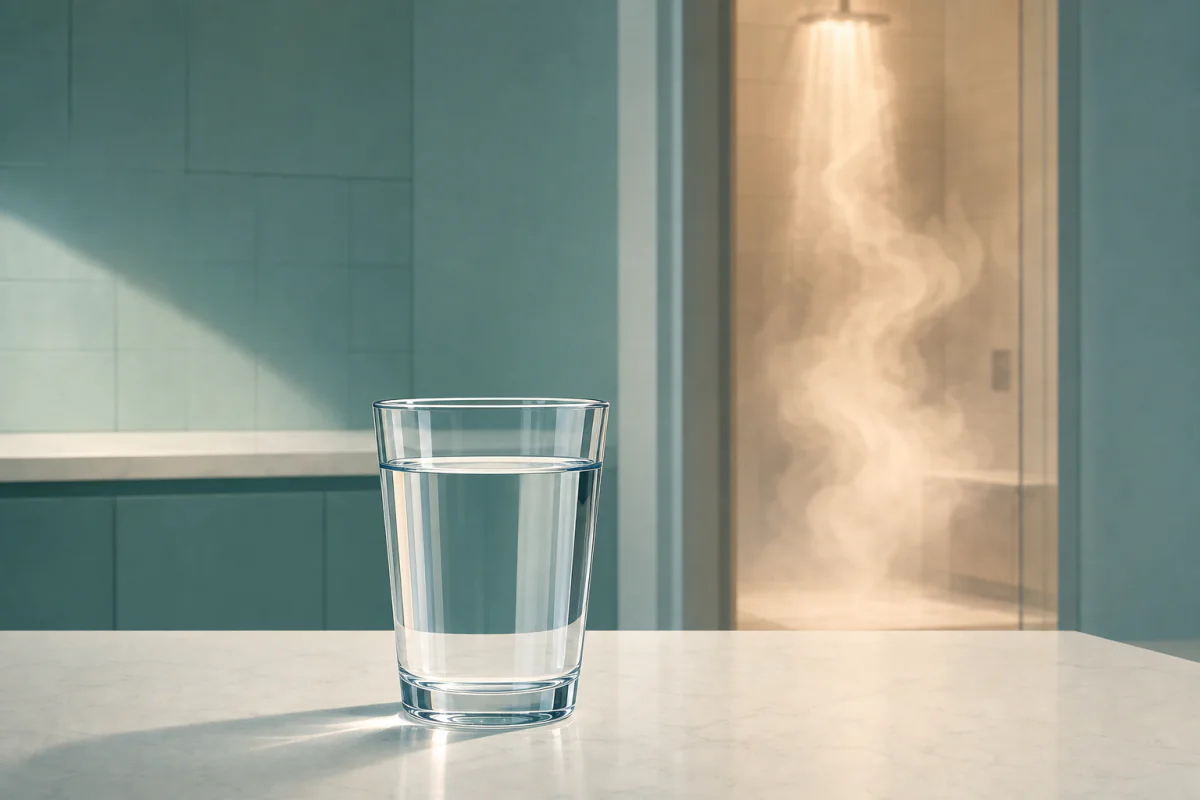
This is the part most people get backwards: for trihalomethanes, most of your exposure does not come from drinking the water. Because trihalomethanes are volatile, they evaporate at room temperature and faster at shower temperature. Multiple risk-assessment studies converge on the finding that showering and bathing contribute roughly 25–60% of total trihalomethane exposure, with inhalation and skin absorption playing roughly equal roles (exposure modeling).
And it runs the wrong way for comfort: hot water in the shower can increase chloroform concentration, because residual chlorine keeps reacting with organic matter at higher temperatures. Indoor swimming pools are another notable source — a large UK study of pregnant women found regular swimmers received greater chloroform doses than non-swimmers. Haloacetic acids, by contrast, are non-volatile, so they are an ingestion concern rather than a shower concern.
The practical implication changes how you'd spend money on this. A great kitchen filter only addresses the fraction of your trihalomethane exposure that comes from drinking, if your system runs high and your showers are long and hot. The good news is that the cheapest mitigation is also free: a 2023 risk-assessment model found that running a roughly 5 L/s bathroom exhaust fan during showers cut modeled inhalation cancer risk by about 35% (risk-assessment modeling, 2023). Turn the fan on and crack the door — it is the highest-leverage, lowest-cost step on this whole list.
Which filters actually reduce disinfection byproducts?
The single most important word here is certification — not brand. "NSF certified" on a box means nothing on its own; the standard number and the specific claim are what matter. Three technologies have a legitimate, tested case for reducing DBPs, and several popular options do not.
Reverse osmosis (NSF/ANSI 58) is the most complete option: multi-stage RO rejects more than 75% of haloacetic acids and about 96% of bromate — the only common consumer technology that handles bromate well (NSF/ANSI 58). The tradeoffs are real: it wastes roughly 3–5 gallons per gallon produced, needs an under-sink install, and removes minerals along with contaminants. An activated-carbon block carrying an NSF/ANSI 53 "VOC reduction" claim is the simpler option — that claim is health-tested using chloroform as the surrogate and covers all four trihalomethanes (NSF/ANSI 53). The catch: you must verify the specific model lists "VOC," because a "53" listing for lead alone does not qualify; carbon block outperforms loose granular carbon, and catalytic carbon handles chloramine better. Distillation (NSF/ANSI 62) removes volatile trihalomethanes along with nearly all dissolved solids, but it is slow and energy-intensive.
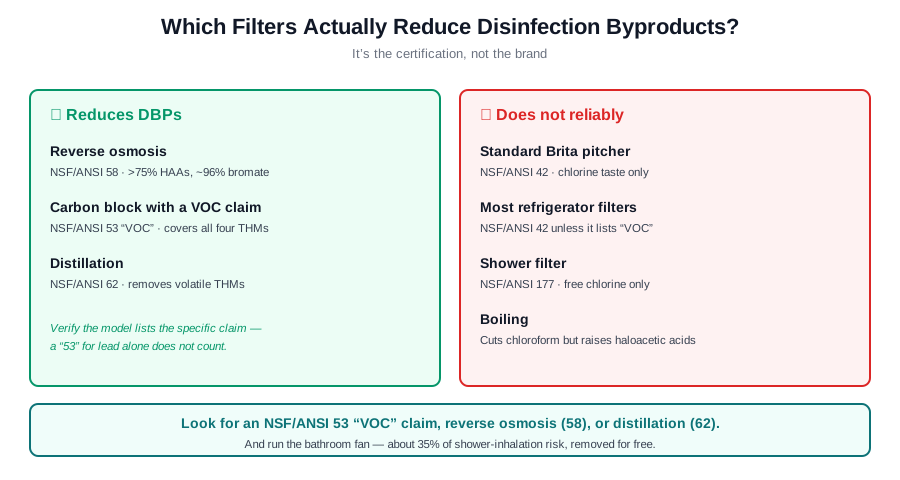
What does not reliably reduce DBPs is where most households go wrong. A standard Brita pitcher is certified to NSF/ANSI 42 only — an aesthetic standard for chlorine taste and odor, not a health claim for trihalomethanes. The Brita Elite adds NSF/ANSI 53 claims for lead, microplastics, and some pesticides, but not for TTHM. Most refrigerator filters are NSF/ANSI 42 unless the spec sheet explicitly lists "VOC." And NSF/ANSI 177 shower filters certify free-chlorine reduction only — they are not health-effects tested for trihalomethanes, haloacetic acids, or chloramine. If you want to confirm any specific model's claims, our filter certification checker and NSF/ANSI 53 guide walk through how to read the listing.
See which certified filters match your water → Compare NSF-certified options for trihalomethanes, or subscribe to the newsletter for one explainer like this each week.
How do the regulated disinfection byproducts compare?
The table below puts the four regulated families side by side on what forms them, the EPA limit, the member health goal, the health classification, and the best removal technology.
| Family | What forms it | EPA MCL | Member MCLG | Health classification | Best removal |
|---|---|---|---|---|---|
| Total Trihalomethanes (TTHM) | Chlorine + organic matter (volatile) | 80 µg/L | Chloroform 0.07; BDCM & bromoform 0 mg/L | Liver/kidney/CNS; possible–probable carcinogens | NSF 53 VOC, RO, distillation |
| Haloacetic Acids (HAA5) | Chlorine + organic matter (non-volatile) | 60 µg/L | DCA 0; TCA 0.02; MCA 0.07 mg/L | Increased cancer risk | RO (>75%); NSF 53 VOC (partial) |
| Bromate | Ozone + bromide in source water | 10 µg/L | Zero | Increased cancer risk | RO (~96%) |
| Chlorite | Chlorine-dioxide disinfection | 1.0 mg/L | 0.8 mg/L | Anemia; infant nervous-system effects | RO |
| Unregulated (NDMA, chloronitramide anion) | Chloramination of organic/nitrogen matter | None | None | NDMA: IARC 2A; chloronitramide unknown | RO; specialized |
| US national | ~113M Americans on chloramine; TTHM limit unchanged since 1998 | — | — | ~8,000 of 79,000 bladder cancers (EPA, 2022) | ~25–60% of exposure is from showering |
Sources: EPA Stage 1 & Stage 2 D/DBP Rules and 40 CFR 141.53/141.54/141.64; Weisman et al. (EPA, 2022) for the bladder-cancer estimate; NSF/ANSI 53/58/62 for removal. MCLGs are the member goals, not group values. How we assembled this: our data and methodology.
One unregulated entry on that table is worth a sentence. Many utilities switched from chlorine to chloramine in the 2000s specifically to lower TTHM and HAA5 — and it works for that. But chloramine generates a different set of unregulated byproducts, including NDMA (classified IARC Group 2A, "probably carcinogenic") and, identified only in November 2024, the chloronitramide anion, which was detected in all 40 chloraminated US samples a research team tested and whose health effects have not yet been established (Fairey et al., Science, 2024). It is a reminder that "regrettable substitution" is a live issue — and a reason the EPA's DBP rules are mid-rewrite, with a proposed revision expected around July 2025 and final action due by October 2028 under a consent decree.
Ready to act on your own numbers? → Look up your city's TTHM and HAA5 results and decide with real data, or subscribe for one explainer a week.
Reading this from a different angle?
- Ready to pick a filter? Read our guide to NSF water-filter certifications — the difference between NSF 42, 53, and 58 is exactly what determines whether a filter touches DBPs.
- Confused by chlorine vs. chloramine? See how to remove chlorine from tap water — the disinfectant chemistry upstream of every byproduct on this page.
- Want the legal-vs-safe context? Read MCL vs. MCLG — why "below the limit" and "at the health goal" are different things, and how to read your CCR for where the TTHM and HAA5 lines live.
Methodology and disclosure
This guide draws on EPA primary sources: the Stage 1 and Stage 2 Disinfectants and Disinfection Byproducts Rules, the federal MCLG/MCL tables (40 CFR 141.53, 141.54, 141.64, 141.65), and the Locational Running Annual Average compliance provisions (40 CFR 141 Subpart V). It also cites peer-reviewed research — Weisman et al. (EPA, Environmental Health Perspectives, 2022) on attributable bladder-cancer burden, Fairey et al. (Science, 2024) on the chloronitramide anion, Krasner & Wright (Water Research, 2005) on boiling, a 2023 dose-response meta-analysis, and shower-exposure risk-assessment modeling — plus NSF/ANSI standards 53, 58, 62, and 177 for filter performance, and the EWG Tap Water Database for system-level exceedance counts. The TTHM and HAA5 figures referenced are drawn from the Consumer Confidence Reports we aggregate across 18,774 US cities. TapWaterData sells no water and earns affiliate commission only on filters recommended in our Filter Buyer guides; this guide contains no affiliate links, but it links to those guides, which do. Our methodology — including how filters are scored (50% contaminant coverage + 30% Amazon rating + 20% affordability) — is published on our data page.