The bottom line
- All 5 facilities sit inside the same water-utility service area as the residents they share it with — same regulated water system, same pipes upstream.
- Per-resident equivalents span a 200× range: Google The Dalles at 34,769 gal/resident/year, down to QTS Fayetteville at 169 gal/resident.
- The viral "QTS used 30M gallons" headline is overstated — the verified figure is 13M on one of 13 connections, per the Fayette County Water System director.
- 2 of 5 facilities have no publicly disclosed gallons figure. North Carolina state law doesn't require utilities to release facility-level water data.
When you turn on the tap in Fayetteville, Georgia, the water comes from Fayette County Water System — the same utility that serves QTS Fayetteville, a 6.2-million-square-foot AI data center under construction in the southern part of the county. When you turn on the tap in The Dalles, Oregon, the water comes from the city utility — the same one that supplies Google's data center, which used 434.4 million gallons in 2024 alone.
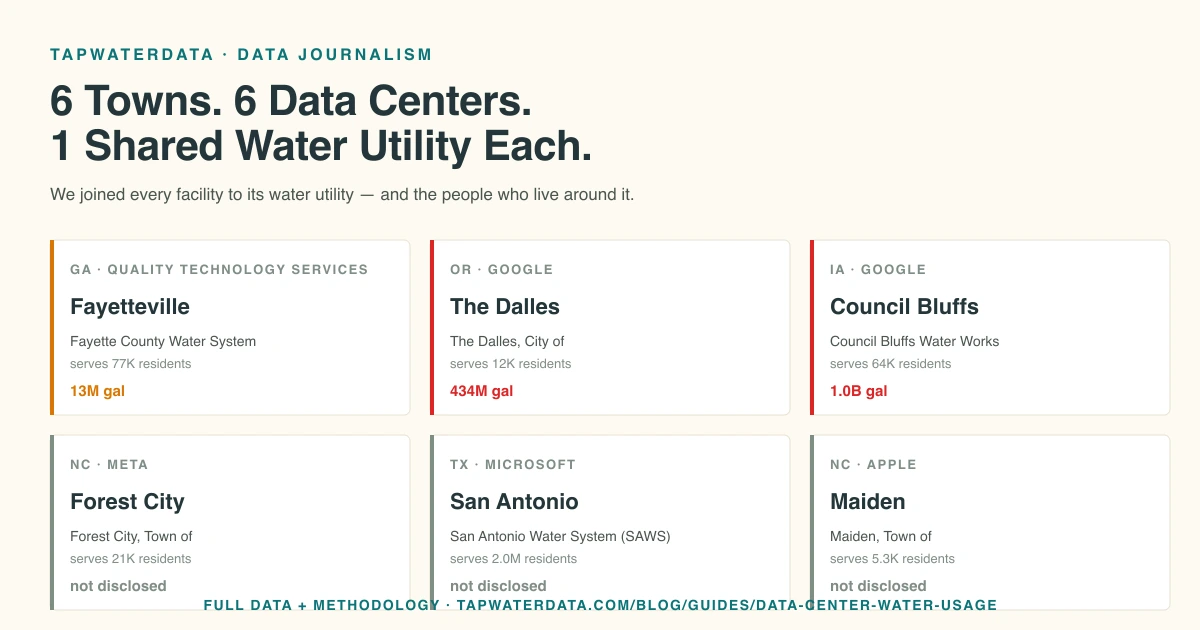
Five American towns. Five water utilities. Five hyperscale data centers that share a service area with the people who live around them. That's the dataset behind this post.
We didn't write it to argue the AI energy debate — there's already plenty of macro-level reporting on that (see MIT Technology Review, the Lincoln Institute of Land Policy, EESI). We wrote it because nobody has done the simple, local question that matters most if a data center moves into your town: which water utility actually serves it, and how many people share that supply?
That question turns out to be surprisingly hard to answer. Existing data-center trackers (FracTracker, datacentermap.com, Business Insider's 1,240-facility map) list locations but skip the utility join. We have 19,626 PWSID-keyed water-utility polygons in our underlying dataset, which let us do the spatial join cheaply. Here's what we found when we did it for five high-news cases.
The five facilities and the utilities that serve them
| Facility | Operator | City | Water utility | Residents on that utility |
|---|---|---|---|---|
| QTS Fayetteville | Quality Technology Services (Blackstone) | Fayetteville, GA | Fayette County Water System | 77,051 |
| Google The Dalles | Google (Alphabet) | The Dalles, OR | The Dalles, City of | 12,494 |
| Google Council Bluffs | Google (Alphabet) | Council Bluffs, IA | Council Bluffs Water Works | 64,447 |
| Microsoft San Antonio | Microsoft | San Antonio, TX | San Antonio Water System (SAWS) | 1,999,472 |
| Apple Maiden | Apple | Maiden, NC | Maiden, Town of | 5,275 |
Every one of those joins is verified by a spatial point-in-polygon check against the utility's official service-area polygon. Every population figure comes from the utility's most recent EPA-tracked records in our city data. Every operator, facility name, and city is cited to at least two independent publishers, with the full citations recorded in our internal methodology and dataset.
The first thing that should jump out: the populations on the right column are not very big. Five thousand. Twelve thousand. Sixty thousand. Seventy-seven thousand. The exception is San Antonio, where the utility serves nearly two million people. But for the other four facilities, you're looking at small to mid-size towns where a single hyperscale data center is sharing the same drinking-water system as the entire population.
How much water vs. how many people
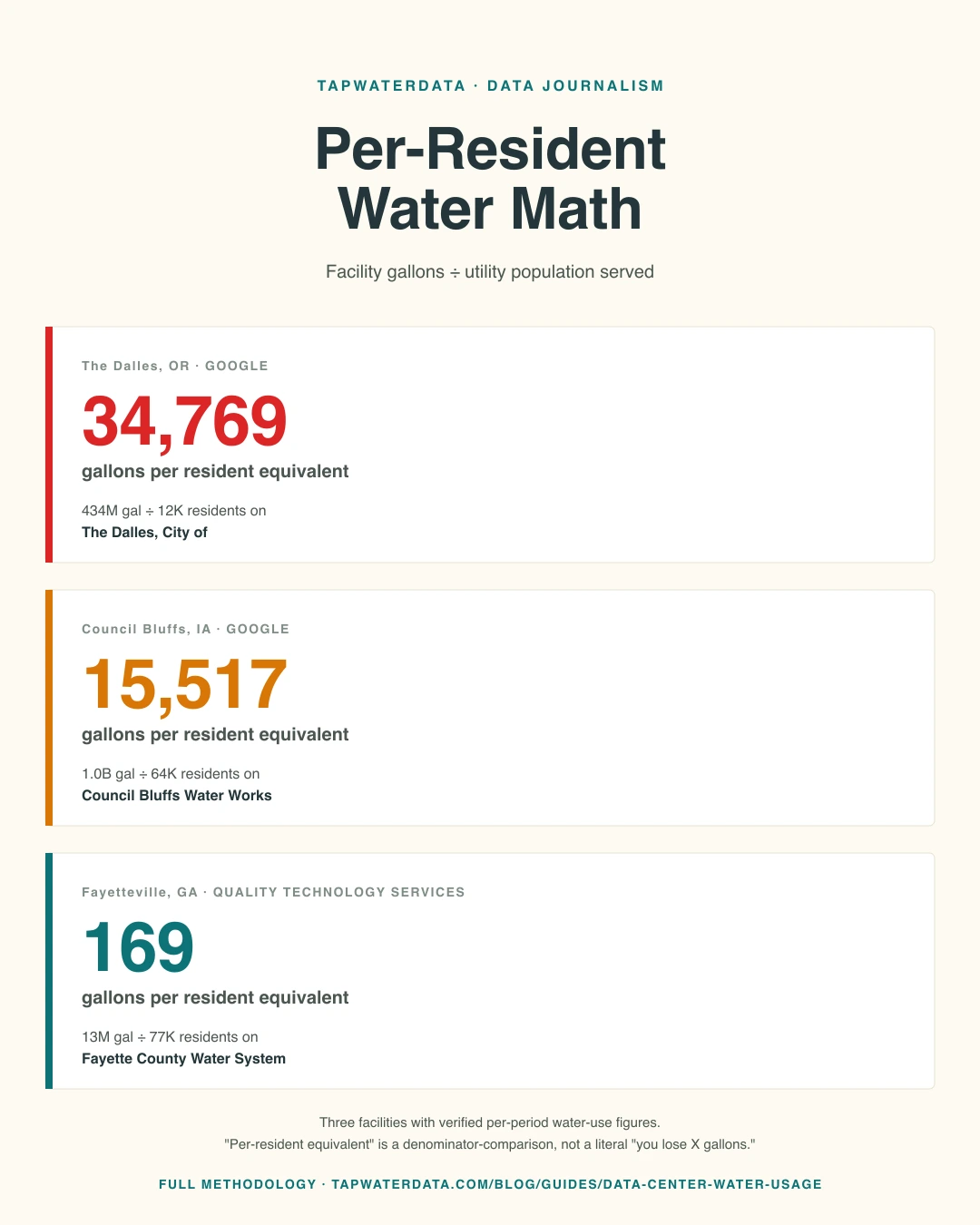
For three of the five facilities, we have a verified per-period water-use figure. Here's the per-resident math.
| Facility | Verified water use | Time period | Per-resident equivalent |
|---|---|---|---|
| Google The Dalles | 434,400,000 gal | 2024 (annual) | 34,769 gallons / resident |
| Google Council Bluffs | ~1,000,000,000 gal | 2024 (annual) | 15,517 gallons / resident |
| QTS Fayetteville | 13,000,000 gal | ~6 months on one of 13 connections (the unmetered one) | 169 gallons / resident |
About this math, plainly
"Per-resident equivalent" is not a claim that the data center "takes" water from any specific person. Utilities can have multiple sources, capacity headroom, recycled-water routing, and separate service tiers. The number is a denominator-comparison: if you split the facility's annual draw across the population of the utility that serves both, this is the per-person arithmetic equivalent. It's useful for putting a hyperscale draw in residential terms, not a literal "you lose X gallons."
With that caveat, the numbers tell a real story.
Google The Dalles — the standout
Google has built its data-center footprint in a town of about 16,200 people — but the city water utility only serves 12,494 of them (some residents are on private wells or smaller subdivision utilities). In 2024, Google's data center campus drew 434.4 million gallons from that utility, which works out to nearly 35,000 gallons per served resident across the year. This is the figure the city tried for years to keep private; The Oregonian sued, and the city settled in early 2026, disclosing 12 years of Google water-use data. According to Oregon Public Broadcasting, Google used 12% of The Dalles' water supply in 2012; by 2024, that share had grown to roughly a third. Google has also built (and transferred to the city) an aquifer storage and recovery facility, reported by Columbia Gorge News, which partially offsets withdrawals.
Google Council Bluffs — the biggest single facility
The Conversation, citing Google's 2025 environmental report, reported that the Council Bluffs campus drew about 1 billion gallons in 2024 — the most of any Google data center. The water comes from the Missouri River, which is also the source for Council Bluffs Water Works' residential service. Spread across the 64,447 residents served by the utility, that's a per-resident-equivalent draw of roughly 15,500 gallons — a denominator-comparison, not a literal "water taken from residents," as the math caveat above explains.
QTS Fayetteville — smaller than the headlines
The verified QTS Fayetteville number is much smaller than what the headlines suggested.
What the QTS Fayetteville story actually says
If you read the headlines from May 8–13, 2026 — Politico, Ars Technica, NY Post, Tom's Hardware — you'd think QTS used 29 or 30 million gallons of water through an unmetered connection over 15 months, while nearby residents experienced drought.
The county's own briefing, given to The Citizen on May 11, says something more specific:
Fayette County Water System Director Vanessa Tigert stated that one meter had been installed "without the knowledge or inspection" of the county water system and referenced more than 13 million gallons of water usage tied to one connection. … The million-gallons figure reflected about six months of combined usage billed at one time — not a single month of consumption.
QTS has 13 water connections at the construction site. Twelve were properly metered. The thirteenth was missed during a county-wide transition from old meters to a new smart-meter system. QTS paid the retroactive charges (about $150,000, per Ars). Both QTS and the county say no rules were broken; QTS told Ars the suggestion that water was used "improperly" is "false and inaccurate." Once operational, the campus is designed to use closed-loop cooling — completed buildings are expected to use water "roughly equivalent to four American households per month," per the county briefing.
That doesn't mean the QTS story doesn't matter. It absolutely does:
- A construction project ran a water connection that wasn't billed for half a year. That's a meter-and-billing failure regardless of the per-gallon math.
- The county briefing only happened because of an open-records request. Without the records request, the public wouldn't know.
- QTS currently generates "just under $500,000 annually in water revenue for the county system" during peak construction (Citizen). That's real revenue — but it's also real demand.
The story is "transparency and accurate metering matter" — not "AI data centers drained your reservoir." And the residential-utility-join data lets us tell the more accurate version: 77,051 people share a water utility with this project. The current consumption is small relative to capacity (the county says QTS uses less than 1% of daily production capacity right now). The long-term watch item is what happens at full operational scale.
That nuance is what gets lost when the only number in circulation is a headline.
What we don't know — and why
Two of our five records have no verified gallons figure — not because we couldn't find numbers, but because the numbers we could find weren't specific enough to publish.
Microsoft San Antonio, TX
The San Antonio Current reported in July 2025 that two data centers in San Antonio — Microsoft's and one operated by the U.S. Army Corps of Engineers — used 463 million gallons combined over two years. We don't have a clean way to split that across operators. Microsoft has publicly committed to shifting most of its San Antonio facilities to recycled water through SAWS, Yancey Water, and East Medina County SUD; the facility we mapped sits inside the SAWS service area (1,999,472 residents).
Apple Maiden, NC
Apple's Maiden campus shares the Town of Maiden water utility with 5,275 residents. Specific water-usage data is not publicly disclosed: under North Carolina state law, utilities are not required to release facility-level water data, and Apple has declined to answer when asked. Government Technology covers Apple's broader North Carolina footprint, including the local tax incentives that brought the campus to Maiden — a 50% rebate on property taxes and an 85% rebate on personal property.
This is the disclosure gap. It's the same reason The Dalles' data was sealed for years until the city was sued, and the reason QTS's 13 million gallons only surfaced when someone filed an open-records request. Where state law doesn't require disclosure, the operator's annual sustainability report is what's available — and those reports tend to aggregate by region or by company-wide totals, not by individual facility.
We list those records anyway because the utility-join itself is the story. Five thousand residents in Maiden, NC, share a water utility with Apple's East Coast data center campus. That's true whether or not Apple discloses the gallons.
Why this matters for your tap
If you live near a hyperscale data center, the practical things to know are:
-
Look up your utility's PWSID. You can find your local water utility on TapWaterData by searching your city. The PWSID is the EPA's national identifier; it ties everything in the annual Consumer Confidence Report to the same regulated system.
-
Check whether your utility lists a data center among its top customers. Some utilities publish their largest-customer lists. Others don't. State open-records laws vary — Oregon and Georgia have been more transparent recently; North Carolina less so.
-
If you're seeing water-pressure or supply issues, file a complaint through your utility's normal process. Your complaint, on the record, becomes part of how the utility responds. The Fayette County situation only became public because a resident asked an elected official about it.
-
Read your CCR for the actual contaminants reported. Whatever's happening at the data center, the residential-facing water-quality question is independent: what's actually in your tap, and what the utility tests for — including emerging contaminants like PFAS "forever chemicals". That side of the equation isn't changed by a data center's presence — but the demand side of the same utility is.
How we built this dataset
This is journalism-grade work, not a research paper. The full methodology — including the exact gates each record passed (spatial containment, utility-population match, water-use figure verifiable to a primary source, link health, math integrity), the records we dropped and why, and the human-reviewer attestation step — is documented internally and available on request.
Three things to note about how we sourced figures:
-
We prefer county/utility-confirmed figures over headlines. The QTS Fayetteville record cites 13M (county director, in records) rather than 29-30M (early headlines), and explains the discrepancy in-context. The newsroom's first number isn't always the final number.
-
Every URL has a Wayback Machine archived snapshot. News articles get edited, paywalled, taken down. If a source goes dead, the verify-links script we run monthly switches the citation to the archived version automatically.
-
Every numerical claim is regex-verified to appear in a saved HTML snapshot. If the dataset says "13 million gallons," that string (or a fuzzily-matched equivalent like "13M") must appear in at least one of the cited sources' archived HTML. We won't publish a number that isn't there.
That's the floor. Everything above the floor is editorial judgment — what to include, what to leave out, where to add context. We try to mark those judgment calls clearly.
What's next for this dataset
This is v1. We expect to:
- Add records as more facilities get covered or new disclosures land. The original goal was 8–12 facilities; we shipped 5 in this first pass and documented the cuts.
- Refresh figures annually when sustainability reports drop.
- Run the link-doctor monthly and patch dead URLs to Wayback fallbacks before they erode trust.
- Add the utility-join data as a sidebar feature on individual utility pages — so if your utility serves a data center, you'll see it on your utility's page.
If you spot a factual error in any record, contact the team — we acknowledge corrections within 2 hours during business days and publish corrections inline.
This article was researched, verified, and authored by the TapWaterData team. The underlying dataset (five records, five states) is publicly available in our repository and is licensed for journalism, research, and public-interest use. For commercial use, please contact us.